Transporting the Scheldt Tunnel’s giant elements: preparations in full swing
Text Niels Rouvrois Beeld TM COTU / Almex Metaal
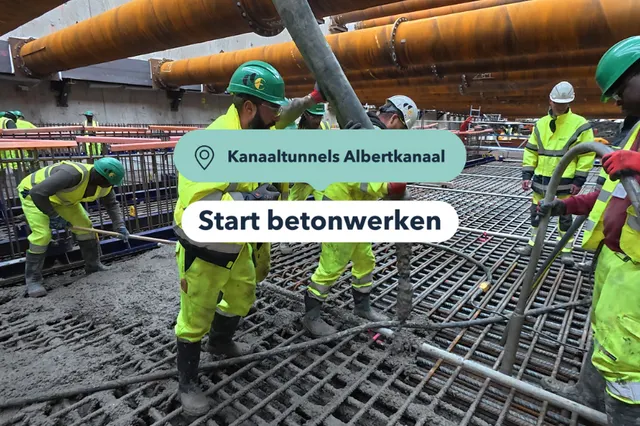
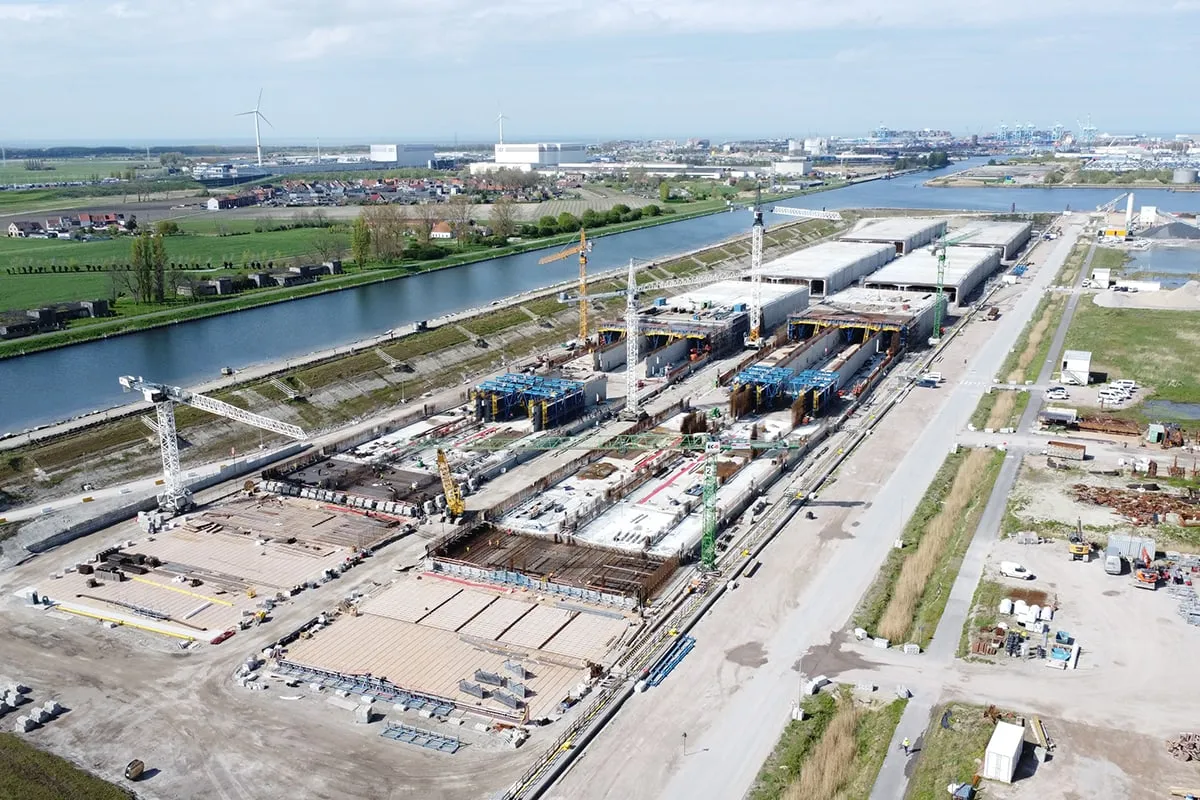
In September, TM COTU carried out the final concrete pour for the eight tunnel elements of the new Scheldt Tunnel. Construction of the centrepiece of the Oosterweel Link began in a construction dock in Zeebrugge in February 2023. Now that the structural work on the tunnel elements is almost complete, their journey to their final destination is being prepared down to the last detail. “We are preparing the operation meticulously so that we can guarantee its successful execution,” says Raymond de Kroon, construction director at TM COTU.
TM COTU stands for Tijdelijke Maatschap Combinatie Oosterweeltunnel. The consortium is responsible for building the Scheldt Tunnel and its associated construction dock in Zeebrugge. The group comprises Belgian construction companies BESIX, Stadsbader Contractors, DEME and Jan De Nul. The client for the Oosterweel Link is Lantis, Leefbaar Antwerpen door Innovatie en Samenwerken. This public-sector management company, formerly known as BAM, was set up by the Flemish government to oversee the Oosterweel works.
200,000 m³ of concrete
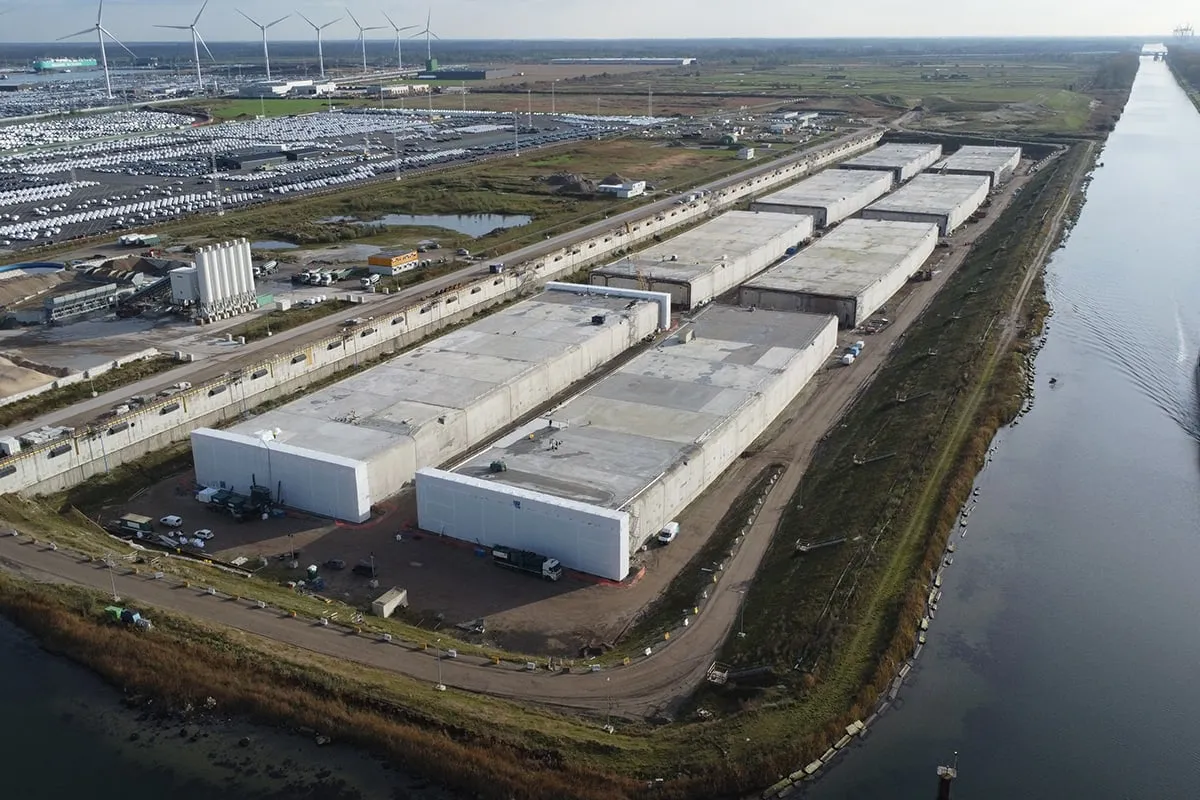
The new Scheldt Tunnel will complete the Antwerp Ring to the north of the city. It connects the new Sint-Anna interchange on the Left Bank with the future Oosterweel interchange access and exit complex on the Right Bank, near Noordkasteel. The new tunnel, which will accommodate two carriageways with three lanes each and a 6-metre-wide cycle tunnel, consists of eight colossal tunnel elements built in a purpose-built construction dock in Zeebrugge. A total of 200,000 m³ of concrete and 50,000 tonnes of steel were used to build the tunnel elements. Each element weighs around 60,000 tonnes and measures 160 metres long, 40 metres wide and 10 metres high.
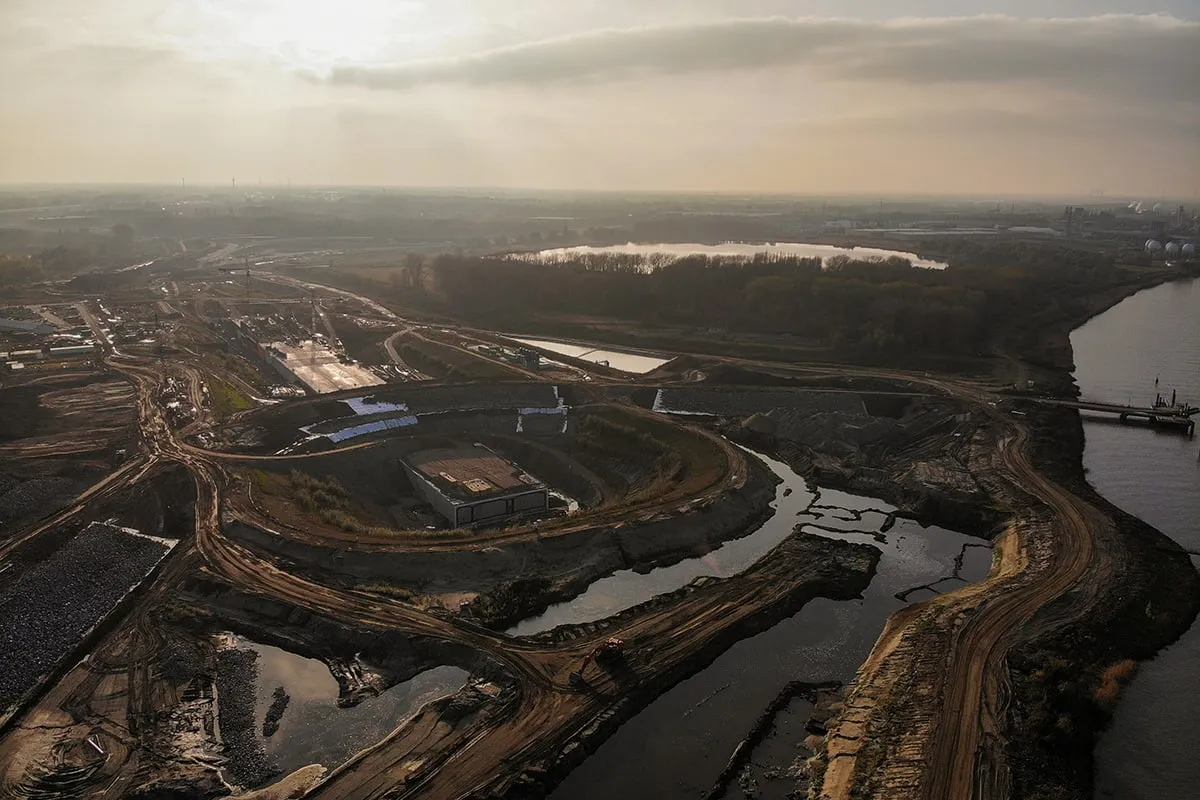
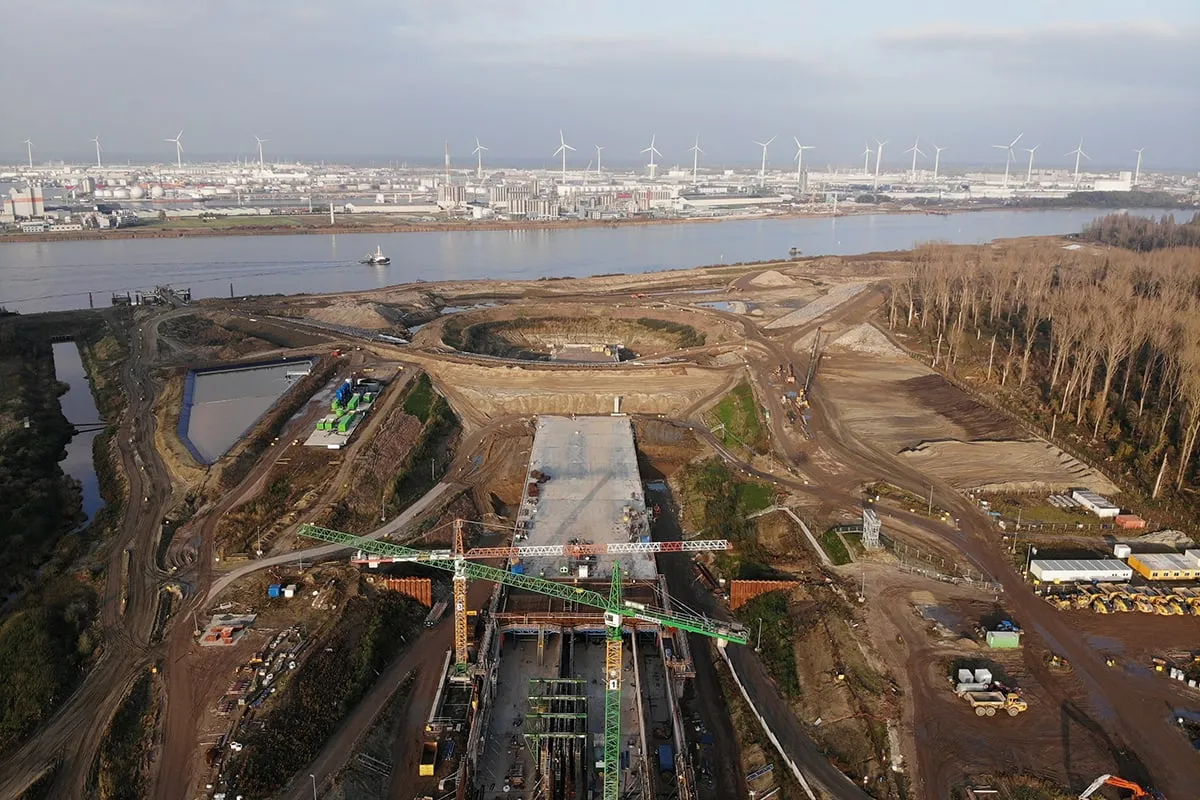
Work began in the Zeebrugge construction dock in February 2023, when the contractor poured the first concrete for the tunnel elements. Almost two years later, and right on schedule, the concreting work is complete. The final tunnel elements are now being waterproofed and prepared for their journey to Antwerp. Raymond de Kroon says: “Our scope for the Scheldt Tunnel includes building two approach ramps and the eight enormous tunnel elements. On the Left Bank, we are building a 450-metre-long approach ramp, while on the Right Bank the ramp is 160 metres long.”
Cut and cover
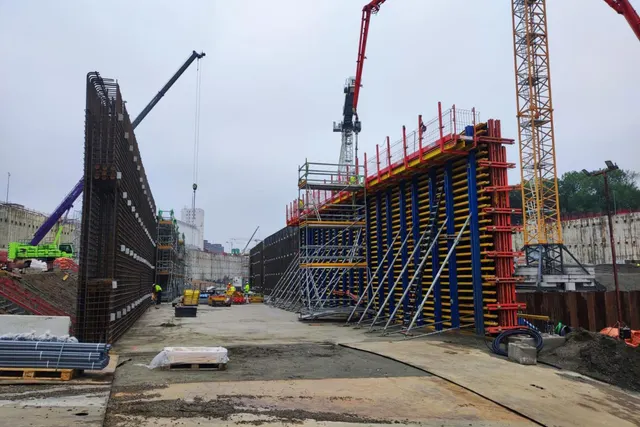
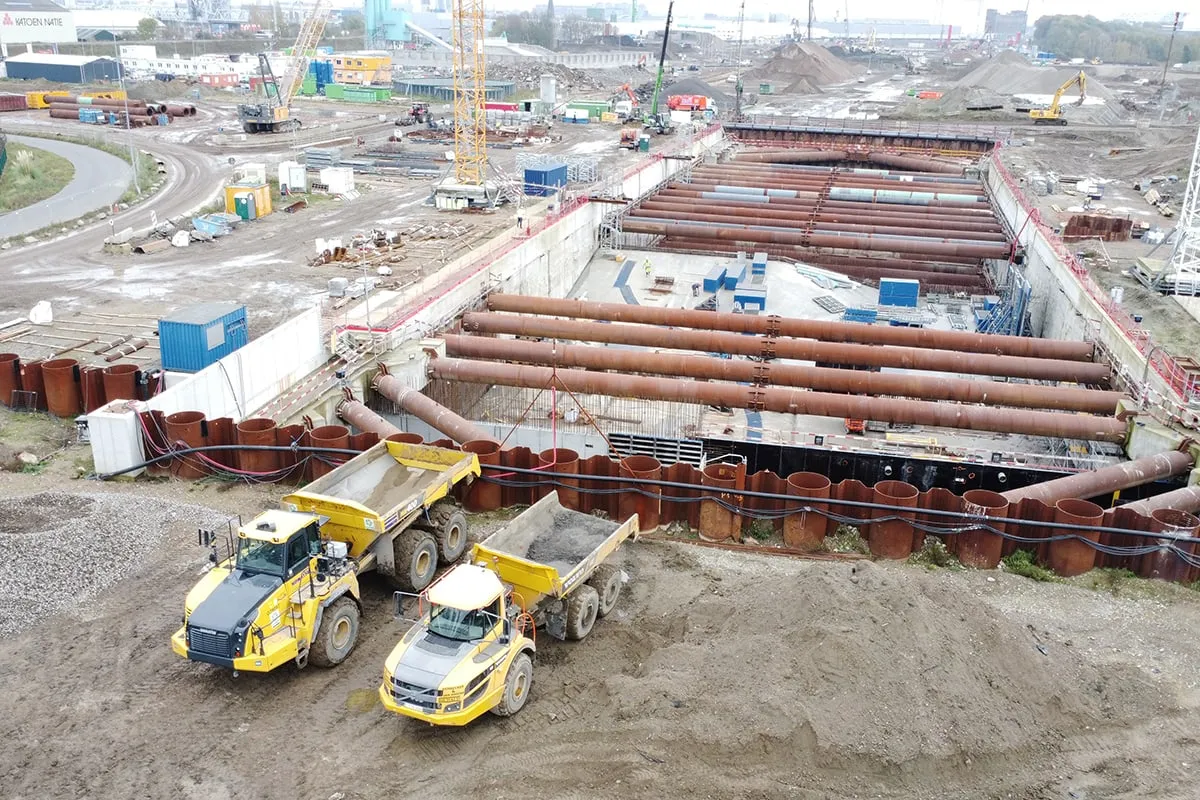
The tunnel approach ramps are being excavated on both banks using the cut-and-cover method. This involves digging a construction pit or trench in which the tunnel, or part of it, is built, before backfilling the excavation. TM COTU commissioned Almex Metaal to design and build the bracing for the excavation, including struts up to 40 m long and weighing up to 50 tonnes, and walers weighing as much as 56 tonnes. “Our scope covers the manufacture, installation, modification and removal of the temporary bracing,” says Gert Neelen, managing director of Almex Metaal.
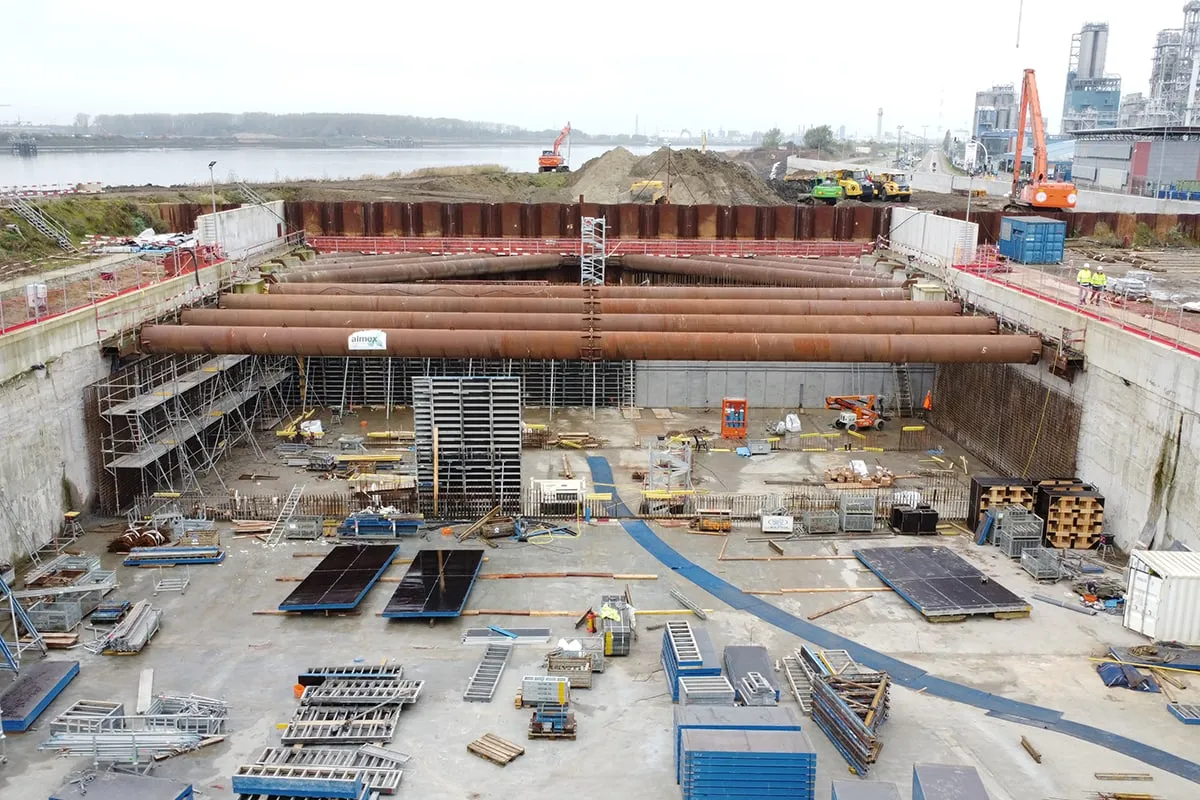
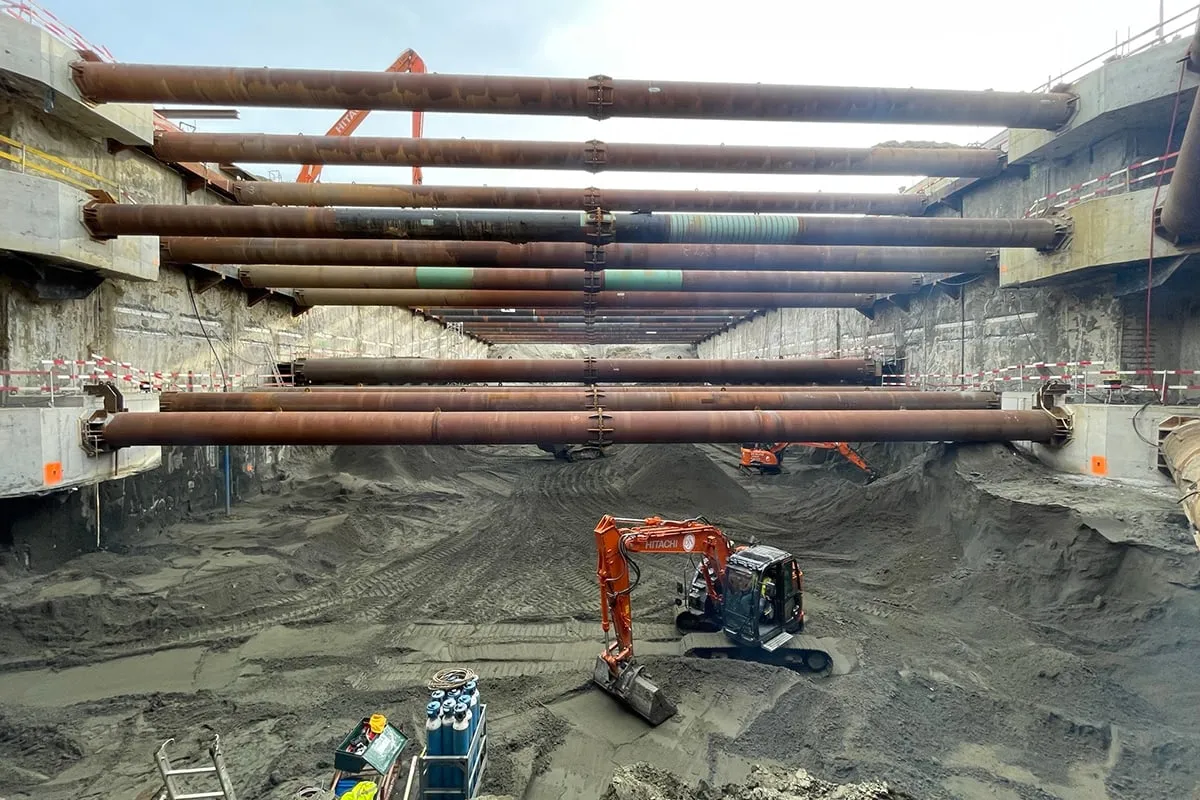
The excavation bracing is on the Right Bank. There is more space on the other side of the Scheldt, where a larger excavation with sloped sides is being used. Ruben Koyen, project coordinator at Almex Metaal, explains: “On the western side, we installed five levels of struts between the diaphragm walls cast in the ground. When COTU excavates a section, we brace the diaphragm wall. The process is then repeated further down. The same principle is used with the temporary combi-walls at the front and rear of the excavation. The bracing is then removed in stages, while TM COTU casts the tunnel approach ramp in stages from the bottom up, starting with the base slab.”
Only the top level of struts remains in place on the western side. Ruben Koyen says: “The bottom four levels have all been dismantled, modified in the workshop and reinstalled on the eastern side. That side is now fully braced. On the western side, the load-transfer bracing has also been installed at two levels. This is needed to ensure the stability of the combi-wall. The load-transfer bracing will remain in place until the excavation is completely finished.”
A logistical tour de force
To avoid disrupting the overall schedule, Almex Metaal had to be ready to transport and install struts as soon as TM COTU progressed with the excavation. Ruben Koyen says: “The 40 m-long struts were split into two 20 m sections for transport, each weighing 25 tonnes. The heaviest waler weighed more than 50 tonnes. On-site storage was not an option, particularly given the limited space, so deliveries and installation had to be just in time. Installation was carried out using a massive 500-tonne crane. The logistics management on this project is particularly challenging, but so far everything is going smoothly. Our cooperation with TM COTU is excellent, and on every project Almex Metaal is committed to being a reliable partner, both in terms of quality and scheduling.”
The structural work on the tunnel elements in the Zeebrugge construction dock is complete, and the cut-and-cover works are also at an advanced stage. This means the tunnel trench can be dredged and the elements can soon be transported and immersed. Raymond de Kroon says: “The structural work on the tunnel elements may be complete, but there is still a lot of preparatory work to do. Ballast tanks need to be installed, the end walls need to be built in … ′
“That work will continue until March-April 2025. The dock will then be flooded, after which the elements will be floated out and transported one by one. Everything needed for transport and immersion, such as towing bollards and lifting eyes, also needs to be provided. Navigation simulations have already been carried out. They are absolutely essential, as the route along the Scheldt is quite long and the channel winds its way along the river. All these preparations are now in full swing. We also need to build two immersion catamaran pontoons, as well as prepare operating plans, risk assessments … We are placing a strong emphasis on training and simulating every step.”
A technical feat
The tunnel sections will set off for Antwerp before the 2025 construction holiday. The elements will be transported to Antwerp one by one and immersed at their final locations. Tugs and push boats will escort them. Raymond de Kroon says: “It will be a technical feat, but also a very nerve-racking moment. We are preparing the operation meticulously so that we can guarantee its successful execution. We will float out the elements one at a time and ensure they sit level in the water. Reaching the outer harbour at Zeebrugge at the right time will be crucial, so that we can take advantage of the incoming tide. The element will then travel to Terneuzen on a single tide, where we will wait for the ebb to pass. The next incoming tide will take it the rest of the way to Antwerp. That is the most efficient way.”
The Scheldt Tunnel is considered the centrepiece of the Oosterweel Link. The tunnel is due to be completed in 2030, when traffic will be able to use the new route. The successful TM COTU consortium brings together major construction companies with extensive experience in large, complex projects. “But this work is particularly challenging given its scale. Immersing the elements, in particular, is not something you do every day. It will take an all-hands-on-deck effort to be prepared for every eventuality. That is a major challenge, but I have a very good feeling about it. The members of the TM have an enormous amount of experience and expertise. Every one of them is a Champions League player. We draw on each member’s strengths where needed. In that respect, we complement one another perfectly,” concludes Raymond de Kroon.
Question about this story? Ask your question
Who worked on Scheldetunnel
- contractorTM COTUIn this story
- bouwkuipstempelingAlmex MetaalIn this story
- clientLantisIn this story
Keep following this
Get an email when a new story is published. No account needed.
- ProjectScheldetunnel
- ThemeExtending the life of bridges and tunnels
- SubjectBridges & tunnels
- CompanyTM COTU
- CompanyAlmex Metaal
- CompanyLantis