Precision engineering and carefully planned lifting operations for the Babeluttebrug in Veurne
Text Joris Hendrickx Beeld Vlaamse Waterweg
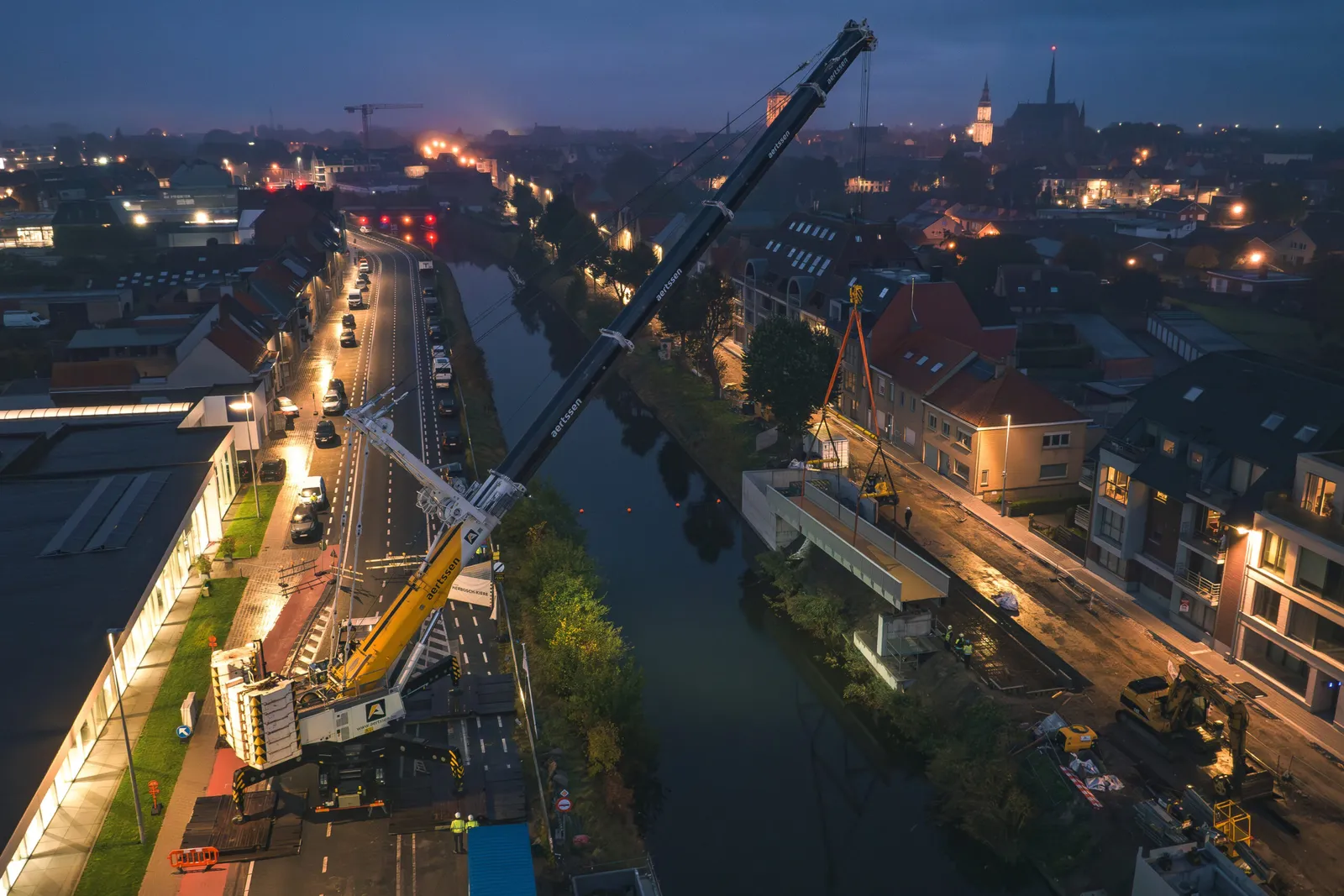
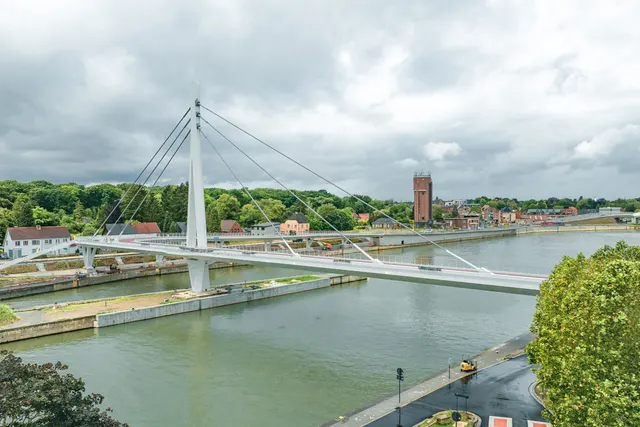
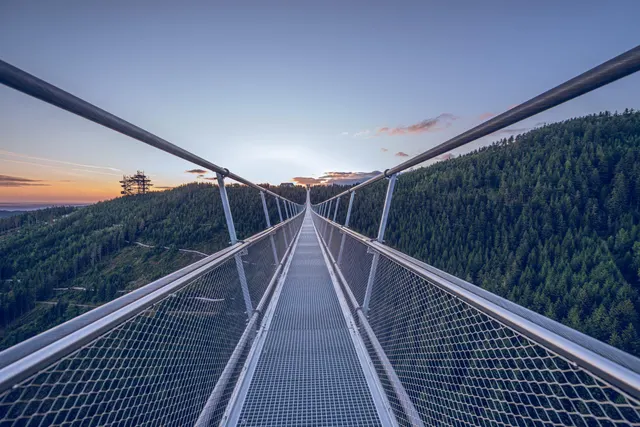
A new bridge for cyclists and pedestrians over the Nieuwpoort-Duinkerke Canal will open in Veurne in spring 2026. The Babeluttebrug links Voetbalstraat and the Nieuwstad district with Noordburgweg and Petit-Paris. Behind its slender design lies a technical story combining precision, off-site fabrication and heavy lifting. Almex Metaal was responsible for the steel structure. Aertssen Lifting took charge of all the lifting engineering and installation. Project Manager Milan Gulickx of Almex Metaal and his Aertssen colleagues Younes Bouazzaoui, Joris Thuy and Koen Van Dyck explain how the project took shape.
Tight tolerances the biggest challenge
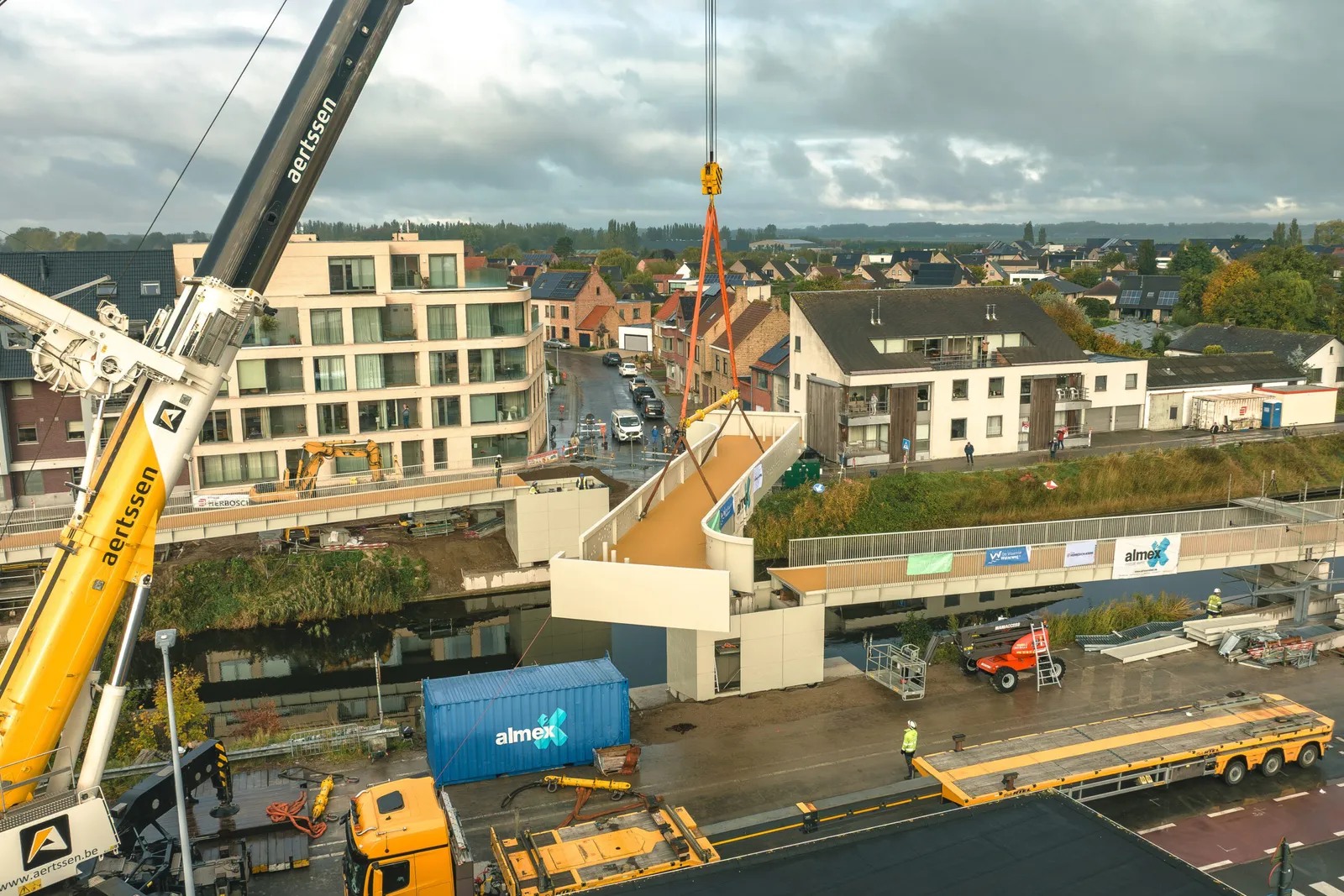
The Babeluttebrug comprises five steel sections: two approach bridges, each in two sections, and one central span. For Milan Gulickx, the key challenge was connecting the bridge to the concrete abutments. “The tolerances were about two centimetres. That is particularly tight for concrete,” he says. This limited margin called for intensive preparation. “We modelled the entire frame in 3D and went through several iterations. Everything had to fit perfectly onto the piers.”
The abutments were built by Herbosch-Kiere. Their precision work proved crucial. “The accuracy of the piers was vital. Without that precision, we could never have installed our steel structure so accurately.” Alongside the technical requirements, aesthetic considerations also came into play. A facing wall with a milled pattern was installed around the piers. This made installation more complex. “The client had clear, detailed requirements for the connection between steel and concrete. These had already been clearly defined at tender stage.”
Off-site fabrication drives efficiency
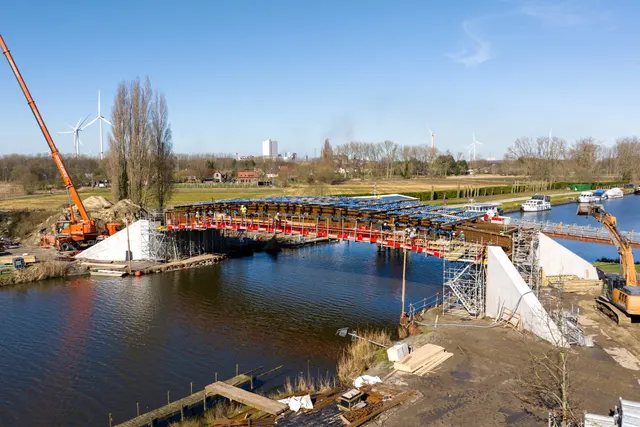
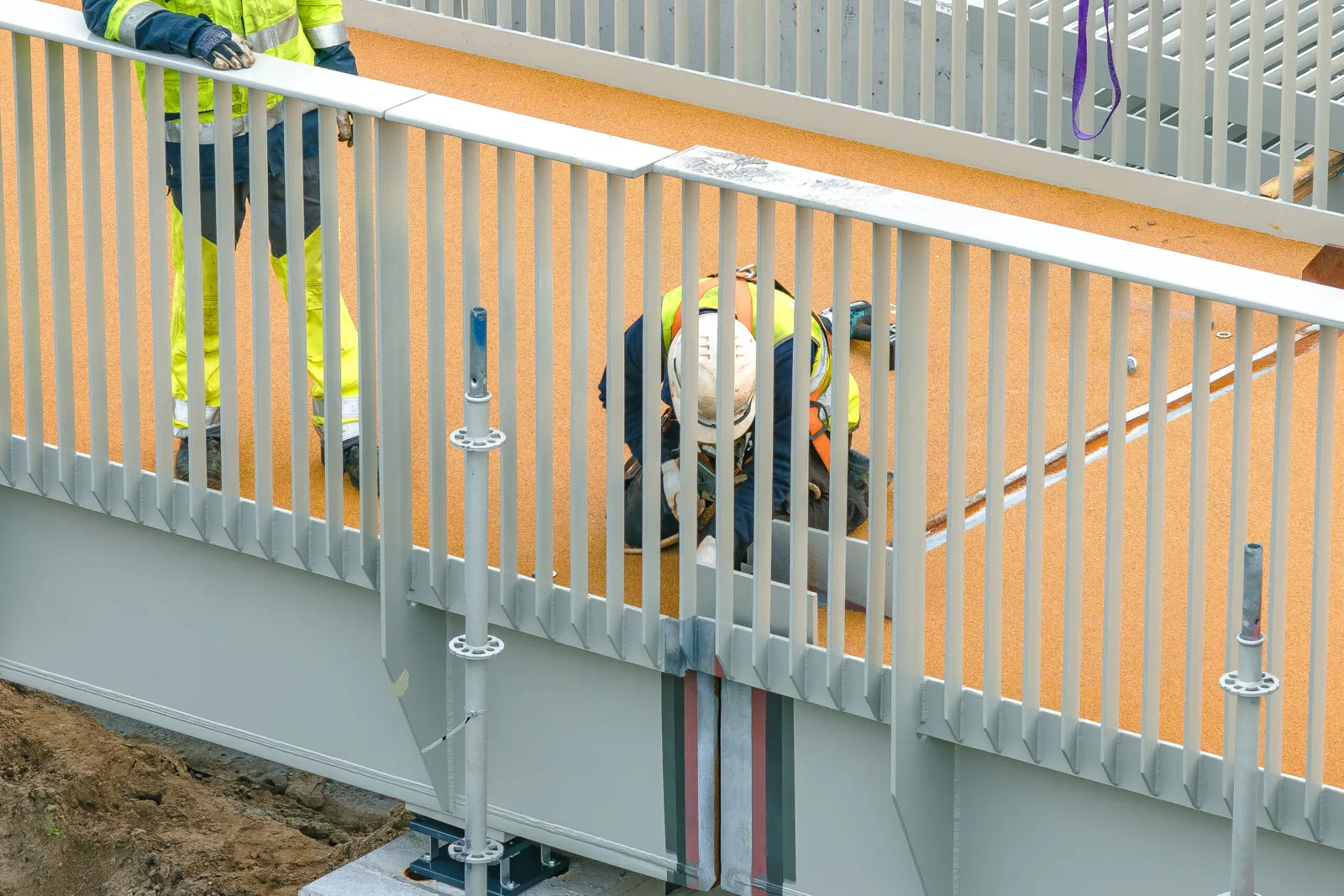
Much of the work took place not on site, but in Almex Metaal’s production hall in Hoogstraten. “The bridge sections were largely prefabricated. We used a custom-made welding table to ensure accuracy,” explains Gulickx. Even the wearing surface was applied in the hall. “On site, all we had to do was finish two site joints after welding the sections together.” The railings for the concrete approach ramps were also produced in advance.
This approach significantly reduced the time spent on site. “By doing as much work as possible in the hall, we reduced our reliance on the weather. That gave us greater control over planning and quality.” The actual installation and finishing on site took three to four weeks. The project as a whole lasted about a year, starting in late 2024.
A logistical puzzle on a confined site
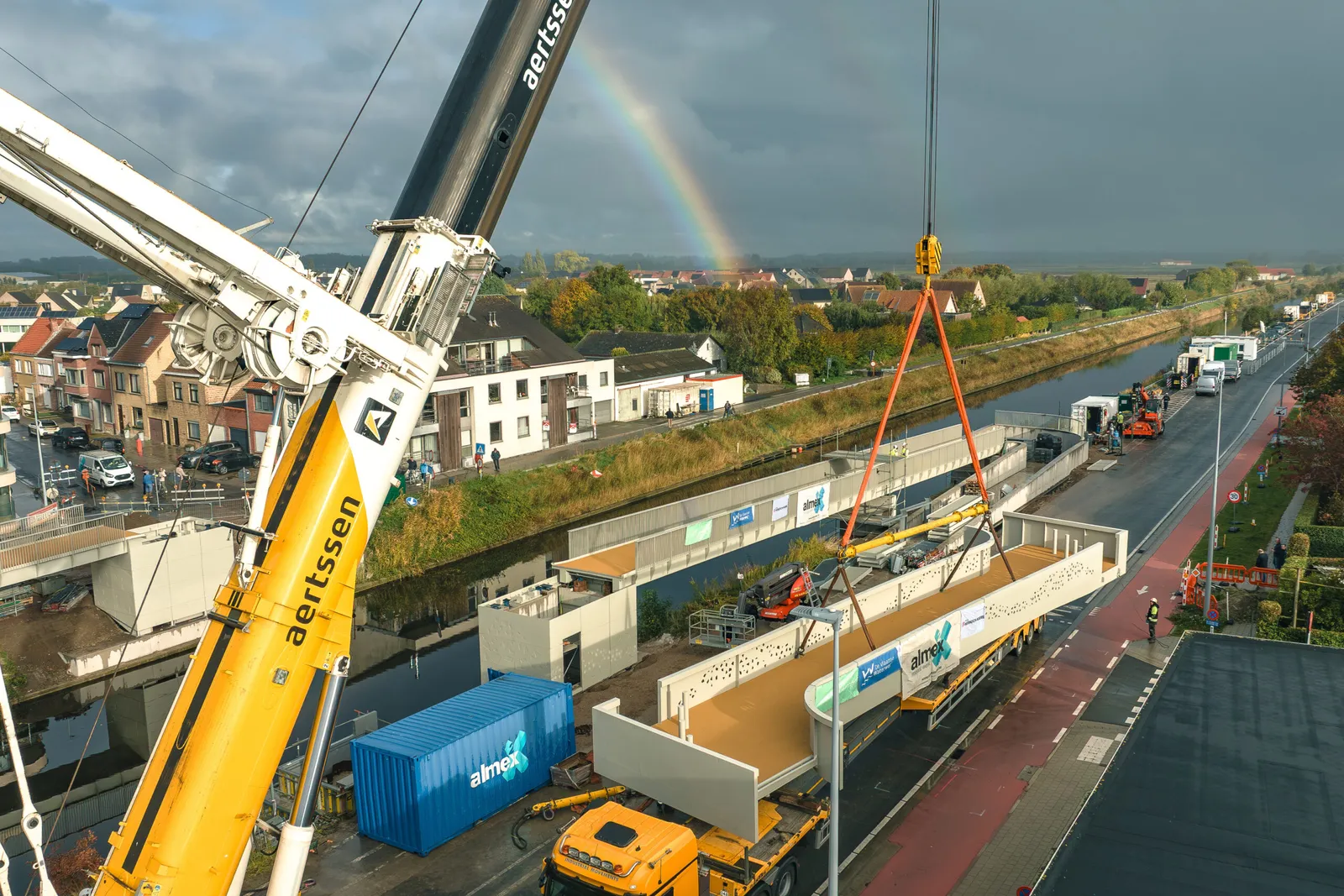
The bridge sections had to be transported to Veurne in five loads. This called for careful logistical planning. “The crane position and installation were planned carefully with Aertssen,” says Gulickx. “We took account of weights, distances and ground pressure. The load-bearing capacity of the quay also had to be considered.”
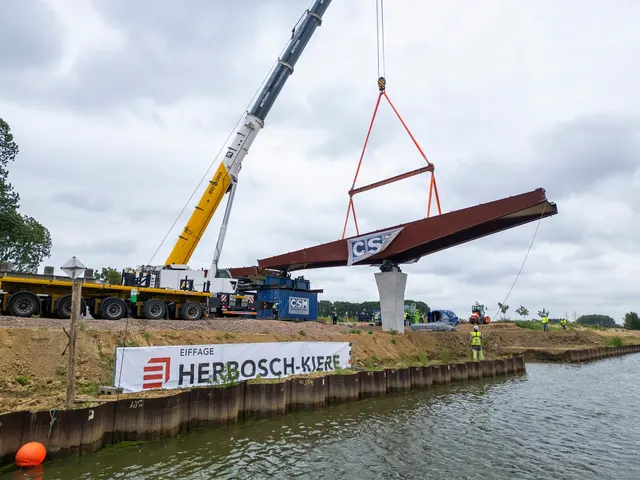
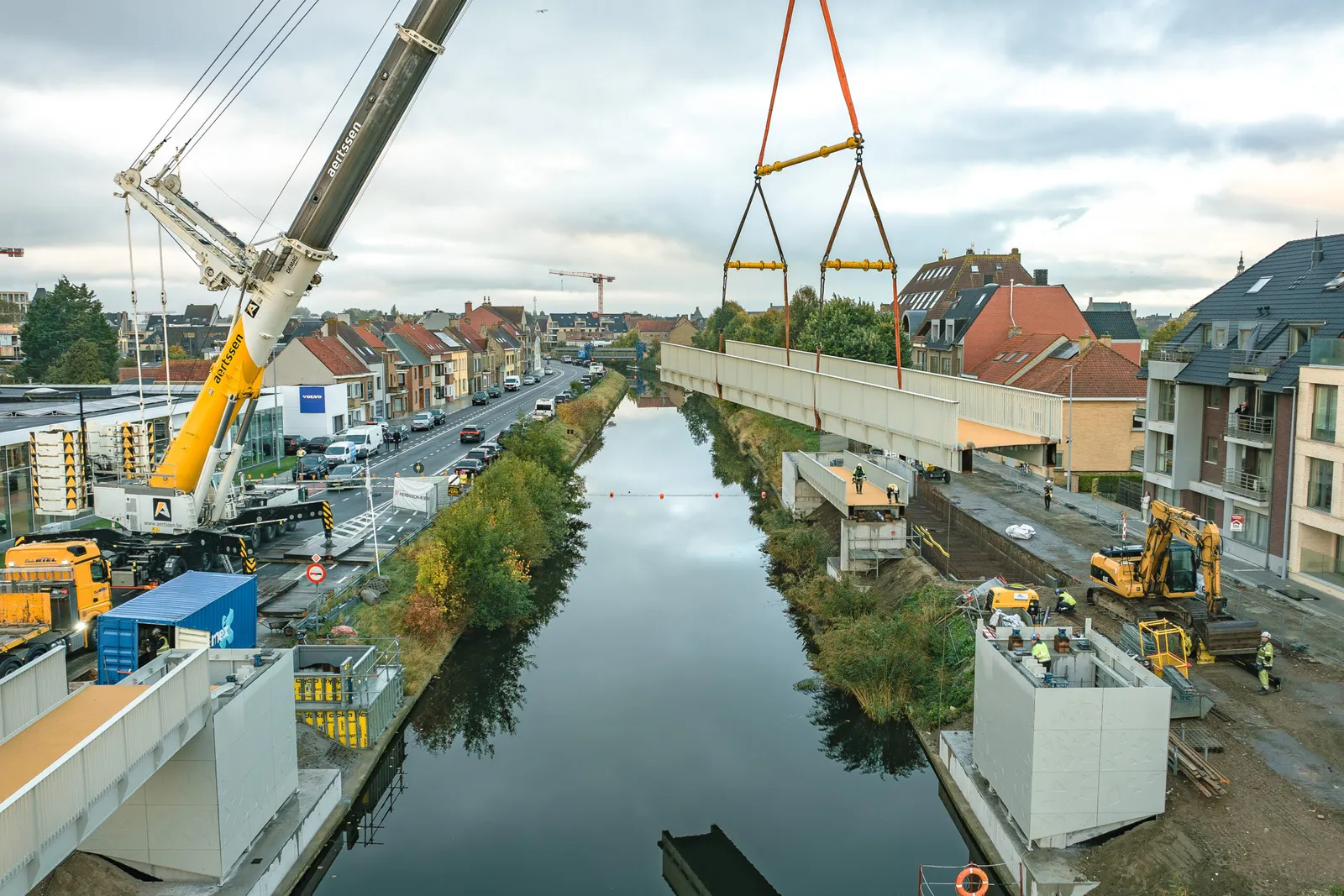
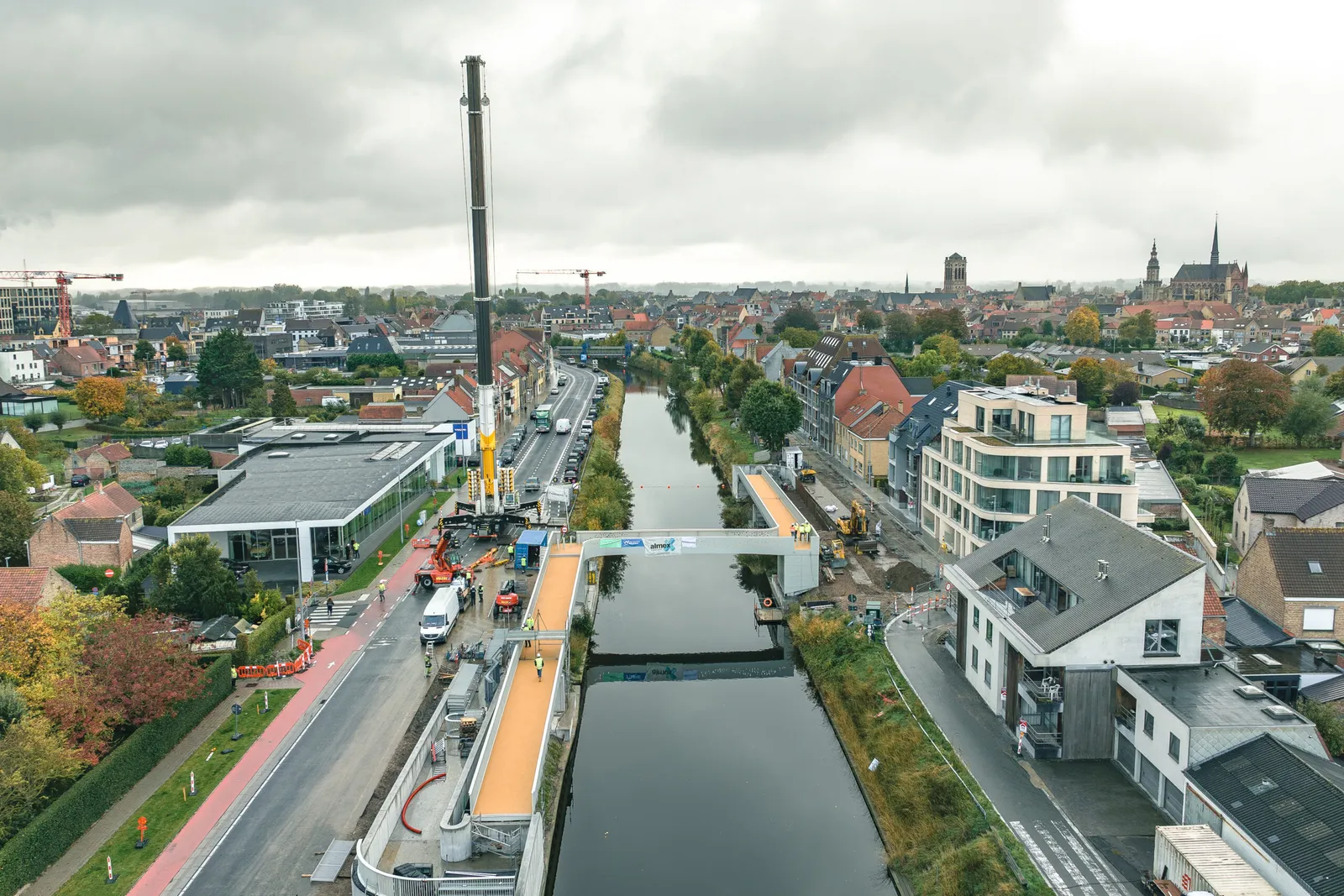
The site was close to the water and a slope. In addition, abnormal-load transport via Rozendalstraat was not possible. A site investigation was therefore carried out in advance. One position was not enough to install all the sections, so the work was carried out from two crane positions on Nieuwpoortkeiweg. Setting up the crane took a full day. This was followed by two intensive days of installation.
Engineering as the foundation for lifting operations
For Aertssen Lifting, the project began with a clear request. “Almex was looking for more than just a crane supplier. It needed a partner able to take on the entire engineering scope,” says Account & Project Manager Younes Bouazzaoui. The assignment covered the development and optimisation of the lifting plan, set-up checks, ground pressure calculations, a rigging study and the final execution. “The focus was very much on stability, ground conditions and safety margins,” says Bouazzaoui. “That called for an integrated approach from design through to execution.”
Several optimisations were made during the study phase. “The crane had to be positioned 1.5 metres further from the water than originally planned. It also needed to be set up on 24-square-metre mats to distribute the pressure correctly.”
The original lifting method was reassessed from a technical perspective. Based on further analysis and experience, the configuration was optimised to meet the applicable load and stability requirements. We also looked for an alternative to the permanent lifting eyes, resulting in an adapted and stable solution.
Choosing a 500-tonne mobile telescopic crane
Installing the bridge sections required heavy equipment. The four approach bridge sections weighed 24 and 28 tonnes, while the central span weighed 34 tonnes. The choice ultimately fell on a single 500-tonne mobile telescopic crane with a customised ballast configuration and guying. “That crane had sufficient reach to access all five bridge sections from two set-up positions,” explains Sales Manager Joris Thuy. “It also provided enough capacity reserve to allow for distance and safety.”
A smaller crane would have offered too little margin. A larger crane was not technically necessary and would have taken up more space. “The 500-tonne crane offered the optimal balance between capacity, safety and site logistics.” Setting up a crane of this size close to the water required the utmost care. “On projects like this, it’s not just about the weight of the load,” Bouazzaoui stresses.
Close coordination between steel fabricator and lifting specialist
Almex and Aertssen worked closely together during the preparation. “We coordinated on ground pressure, underground services, technical details of the bridge sections and transport planning,” says Thuy. “Open communication is essential on complex infrastructure projects like this.” That coordination paid off during execution. The work was spread over four working days: set-up, installation of the bridge sections on one side, relocation of the crane and installation of the sections on the other side, followed by dismantling. Bouazzaoui says: “Thanks to the extensive preparation, the work was completed entirely to plan.”
Integrated expertise adds value
The Babeluttebrug demonstrated how close collaboration and the integration of different areas of expertise can make a difference on complex infrastructure projects. “On many projects, Aertssen can go a step further by bringing together all the expertise needed under one roof, where relevant and according to the requirements of the project. Complex projects inevitably bring together engineering, stability, crane technology, rigging, logistics and execution,” says Bouazzaoui.
“With all these disciplines within one group, you can align design and execution from the outset. Stability calculations can then be translated directly into practical solutions. Logistics, lifting operations and heavy transport fit seamlessly together. This prevents misunderstandings and increases efficiency for the client. Consistent procedures across all teams bring clarity and safety to the site. Everyone works to the same standards.”
Evolving into a multidisciplinary partner
Business Development Manager Koen Van Dyck explains how this fits into the company’s wider vision: “Aertssen is increasingly becoming a multidisciplinary partner for complex industrial projects. Our experience in sectors including petrochemicals, energy, onshore/offshore and industry gives us extensive expertise in successfully delivering highly precise and technically demanding assignments.”
“What sets us apart is the unique combination of disciplines within our group,” he says. “We can support our clients from the design and engineering phase, through preparatory earthworks and infrastructure works via Aertssen Infra, to abnormal-load transport via Aertssen Transport and final installation using our modern fleet of lifting cranes and specialised, often bespoke, lift & shift solutions at Aertssen Lifting.”
“In short: together, we build better. Clients can rely on one strong partner throughout the entire process, with clear communication and maximum efficiency, while safety remains the top priority,” concludes Van Dyck.
Een zakelijke vraag aan Herbosch-Kiere? Get in touch
Who worked on it
Babeluttebrug in Veurne
- landhoofden
 Herbosch-Kiere
- steel structureAlmex Metaal
- hijsengineering en plaatsingAertssen Lifting
Keep following this
Get an email when a new story is published. No account needed.
- ProjectBabeluttebrug
- ThemeExtending the life of bridges and tunnels
- SubjectBridges & tunnels
- CompanyHerbosch-Kiere
- CompanyAlmex Metaal
- CompanyAertssen Lifting