New technology pushes the boundaries of underground construction
Text Joris Hendrickx Beeld Denys
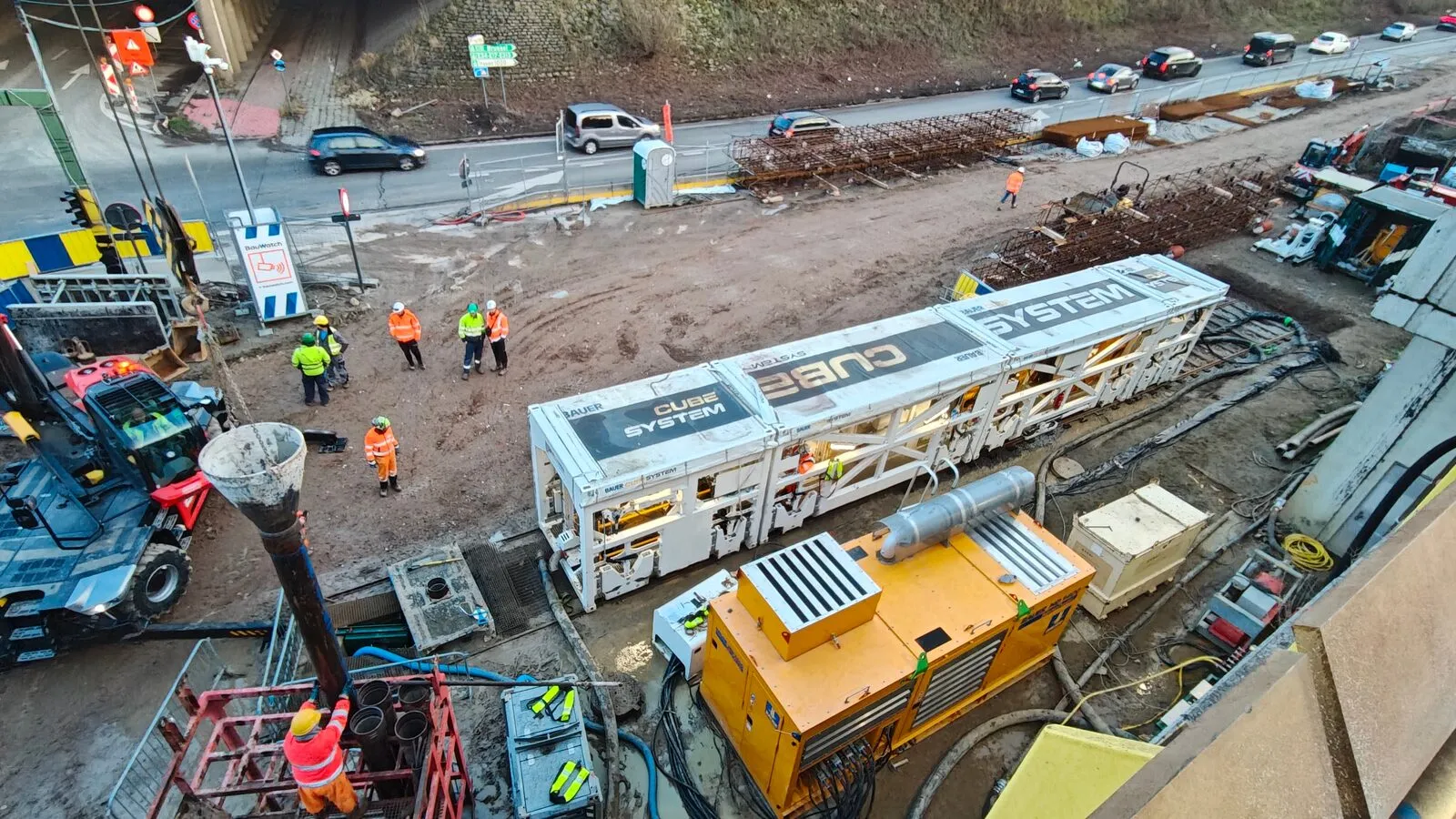
After five years of research and development, Denys has deployed its innovative Cube System for the first time on a major infrastructure project. At the Oosterweelverbinding, the new technology proved its value beneath an existing railway bridge, where headroom was limited. The system adapts proven diaphragm wall technology for locations that conventional machines cannot reach. According to Maarten Vanneste of Denys and Christian Riedl of BAUER, it opens up new possibilities for underground construction.
Born out of practical experience
The Cube System has its roots in a project Denys carried out in Brussels between 2008 and 2012. “We built an underground connection between an existing and a new pre-metro line through a single access shaft, beneath several streets and buildings. For some of the work, we still used the conventional technique of supported trenches. This is labour-intensive and ergonomically demanding, so we looked for a safer alternative,” says Vanneste. Together with BAUER Maschinen, Denys developed the Cube System, which constructs diaphragm walls from an underground tunnel.
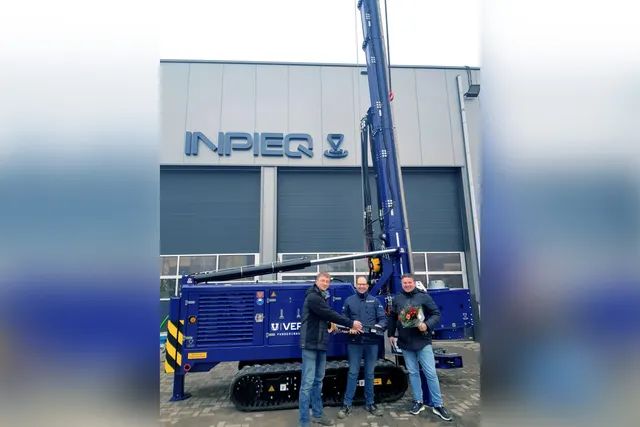
Riedl also says the partnership grew out of a specific problem on site. Denys contributed its experience of complex inner-city projects, while BAUER brought more than forty years’ experience in diaphragm wall cutters. The company has now built more than five hundred such cutter units. “Denys defined the challenge from a construction perspective. BAUER translated it into a robust machine concept,” says Riedl. “This was not a conventional customer-supplier relationship. It was a joint development process involving tests, modifications and continuous optimisation.” Future Foundations and ICOP also played a part, helping turn the concept into a practical application on site in Antwerp.
Proven technology in a new form
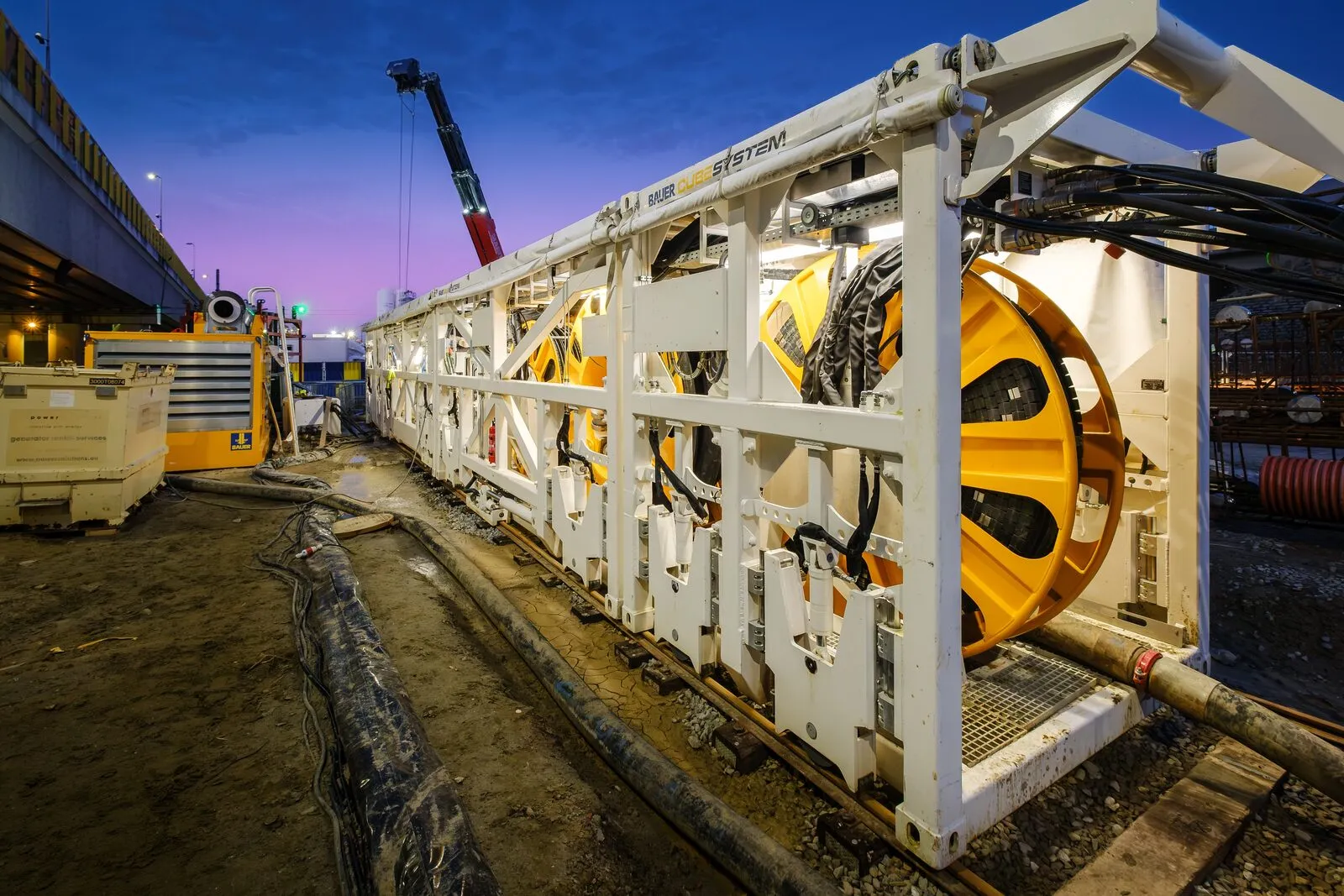
The new system constructs diaphragm walls from a microtunnel. Access shafts are needed only at the corners of the underground structure, keeping disruption at the surface to a minimum. It also makes projects possible in locations where conventional machines will not fit. “The conventional diaphragm wall machine has been completely redesigned and made modular,” says Vanneste. “Its height was eventually reduced to just 2.9 metres. We also separated the cutter from the pump.”
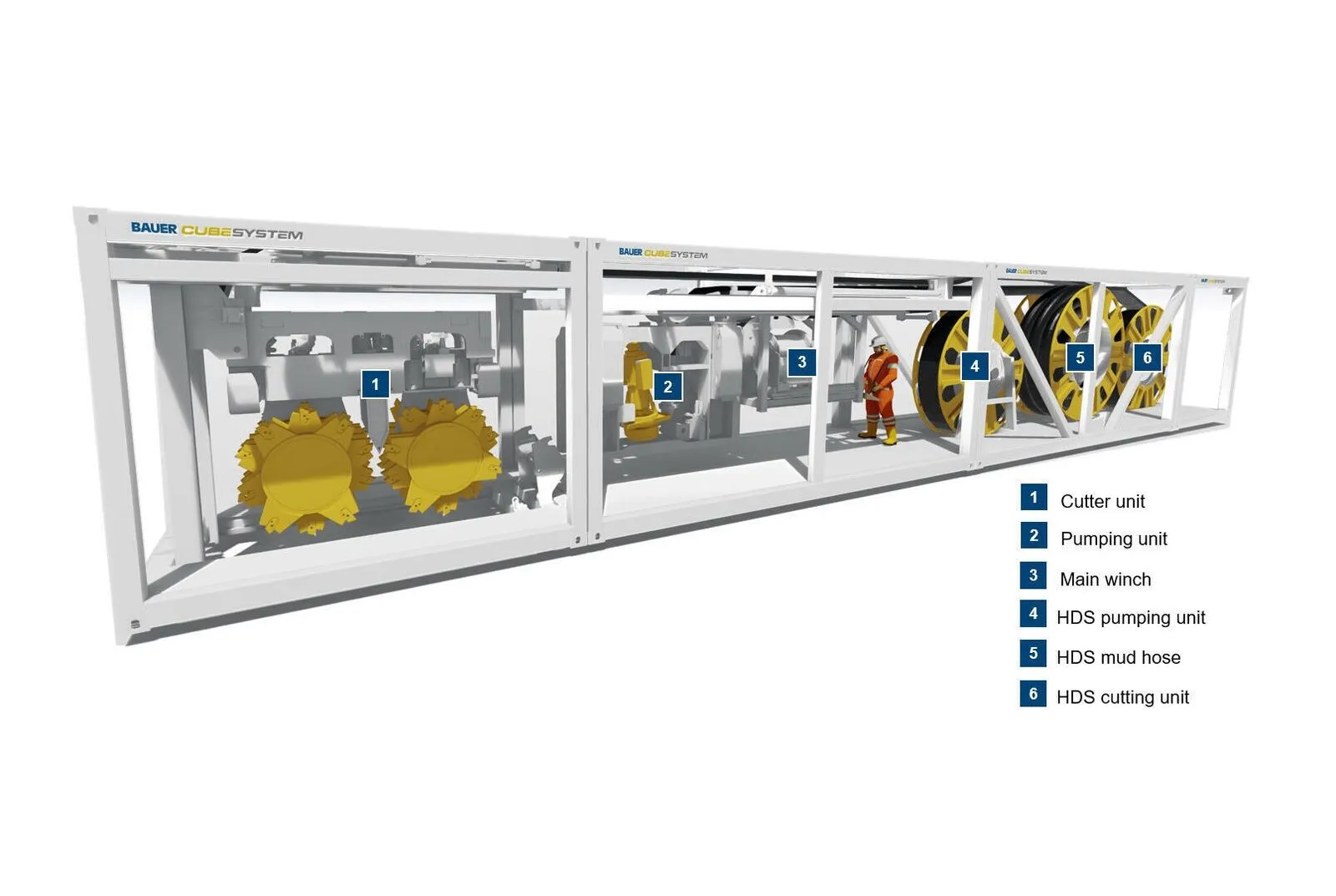
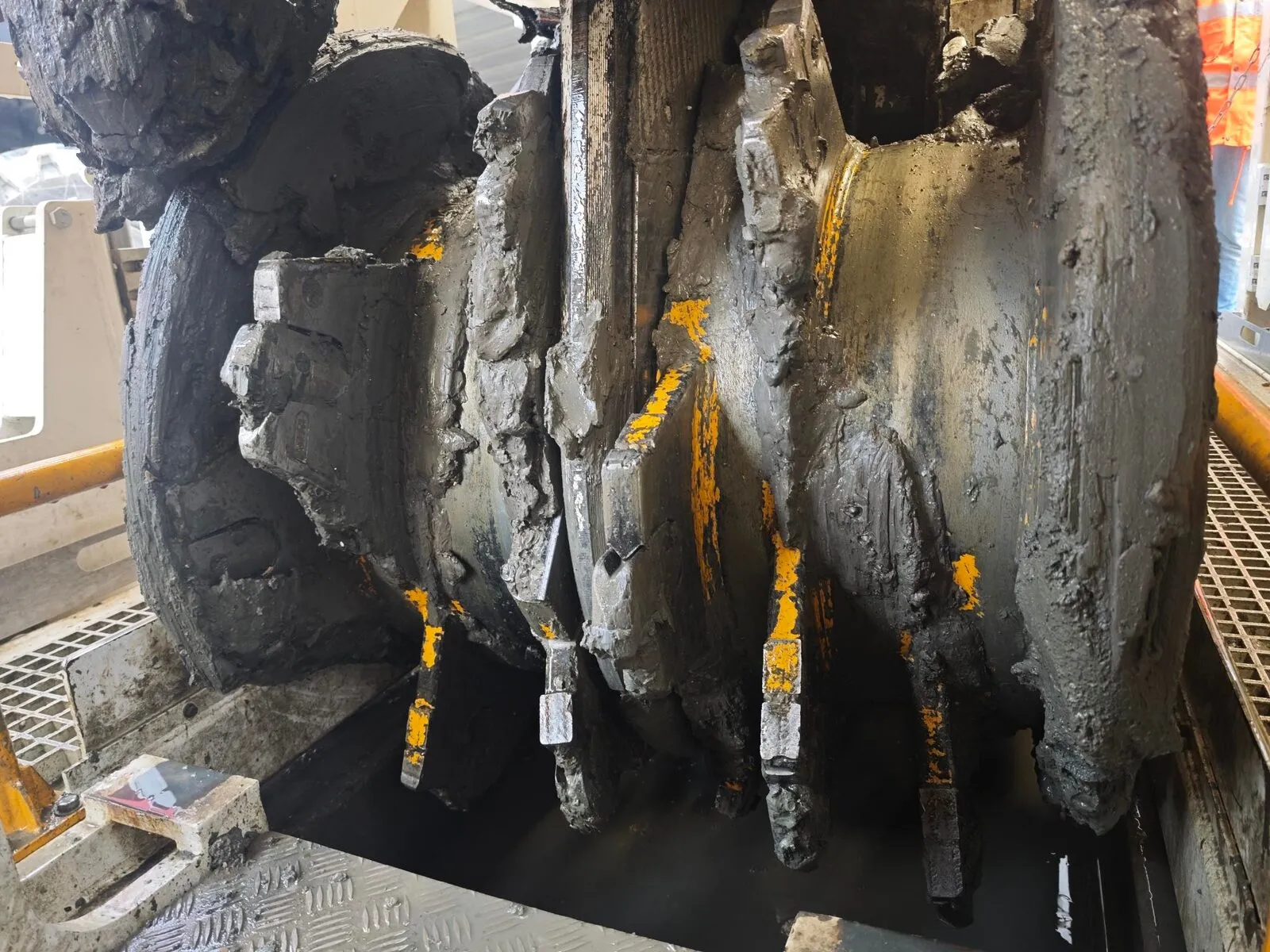
According to Riedl, that was one of the main technical challenges. The system is based on BAUER’s conventional hydromill technology, in which two counter-rotating cutter wheels loosen the ground. The soil is broken down in supporting fluid and pumped to the treatment plant. “We did not reinvent the principle itself,” Riedl explains. “The major step was rearranging the main components. This means proven diaphragm wall technology can now be housed in a much more compact, modular machine.”
“The machine had to be compact while still being heavy and stable enough for accurate cutting. To achieve this, the cutter frame was split into upper and lower sections. During assembly, the lower section is first lowered into the pre-excavated trench. The upper section is then added and the two are connected,” says Riedl.
As with the conventional method, the trenches are first filled with bentonite to support their sides. Vanneste explains: “We then use a separate module to install a reinforcement cage, after which we replace the bentonite with liquid concrete. First, we construct primary wall panels at equal intervals. We then fill the gaps with secondary panels to create a continuous, connected concrete wall.”
Modular and flexible
“The machine consists of four sections, which are lowered separately and assembled underground. Thanks to its compact design, the system can work beneath bridges, in existing basements, in urban areas with limited space, and in microtunnels with an internal diameter of 4 metres. The machine is housed in four High Cube shipping containers, making it easy and safe to transport,” says Vanneste.
The fully assembled installation measures approximately 18.3 metres long, 2.44 metres wide and 2.9 metres high. It weighs around 56 tonnes. The system cuts trenches 640 to 1,000 millimetres wide and 2.4 metres long. The maximum cutting depth is approximately 40 metres. “The power supply is flexible too. The system can be diesel-hydraulic or electro-hydraulic. This makes it particularly suitable for inner-city projects with strict requirements on noise, emissions and traffic. At the same time, it is flexible enough to meet other requirements and site conditions, since the power unit can be replaced easily,” says Riedl.
First field trial at Oosterweel
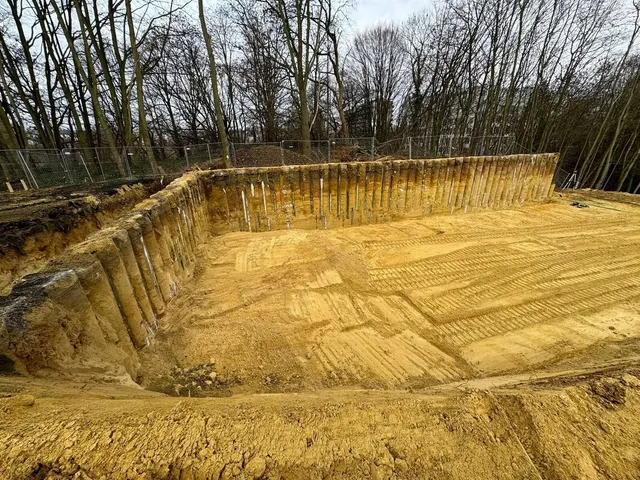
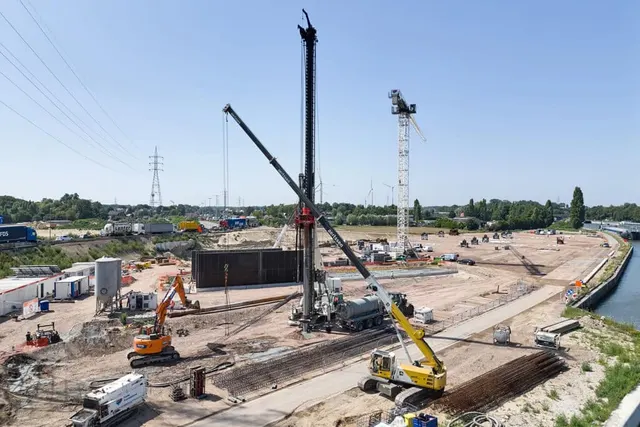
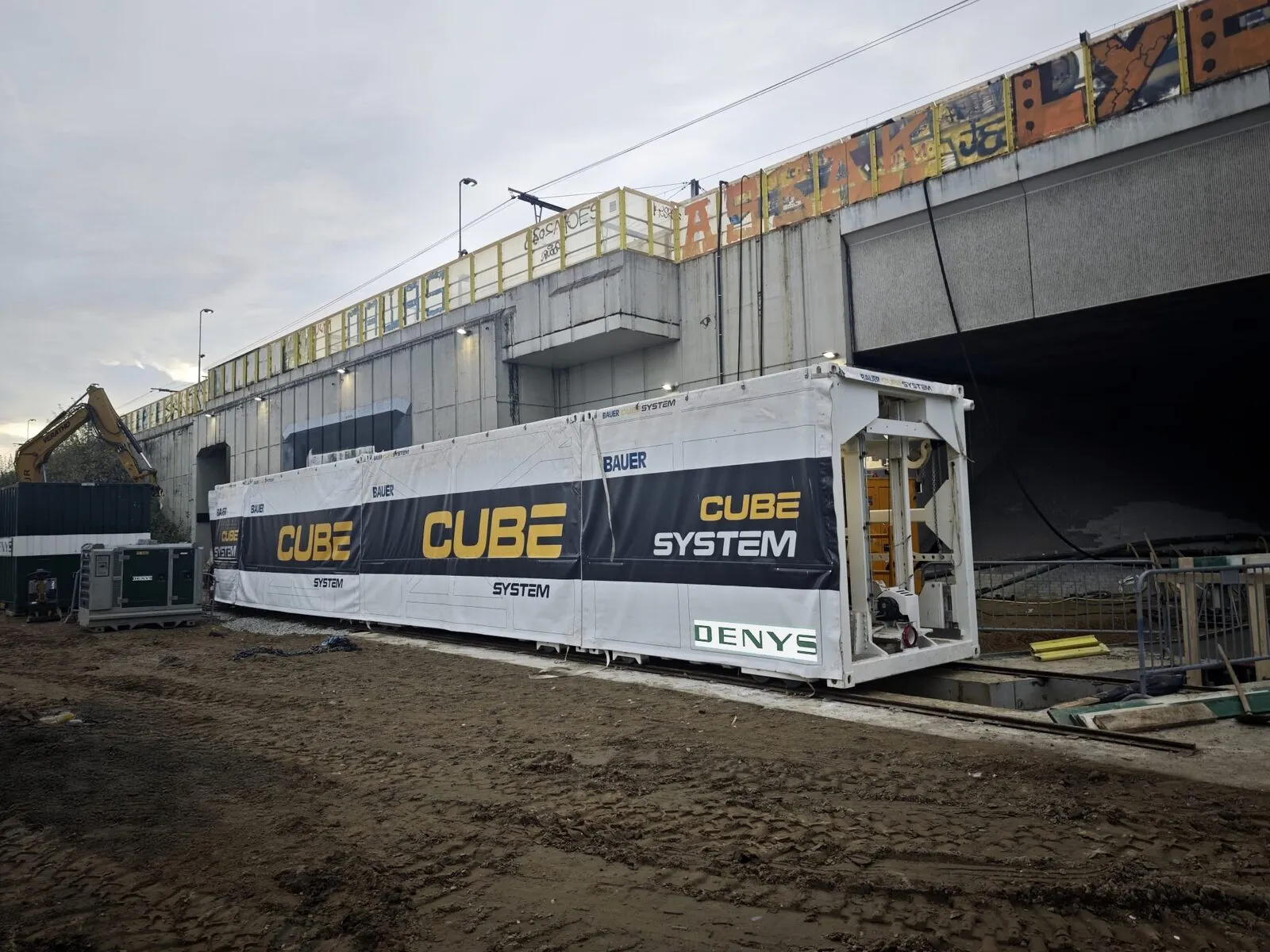
After years of development and testing, the system was deployed for the first time on a live project in 2026, at the ROCO site within the Oosterweelverbinding. Beneath the railway bridge on Groenendaallaan, Denys constructed a 142-metre-long, 30-metre-deep cut-off diaphragm wall. The limited headroom of 5.1 metres made the site an ideal place to put the new technology to the test.
According to Vanneste, the Cube System also offered a technical advantage. “The original design called for a jet grout wall, but that does not provide the necessary control. This increases the risk of deviations and affects watertightness. Our system allows us to control the construction process far more accurately.” Denys ultimately built 64 wall panels, extending up to three metres into the Boom Clay layer. During a test, the machine even penetrated fifteen metres into this hard ground.
For BAUER, Antwerp marked the transition from development to proven construction technology. “The initial tests and the deployment in Antwerp confirmed that the system also works under real, restricted site conditions,” says Riedl. “It also proved that productivity can be higher than initially estimated when conditions are suitable.” Vanneste adds: “The project was completed ahead of schedule. That proves the system is ready for future projects.”
Lessons from the first project
The first application also yielded practical lessons. A compact machine alone is not enough. The entire site operation must be organised around the system. “Good logistical planning is particularly important,” says Riedl. “This includes guiding the machine, material flows, installing reinforcement and coordinating with other activities.”
The project also provided information on operation, assembly and access for maintenance. The availability and management of spare parts also received extra attention. For Riedl, this is a key difference between a prototype and a mature construction method. “The project confirmed the concept. At the same time, it helped turn an innovation into a technique proven in practice.”
Underground construction with less disruption at the surface
“This first application shows that underground construction is also possible in places where conventional diaphragm wall machines simply cannot operate. This creates opportunities for metro stations, car parks, data centres, water storage facilities and other underground infrastructure, while keeping disruption at the surface to a minimum,” says Vanneste. Riedl sees the greatest potential in densely built-up cities. There, demand for underground space is growing, while traffic and surface activities need to continue as far as possible.
Its limited width of 2.44 metres creates further opportunities. “This means the system can, for example, be deployed on a narrow dam crest or in a single traffic lane,” Riedl explains. “Traffic can then continue in the other lane. The same principle applies alongside railway lines, where an adjacent track can remain in service.” Another option is to install the machine in a trench and temporarily cover it. This creates a worksite that is barely visible from the surface.
According to both partners, this is where the system’s main added value lies. The Cube System does not replace conventional diaphragm wall technology. It extends its reach. Locations that until now were too low, too narrow or too difficult to access are now within reach. As Riedl puts it: “The Cube System is specially designed for very confined spaces and, thanks to its minimal footprint, opens up new possibilities in demanding urban environments where the construction of diaphragm walls was previously impossible.”
Question about this story? Ask your question
Keep following this
Get an email when a new story is published. No account needed.
- ThemeUsing and protecting the subsurface
- SubjectFoundation engineering