Panel discussion on the future viability of the textile industry
Text Messe Frankfurt / Niels Rouvrois Beeld Messe Frankfurt / Jean-Luc Valentin
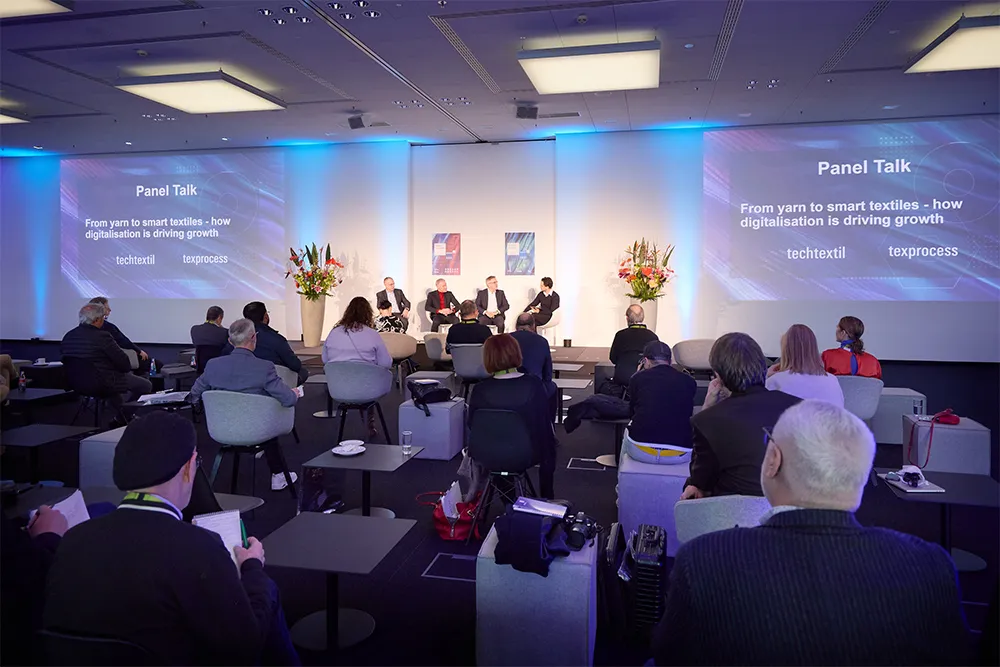
Technical textiles are increasingly used in the infrastructure sector. Like the construction industry as a whole, the textile industry is being shaped by digitalisation. How does digitalisation influence innovation in the textile industry? How can it be used to tackle the challenges currently facing the sector? What are the latest developments? What does the digital future of the textile industry look like? At a panel discussion ahead of this year’s editions of Techtextil and Texprocess (23 to 26 April), experts considered these and other questions and offered a preview of both trade fairs.
Digitalisation is not yet embedded in many companies. For example, a 2022 study by the German Economic Institute found that only 31% of companies in Germany are able to use data efficiently. However, it is essential for companies to improve their digital infrastructure, as regulations such as the EU Strategy for Sustainable and Circular Textiles and its associated digital product passport require a corresponding level of digitalisation. At the same time, digitalisation helps companies meet the sustainability requirements of customers and partners, for example by improving supply chain transparency or resource calculations. Companies that want to remain competitive and produce efficiently and flexibly can no longer afford to ignore digital technologies. Digitalisation offers solutions to many of the challenges currently facing the industry.
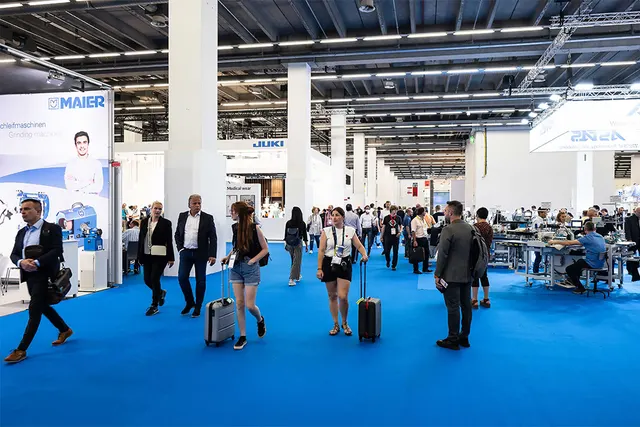
Techtextil and Texprocess support companies on their journey towards a digital future. At these leading international trade fairs, more than 1,600 exhibitors from around 50 countries will showcase their latest developments and innovations. Visitors can find the right partners and digital solutions for their individual needs. The extensive programme provides the ideal setting for discussions with industry representatives and experts.
“The sectors have enormous innovation potential, particularly in digitalisation. We can only realise it through international collaboration and the exchange of information. The global industry comes together at Techtextil and Texprocess. Dialogue, knowledge transfer, unique innovations and versatile solutions help companies prepare for the future,” says Olaf Schmidt, Vice President Textiles & Textile Technologies at Messe Frankfurt.

Panel discussion
During the panel discussion, Prof. Thomas Gries, Director of the Institute of Textile Technology (ITA) at RWTH Aachen University, Elgar Straub, Managing Director of VDMA Textile Care, Fabric & Leather Technologies, and Olaf Schmidt shared their perspectives on digitalisation in the textile industry. The discussion was moderated by Zackes Brustik.
Digitalisation helps companies tackle the challenges currently facing their industry and remain competitive. Companies can harness digital advances to address shortages of raw materials and labour, energy costs and more demanding sustainability requirements, and to produce more efficiently, quickly, flexibly, transparently and cost-effectively.
“Constantly changing consumer and regulatory requirements, together with labour shortages and more difficult trading conditions resulting from geopolitical changes, continually present processors of technical textiles with new challenges. Manufacturers of machinery, systems and processes for processing textile materials provide the solutions needed. Through digitalisation and automation, we help our customers improve flexibility, sustainability and quality, and expand their product potential. We support their production while also driving innovation,” explains Elgar Straub.

Research and industry drive innovation
Although many companies have already digitalised individual steps in their process chains, the entire textile value chain must be digitalised and all gaps closed if the industry is to realise its full potential. “Resilient and sustainable value chains are vital to the future viability of the textile industry. Digitalising every process step is the foundation for this. Researchers and industry must work closely together to achieve it,” says Prof. Thomas Gries.
Digitalisation opens doors
The latest digital developments will be on show at Techtextil and Texprocess. The range spans production technologies, textile-processing machinery, fibres, yarns and nonwovens, as well as functional and smart textiles. The diversity of industries in which these products are used is unique. From healthcare and mobility to construction, they are used across a wide range of applications. Digitalisation is also driving significant progress in the textile industry: it can make production and processing more efficient, while smart products can create new added value.
Question about this story? Ask your question
Keep following this
Get an email when a new story is published. No account needed.
- ThemeSmarter, safer construction site management
- SubjectGeotextiles