









Successful formwork for Nieuwe Sluis Terneuzen thanks to unique Belgian-Dutch synergy
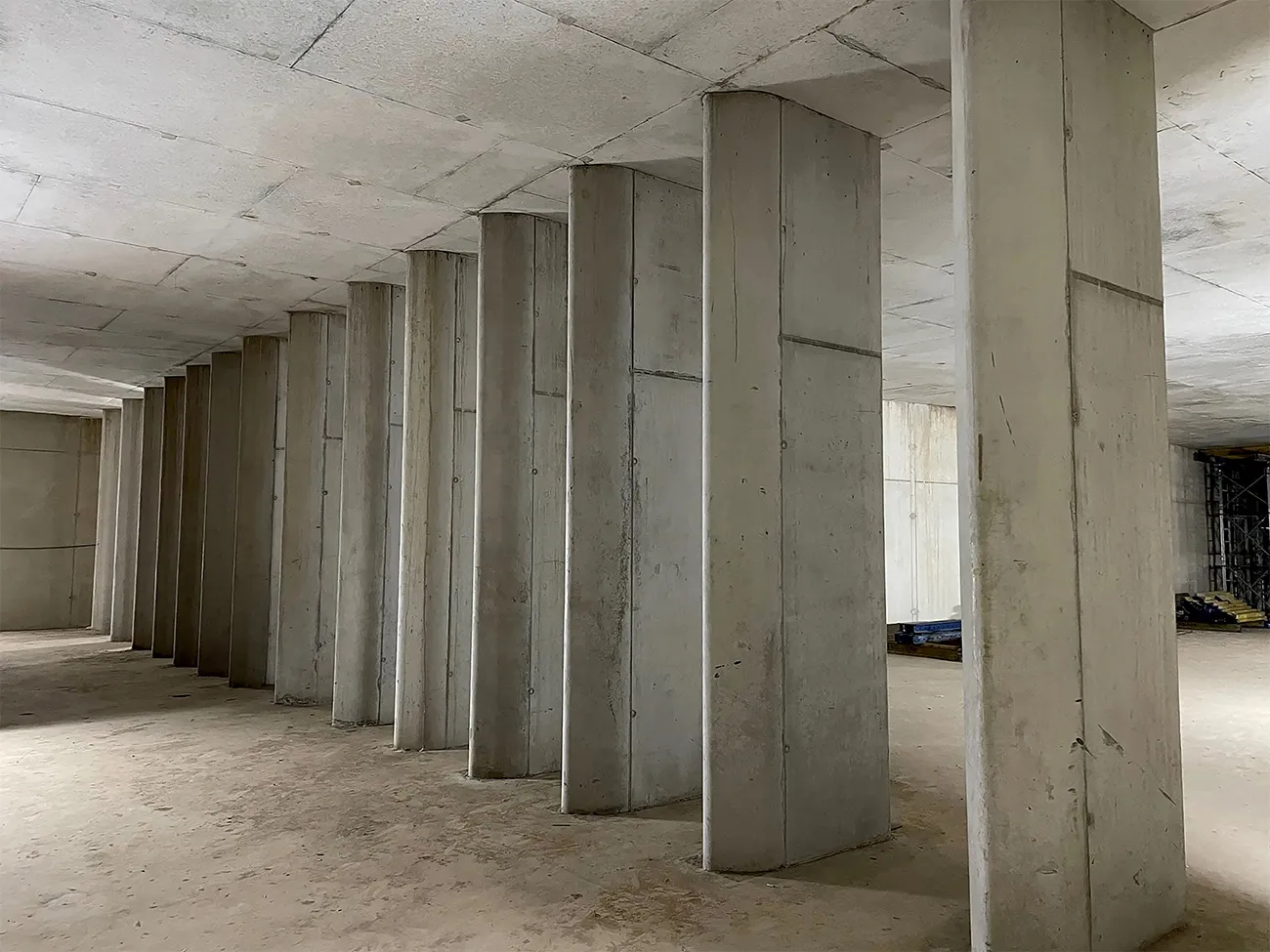
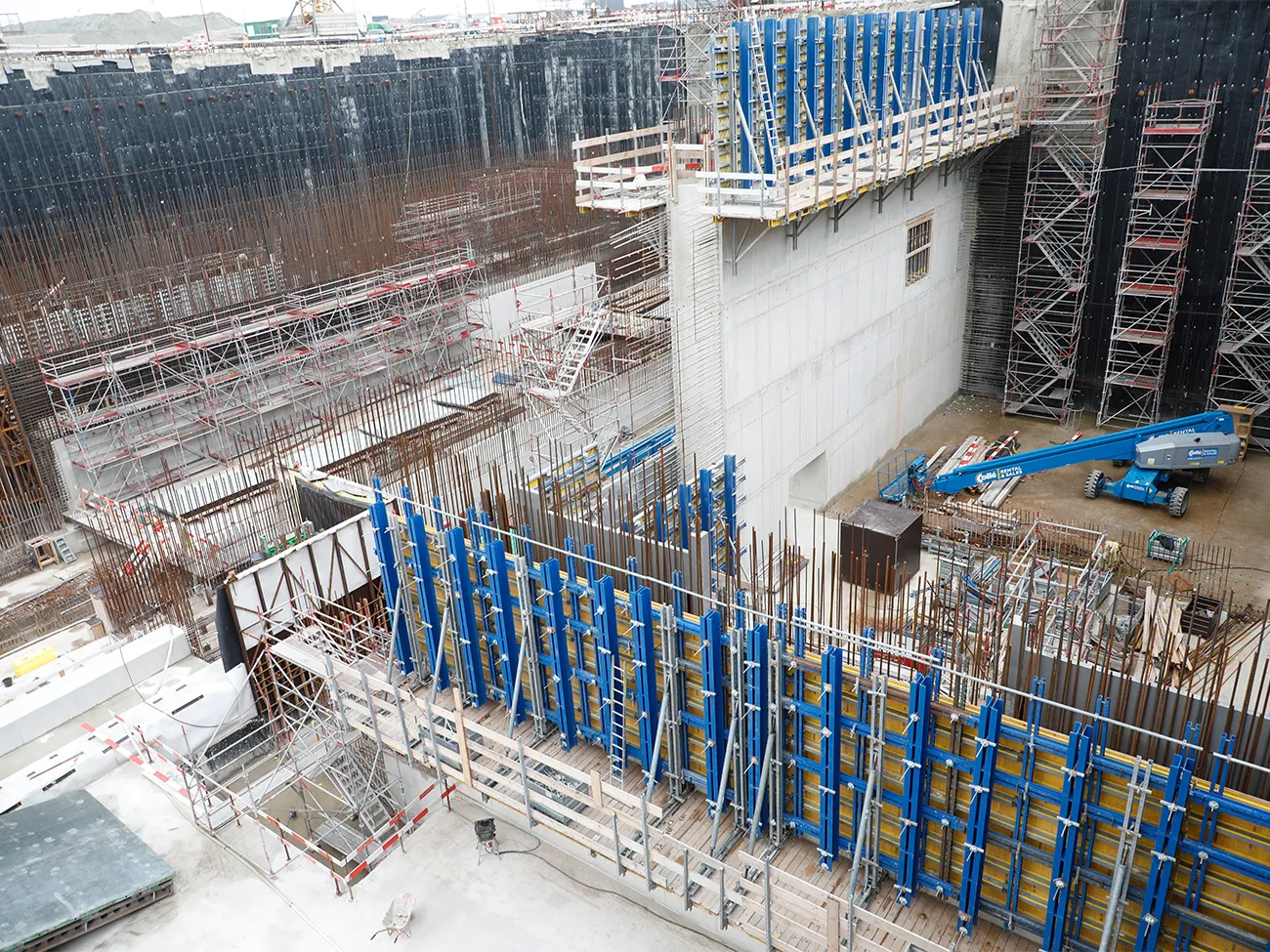
Construction of Nieuwe Sluis Terneuzen is in full swing. The lock complex is the gateway to the ports of Ghent and Terneuzen in North Sea Port, providing a shipping link between the Netherlands, Belgium and France. The new lock will improve access and ensure smoother passage for the growing volume of shipping traffic, including both inland vessels and seagoing ships. For the formwork for the bridge chambers, cellular wall structure, inlet structure and gate chamber, among other elements, contractor consortium Sassevaart, comprising BAM, DEME, Stadsbader Contractors and Van Laere, called on Doka, the Austrian formwork specialist with its Belgian headquarters in Ternat.
Thanks to the new lock and the resulting infrastructure improvements, Flanders and the Netherlands can both expect a significant economic boost. The new lock will allow larger seagoing ships to travel along the Ghent-Terneuzen Canal to the port of Ghent. Lock capacity will also increase, reducing waiting times for inland vessels. The first ship will pass through Nieuwe Sluis in 2023. It comes as no surprise that Sassevaart turned to Doka for the formwork on a project of this scale. “Our track record on major infrastructure and lock projects, and our position in the Belgian, Dutch and international markets, make Doka an ideal formwork partner for projects like this,” says ir. Koen Lamers, managing director at Doka. “For example, we also helped build Kieldrechtsluis in Antwerp.”
Cross-border collaboration
A distinctive feature of this project for Doka was its cross-border nature. Koen Lamers says: “Not only does the project as a whole cross borders, with major construction companies from both countries in the contractor consortium, but Doka itself is also working across borders on this project. Doka Belgium and Doka Netherlands joined forces on engineering, capacity, logistics and materials, which is quite unique. In practical terms, this was the best solution. The lock is in the Netherlands, but the site is closer to the Belgian branch. That delivers significant savings in terms of travel and transport.”
One important consideration in the collaboration was the difference between the preliminary design and study phases in the two countries. In the Netherlands, the preliminary phase takes considerably longer, including for suppliers. The formwork study, covering engineering and construction phasing, had to be finalised well in advance of the work. Brecht Diependaele, technical manager at Doka, says: “By Belgian standards, we were indeed involved in the project very early. This meant we could plan our material requirements very effectively. Despite this different approach during the study phase, the synergy between Doka Belgium and the Netherlands was particularly smooth. The fact that we use standardised processes for engineering and materials across Doka was certainly a major advantage in this respect.”
Sloping roof slab
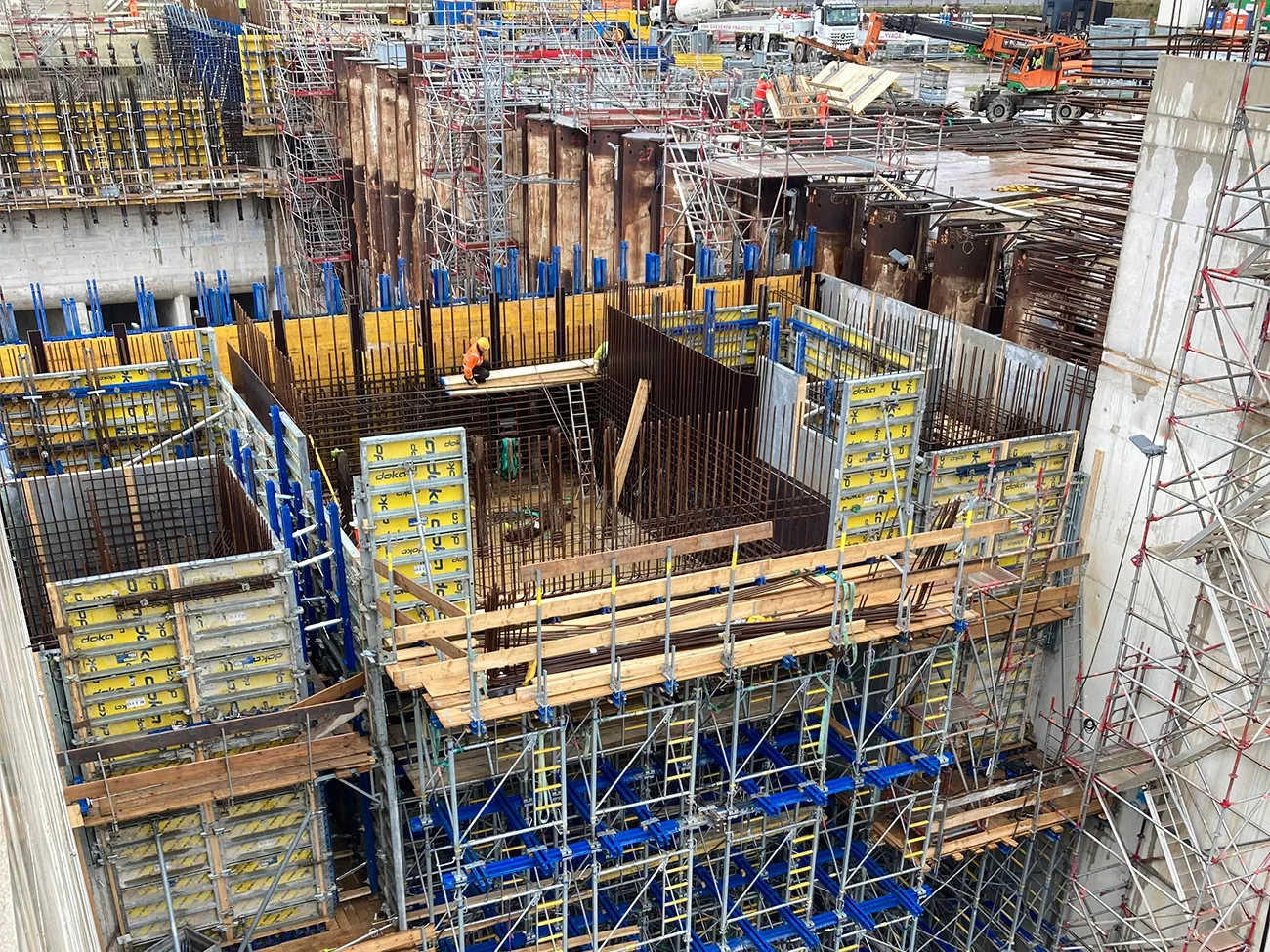
The concrete structure has now been successfully completed. Brecht Diependaele says: “Although Doka has the experience and expertise to deliver projects of this scale, every project has its own specific challenges. For the gate chamber, for example, a sloping roof slab 2 metres thick had to be cast in a single pour. We had to account for a relatively unusual gradient of around 21%. The bridge bearing hinges were also a challenge, with heavy corbels requiring substantial support because of the high concrete loads. We also drew on our experience from other lock projects when designing the formwork for the bridge chambers and walls.”
Overall, the project comprised approximately 75% ‘standard formwork’ and 25% ‘specialist engineering’. Koen Lamers says: “That is quite a high proportion. And in this case, the standard formwork was the less commonly used type for large structures subject to heavy loads.” Brecht Diependaele adds: “For the gate chamber, for example, we had to work without spacers. Imagine a very large block of concrete with 16 slots for stoplogs, built without through-ties or spacers. The tolerances were therefore very tight. But this part of the project also went flawlessly, right from the first pour.”
Successful project
Doka had to be able to supply a large quantity of formwork materials for the construction of Nieuwe Sluis. “But we can handle that, with support from our other branches if necessary,” concludes Koen Lamers. “One specific section, namely the door chambers, was built using formwork owned by one of the contractors. But this was clearly agreed in advance, and all the other formwork work was included in our contract. One interesting detail: the door chambers were formed using the principles we developed for Kieldrechtsluis in Antwerp. Sassevaart therefore had great confidence in Doka. Ultimately, we can look back on this project as a success. Projects like this are where Doka stands out, thanks to the seamless combination of engineering, flexibility and excellent logistical support,” concludes Koen Lamers.
Question about this story? Ask your question
Keep following this
Get an email when a new story is published. No account needed.
- ThemeStrengthening waterways and coastlines
- SubjectHydraulic engineering







