









Sewerage & underground infrastructure
Glass fibre reinforced pipes for complex sewer systems
Text and images Deschacht
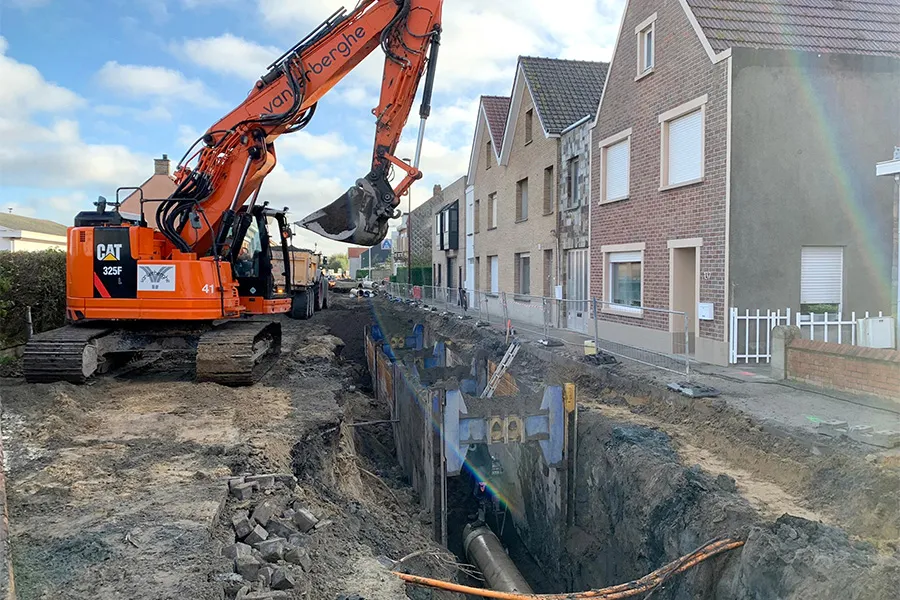
Choosing the right sewer pipe is crucial for sewer works. When installing a separate sewer system in De Haan, contractor Vanlerberghe deviated from the specified vitrified clay pipes. Due to the poor ground conditions, the sewers had to be installed between a water-retaining barrier and on an additional pile foundation, making installation complex. The company therefore opted for glass fibre reinforced plastic pipes in collaboration with Deschacht.
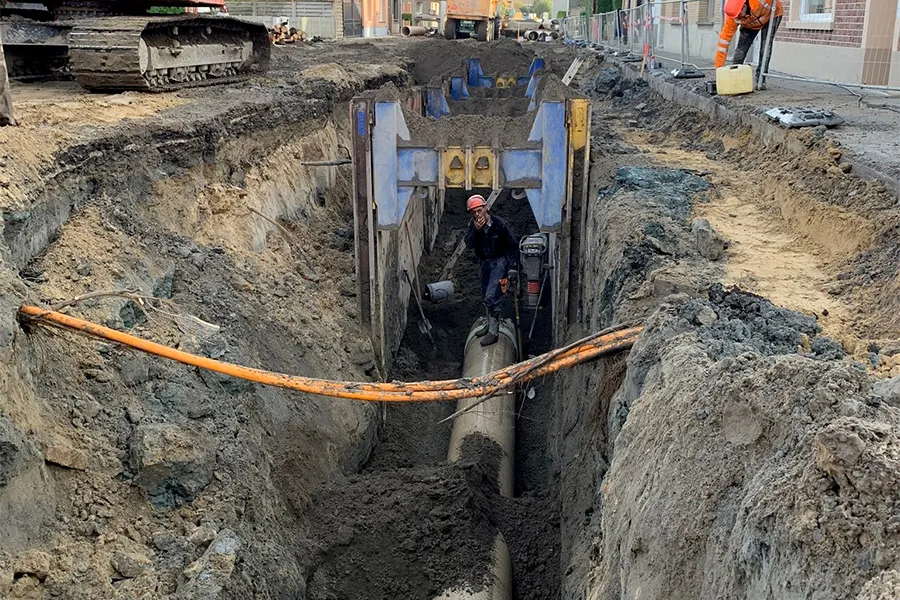
Contractor Vanlerberghe specialises in sewer works and underground concrete structures. Its expertise is particularly valuable on complex projects. That expertise was needed when replacing an existing sewer system in Grotestraat in De Haan. “The original design specified vitrified clay pipes, but given the difficult installation conditions, and with the water-retaining barrier, a CSM wall installed by our subsidiary Omni-tech, leaving very limited trench width, we looked for an alternative,” says Nicky Portier, site manager at Vanlerberghe. “In this situation, the small outside diameter of the GRP pipes is a major advantage.”
Chemically inert
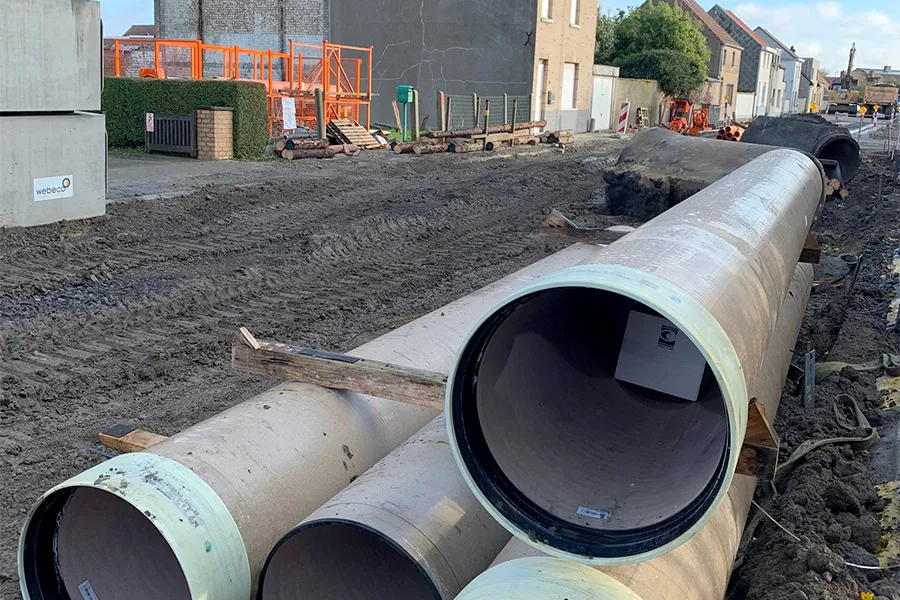
Vanlerberghe has worked closely with Deschacht for a long time, and once again found a solution in the range of the Belgian building materials specialist: Amiblu glass fibre reinforced plastic pipes, or GRP pipes. Brecht De Meyer, Customer Service Manager for road and utility construction at Deschacht, says: “This is an exceptionally strong plastic pipe that is virtually chemically inert. It is a two-component pipe made from glass fibres and a polymer matrix, including epoxy and polyester resins, which enhance the pipe’s chemical resistance. This makes it ideal for conveying wastewater, as well as sulphur-containing products or sulphur vapours. In addition, GRP pipe is very light relative to its strength compared with other pipes. This makes transport and installation easier.”
Vanlerberghe had already used GRP pipes regularly, and they proved to be an excellent solution for the project in De Haan too. Deschacht supplied GRP pipes with diameters of 600 (200 metres), 700 (150 metres) and 800 (100 metres). “Another challenge on this project was the very limited space available for storing the pipes. That was another reason to choose GRP pipes: their walls are very thin compared with concrete pipes, so they take up less space,” says Nicky Portier.
Improved resistance to point loads
The project is still under way, but site manager Portier is already pleased with the choice of GRP pipes. Nicky Portier says: “We see an advantage in using GRP pipes in poor ground conditions, where pipes have to be laid on a pile foundation. GRP pipe can be considered flexible rather than rigid. The specified vitrified clay pipes are much more susceptible to breakage from point loads where they rest on the pile foundation. In addition, GRP pipes are not brittle and are far less prone to cracking or splitting, which was also an advantage when using limed, recycled backfill materials.”
“We could also once again rely on excellent cooperation with Deschacht, a valued partner that always works with us to find a quick solution when problems arise,” concludes Nicky Portier. ■
Een zakelijke vraag aan Deschacht? Get in touch
Companies in this story

Keep following this
Get an email when a new story is published. No account needed.
- ThemeRenewing pipelines and sewers
- SubjectSewerage & underground infrastructure
- CompanyDeschacht







