









A passion for sewerage
Water management and the comfort it provides are so much a given today that we no longer stop to think about the fact that they rely on a great deal of expertise, and increasingly so.
Installing a good sewer system is an essential prerequisite. The sector has to take account of a great many rules and factors, often for environmental reasons. As part of its feature on water management, BETON, FEBE’s bilingual magazine, visited the site in Harpstraat in Koersel-Beringen.
Words | Febe / Niels Rouvrois Photography | FEBE
Until a few years ago, the busy construction site here was a particularly desolate plot, left vacant when Koersel’s town hall closed. The City of Beringen saw potential in the area and commissioned a masterplan. The Academy of Music, Drama and Dance moved into the vacant administrative building. A new building will provide space for the expansion of several public services. Opposite the so-called Academiepark, Harpstraat, which had already been built, has been extended, and a sewer system installed to serve a residential development comprising eight flats and six houses.
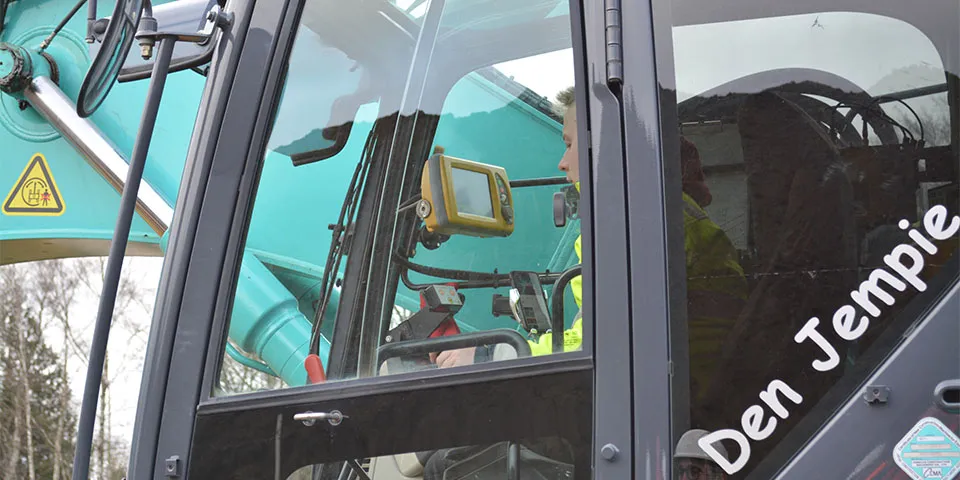
The 2D design drawings are displayed directly on the screen in the excavator
“It’s a separate sewer system for the entire development,” says Bart Van Genechten, co-owner of V&V Infra. Bart Van Genechten and Kristof Van Herck share operational management: “I focused more on the company’s technical office and estimating, while Kristof mainly took charge of the operational side. But we don’t want to define our roles too rigidly, and step in for each other whenever needed.” Van Herck founded V&V Infra nine years ago with Vandebos Bouwonderneming from Alken. The company grew quickly and now employs 26 office staff, alongside a strong team of subcontractors.
Precision
V&V Infra believes precision is key to installing a good sewer system. Bart Van Genechten says: “A sewer project starts with accurate measurements.” The need for thorough preparation is undoubtedly linked to the arrival of digitalisation in the sewerage sector. Van Genechten says: “That’s right, it’s a challenge, but it does make our work somewhat easier. We have four excavators fitted with machine control, and we believe it’s important to keep up with 3D technology. We use the design drawings to create a 3D model, submit it to the local authority for approval, and upload it to the excavator’s control unit. The screen shows where the sub-base is and what we can excavate. You can see your position on the plan, where you’re digging and where the boundary line is. You can even see the kerbs. Using the computer model, we can excavate the sewer trench directly to the required level.”
Porous
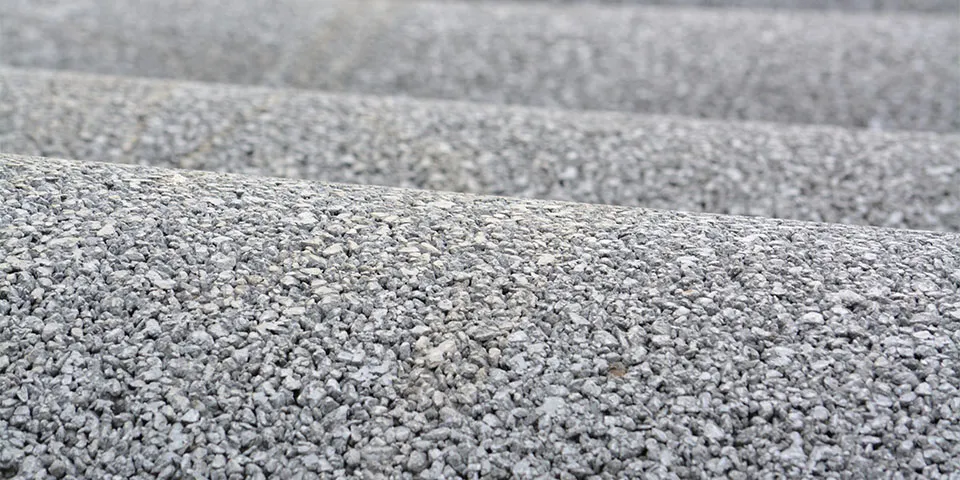
“Not all the sewer pipes in Harpstraat in Koersel-Beringen are made of concrete,” explains Van Genechten. “But porous concrete pipes (supplied by Tubobel nv, ed.) were chosen for the stormwater drainage. This allows a combination of infiltration into the ground and discharge. A wadi has also been included at the end of the sewer system, where excess water can collect.” The decision to install 800 mm porous sewer pipes was not made by V&V Infra itself. Bart Van Genechten says: “Fluvius first carries out a soil survey and decides what needs to be installed on that basis. In Flanders and Wallonia, wastewater and rainwater must be drained separately for new builds or when a sewer system is renewed. Rainwater (RWA) must not enter the wastewater sewer (DWA). There are several options for rainwater. It can be reused, infiltrated into the ground, stored temporarily or discharged via the stormwater drainage system.”
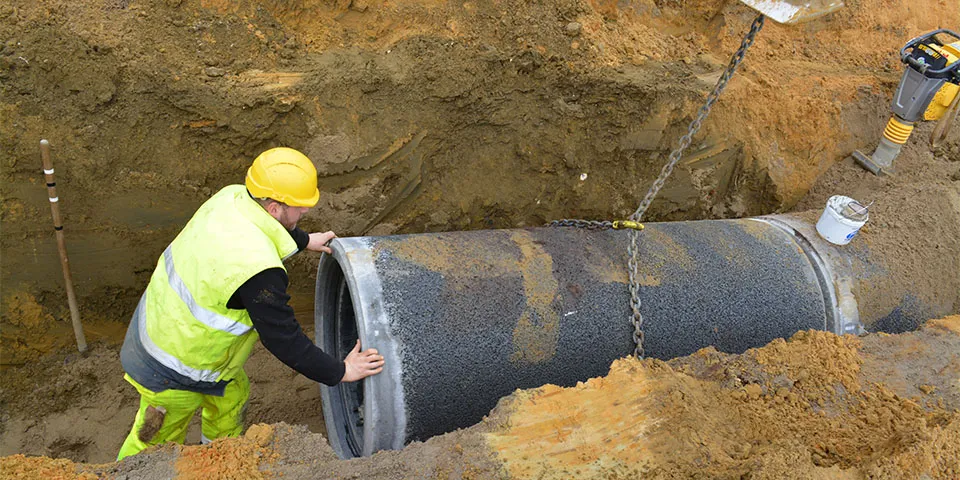
“The main thing is to position the pipe correctly so that it connects properly to the manhole it leads to.”
“Concrete is a pleasant material to work with,” the site manager continues. “The main thing is to position the pipe correctly so that it connects properly to the manhole it leads to. But our excavator operators have plenty of experience. The big advantage for me is that concrete can take a knock. Other materials can be damaged quite easily when being lifted or handled.”
Complexity
The site in Harpstraat once again shows that sewer installation and roadworks are becoming increasingly complex. “More and more people are needed for each project. The work itself is much the same, but the administrative follow-up is becoming more demanding. The sewer is installed, but at the same time you’re dealing with permits for traffic signs and work meetings, demolition monitoring and soil movement regulations, execution and site supervision. You also have to prepare as-built records, such as the property connection forms. It’s an interesting sector,” concludes Bart Van Genechten.
This article was previously published in FEBE magazine BETON, no. 247
Question about this story? Ask your question
Keep following this
Get an email when a new story is published. No account needed.
- ThemeRenewing pipelines and sewers
- SubjectConcrete







