Waterbouwkundig Laboratorium trials new technology for inland waterway locks
‘Contactless mobile measuring equipment can improve safety and efficiency and increase throughput’
Waterbouwkundig Laboratorium, part of the Department of Mobility and Public Works, is working with Apixa and Iv-Infra as delivery partners on a new technique to measure a vessel’s movements in a lock. “We are exploring how innovative technology can be used to optimise the safety and efficiency of locks in Flanders and improve the flow of shipping,” says Jeroen Vercruysse of Waterbouwkundig Laboratorium. The project is supported by the Innovative Public Procurement Programme (PIO).
The Flemish Government aims to provide a reliable, efficient and intelligent waterway network. Locks play an important role in this. When a vessel needs to enter a canal or river reach with a higher or lower water level, it does so through a lock. This process is also known as ‘locking’. During the process, the vessel is subject to forces caused by water flowing in or out, or by water moving within the lock chamber. The vessel is therefore secured with ropes or thick cables. It is important that these forces remain within safe limits, otherwise the ropes may break.
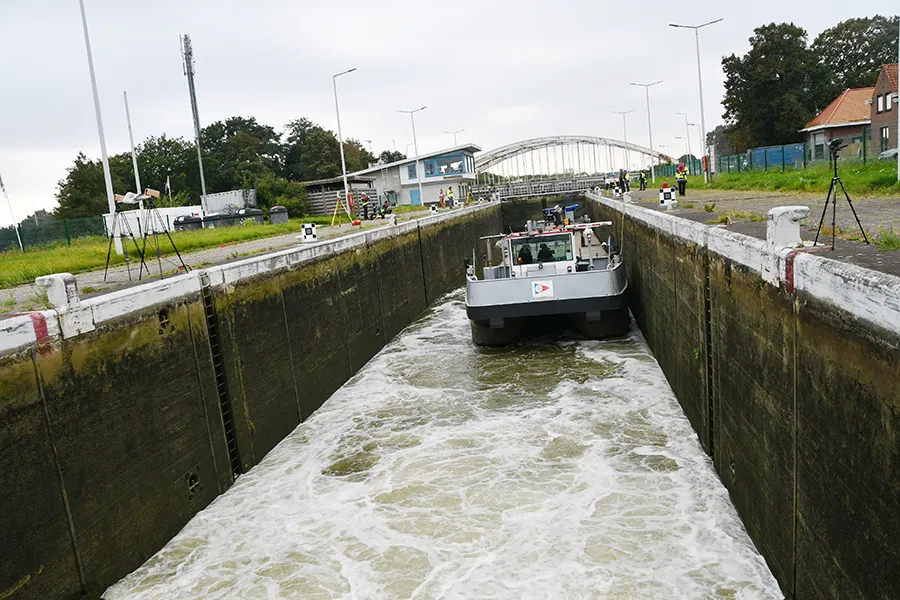
Contactless mobile measuring equipment
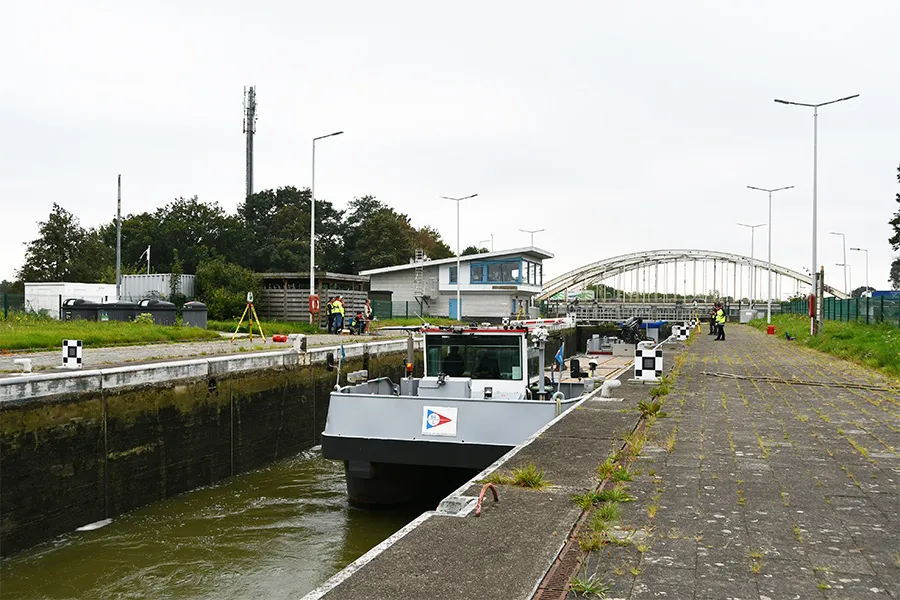
Waterbouwkundig Laboratorium, part of the Department of Mobility and Public Works, is now investigating whether and how contactless mobile measurement technology can be used to accurately measure the forces acting on a vessel during locking. Using an innovative set-up, researchers can safely and efficiently measure a vessel’s movements and tilts in a lock chamber during locking from the quay. Movements and tilts provide a good indication of the forces acting on a vessel.
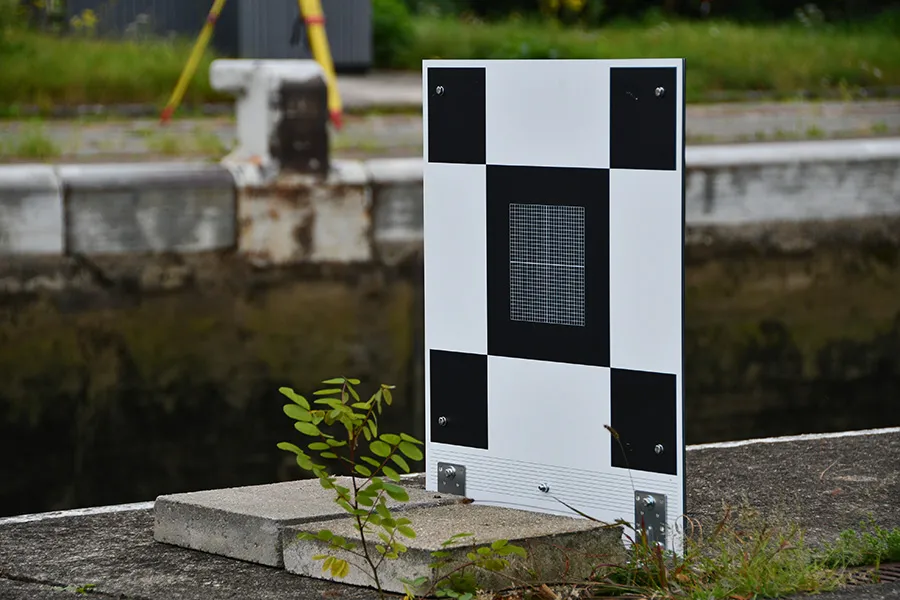
‘Proof of Concept’ measurement set-ups
Waterbouwkundig Laboratorium is working with Apixa and Iv-Infra on this project. The two companies are each developing their own ‘Proof of Concept’ measurement set-up and will analyse the vessel’s movements in different ways.
- Apixa will carry out a photogrammetric survey of the bow and stern of the vessel. Four cameras will track various points on the bow and stern over time, allowing the vessel’s movements to be measured accurately.
- Iv-Infra will use drones to place prisms on the vessel. The exact position of these prisms will be measured during locking using infrared signals emitted by total stations on the quay. The total stations will continue to track the signal over time. The viewing angle will be measured each time, while the distance will be calculated from the travel time of the infrared signal reflected by the prism.
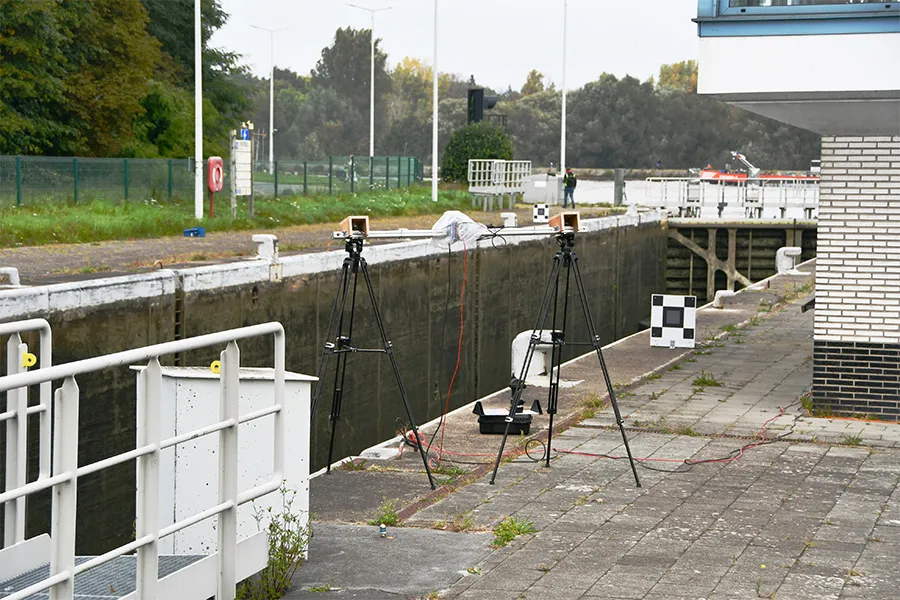
Both set-ups were tested beforehand in a simulated dry setting. The two companies will test their measurement set-ups in a wet setting on a commercial vessel in the lock at Viersel (Antwerp). Waterbouwkundig Laboratorium will carry out the reference measurements and validation together with the Department of Mobility and Public Works’ General Technical Support division (ATO). On Wednesday 11 October, Apixa’s photogrammetric set-up was tested as part of its ‘Proof of Concept’ in the lock at Viersel. Iv-Infra’s ‘Proof of Concept’ is scheduled for Wednesday 8 November. The wet tests are being carried out in collaboration with De Vlaamse Waterweg nv, which manages and operates the Flemish waterways.
Lydia Peeters, Flemish Minister for Mobility and Public Works: “Flanders aims to lead the way in innovation and sustainability in inland shipping. This innovative test project is a perfect fit. By investing in smart infrastructure, we can make inland shipping more attractive and promote a modal shift to sustainable forms of transport.”
Jo Brouns, Flemish Minister for Economy, Science and Innovation: “Through the Innovative Public Procurement Programme, we encourage innovation within our public authorities. Working closely with companies and research institutions, we develop and test innovative solutions to a wide range of real-world challenges and problems. Specifically, we are investing in innovative measurement technologies that will ultimately make shipping in Flanders smoother and safer.”
Long-term ambition
If the measurement set-ups prove useful in practice, Waterbouwkundig Laboratorium intends to use them in other research and advisory projects, both to optimise our locks and to validate and improve existing theoretical models. It is also exploring with De Vlaamse Waterweg nv whether the measurement set-ups could be deployed on a larger scale.
Innovative Public Procurement Programme (PIO)
Waterbouwkundig Laboratorium has secured support from the Innovative Public Procurement Programme (PIO) to develop this measurement infrastructure. Through innovative public procurement, PIO creates further opportunities to modernise the Flemish public sector in collaboration with businesses and research centres, and to provide innovative solutions to a range of societal challenges.
Question about this story? Ask your question
Keep following this
Get an email when a new story is published. No account needed.
- ThemeStrengthening waterways and coastlines
- SubjectHydraulic engineering