









New wave flume at the Flanders Hydraulic Research Laboratory opens the door to innovative research into coastal safety and climate impacts
Text and images DMOW
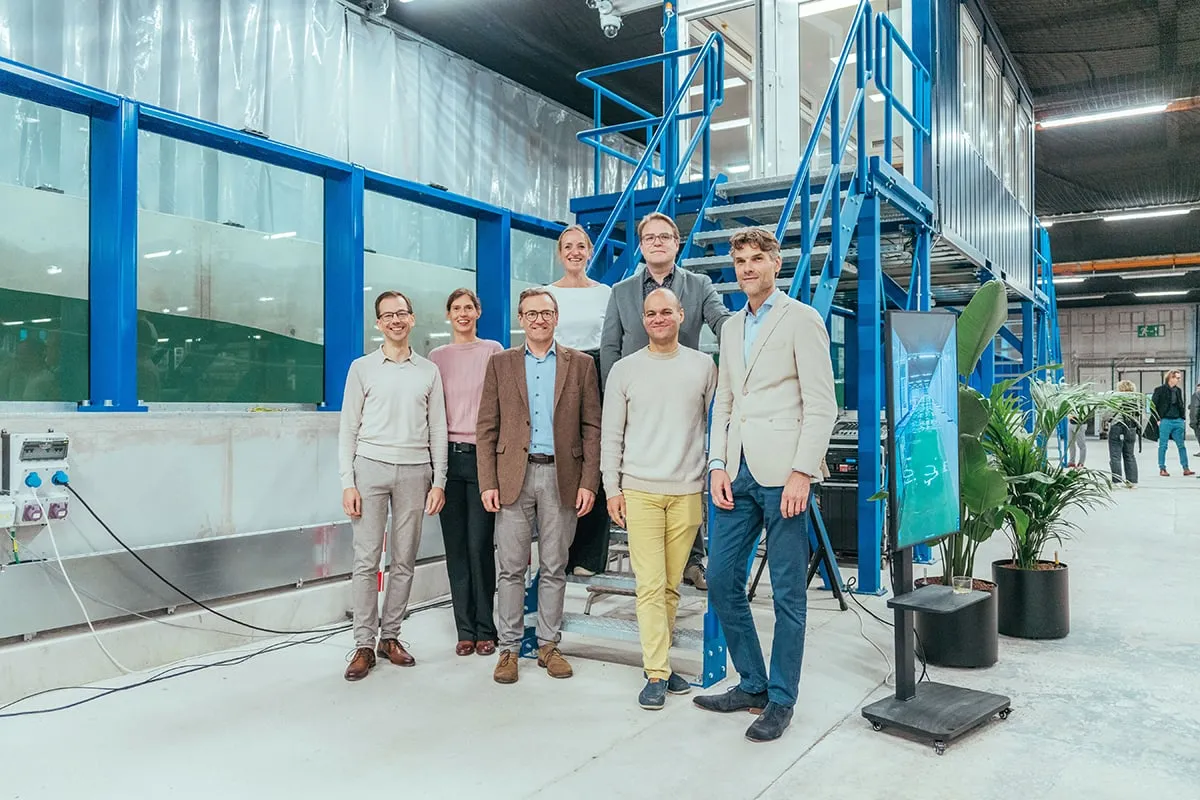
The Flanders Hydraulic Research Laboratory (WL), part of the Department of Mobility and Public Works (MOW), today unveiled its new, larger and more modern wave flume. This research facility is designed to simulate complex wave and water movements in a controlled environment. The official opening took place at the WL’s headquarters on Berchemlei in Antwerp. The new wave flume was built with support from the Innovative Public Procurement Programme (PIO) and the Flemish Agency for Maritime Services and the Coast (MDK).
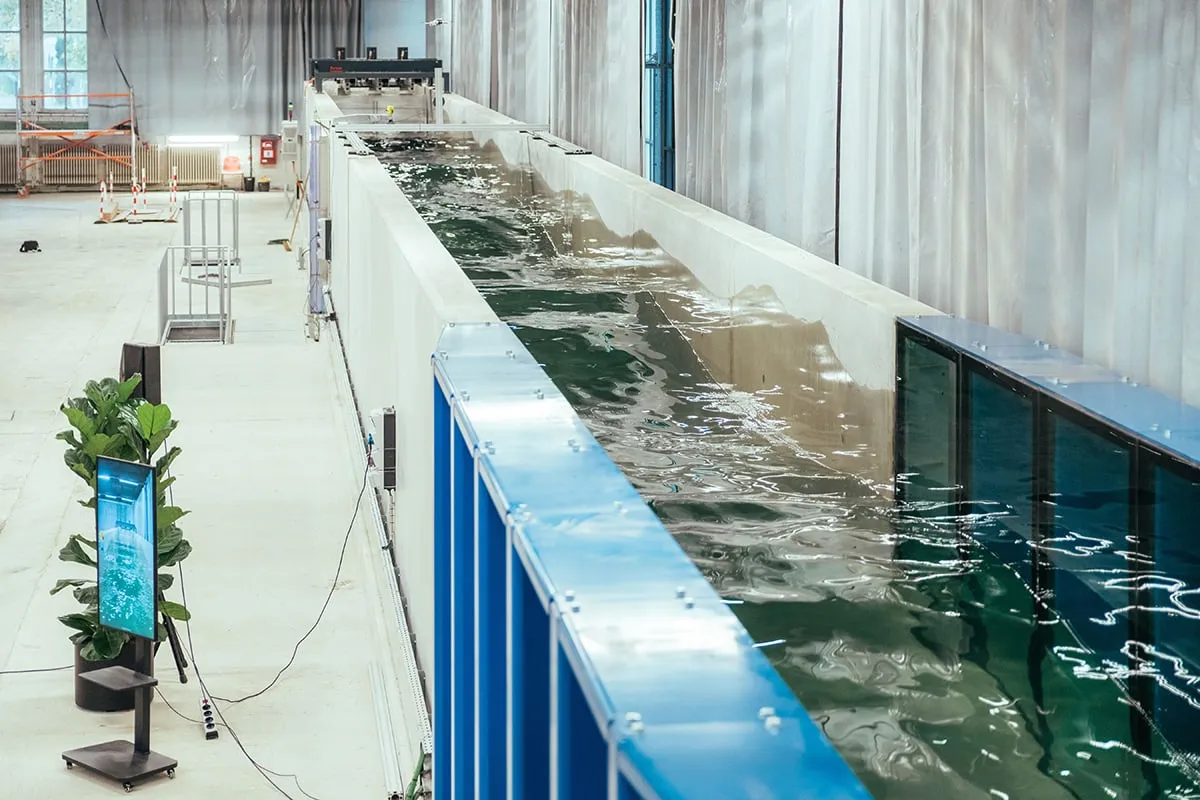
A wave flume is a long, narrow laboratory facility in which different types of waves are reproduced at scale using a computer-controlled wave generator. Researchers use a wave flume to test wave impact and overtopping on a scale model of a sea dike, breakwater, quay wall or other structure. The stability of dike revetments and harbour breakwaters, and erosion protection around the foundations of offshore wind turbines, can also be tested in a wave flume.
Extremely precise
The Flanders Hydraulic Research Laboratory already has two small wave flumes, each 41 metres long, 0.70 metres wide and 0.86 metres deep. The new wave flume is located at the headquarters in Antwerp and is larger: 84 metres long, 2 metres wide and 2.50 metres deep. The standard water depth is 1.50 metres. In the new wave flume, waves and structures can be simulated or built at a larger scale (up to approximately 1:10-1:15), leading to more accurate results. In addition, the new wave flume has been built to a level of precision exceeding the usual standards in the construction sector.
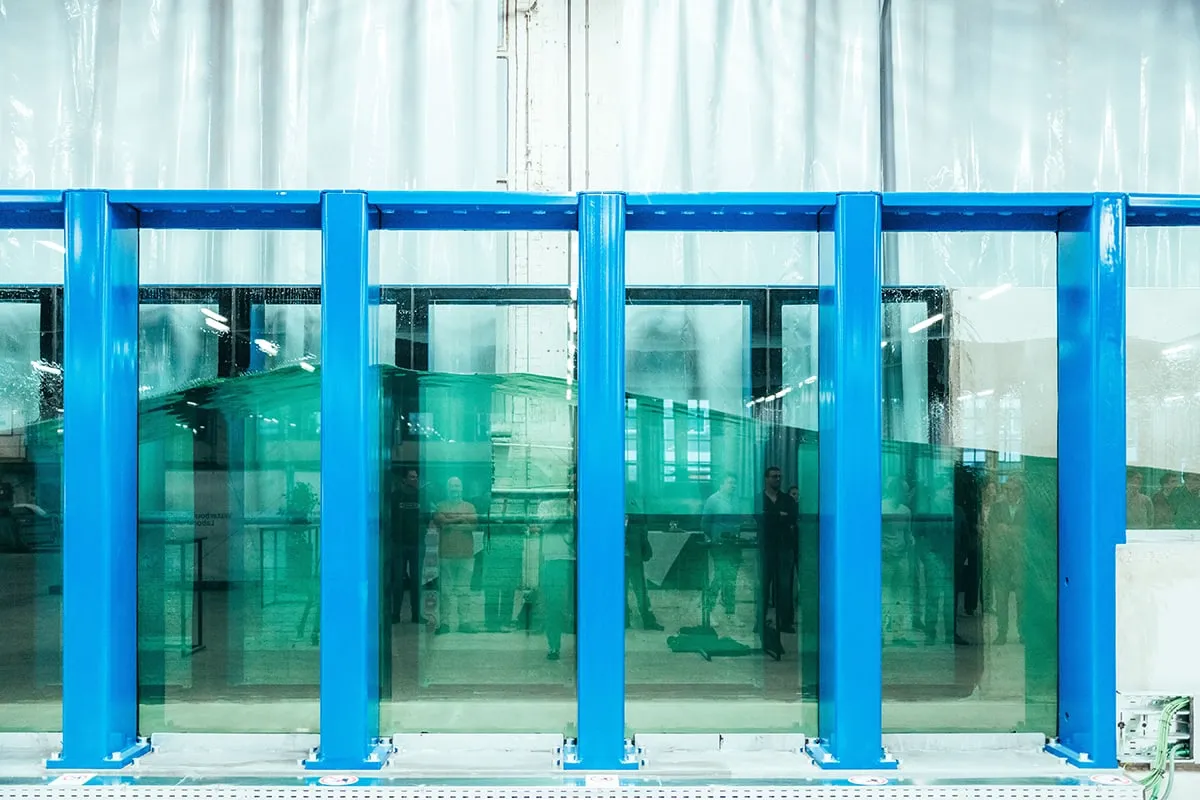
The wave flume was built by Consmema of Hattemerbroek (the Netherlands). The company used innovative technologies and bespoke solutions, including for the installation of 42-metre-long glass sections, specially designed for optical measurement methods such as Particle Tracking Velocimetry (PTV). This technique visualises water movement and accurately measures water velocities. The glass sections fit seamlessly against the concrete walls of the wave flume, giving researchers a better view of wave movement.
The wave generator was built by HR Wallingford of Oxfordshire (United Kingdom). It can move 2 metres forwards and backwards and generate waves up to 80 centimetres high. Its computer control can generate both regular and irregular waves and includes an integrated wave absorption system that simultaneously neutralises reflected waves. The wave flume also has a pumping system for automatic filling and draining, a modern wave generator and a raised platform with a control cabin that gives researchers an excellent view of the flume.

Wave flume opens the door
In the context of climate change and Kustvisie, the Flemish Government’s strategic policy plan to protect the coast from rising sea levels, the new wave flume could provide new insights. Under Kustvisie, the Flemish Government proposes moving the coastline an average of 100 metres seawards over the long to very long term. Dunes and dikes would then be raised and widened, while the beach would shift seawards to keep the hinterland dry as sea levels rise. A wave flume can be used to further investigate the impact of waves on ‘nature-based’ solutions, such as a dune, either on its own or combined with a dike.
Filip Boelaert, Secretary-General of the Department of Mobility and Public Works: “I am very proud of this impressive feat of innovation. The new, larger wave flume will allow us to map the impact of wave and water movements on sea dikes, harbour breakwaters, quay walls and other structures even more accurately. This opens the door to research into the impact of climate change and rising sea levels on our coast.”
The WL is also participating as a research partner in the European DuneFront project. As part of the project, the WL will carry out a test programme in the new wave flume in 2026. In time, the knowledge gained could be applied to adapt coastal defences to the effects of rising sea levels.
Question about this story? Ask your question
Keep following this
Get an email when a new story is published. No account needed.
- ProjectGolfgoot in het Waterbouwkundig Laboratorium
- ThemeStrengthening waterways and coastlines
- SubjectHydraulic engineering







