









New quay wall and cycle route along the Roeselare-Leie Canal in Izegem
Text Thierry PfleidererImage Herbosch-Kiere
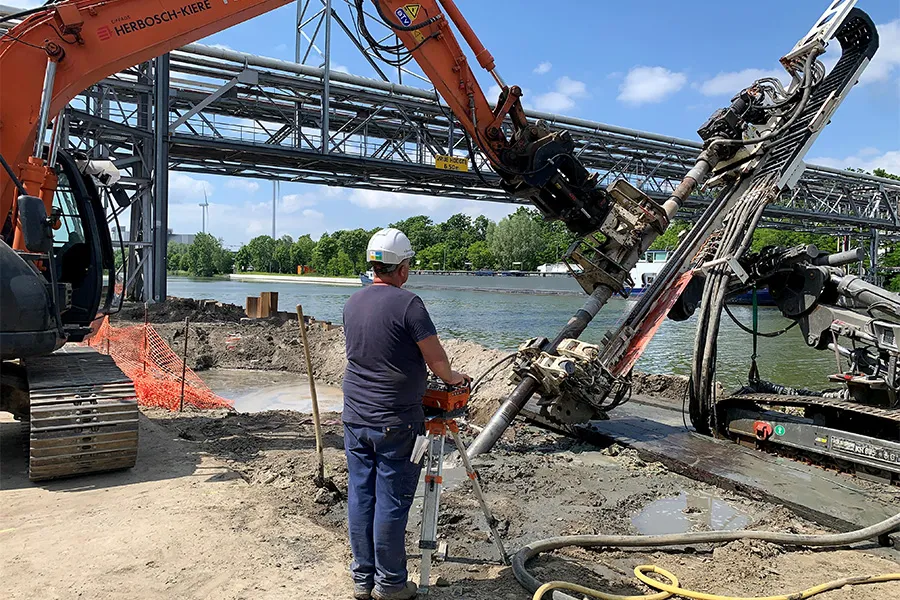
Herbosch-Kiere (Eiffage Group), a specialist in hydraulic engineering, dredging, offshore energy projects and foundation construction, has been commissioned by De Vlaamse Waterweg to build new quay walls and a cycle route along the Roeselare-Leie Canal in Izegem. It is a challenging project, but one that this experienced company is well equipped to handle.
The old masonry quay walls along the Roeselare-Leie Canal in Izegem date from 1918 and are founded on timber piles and groynes. Over the years, erosion and soil washing out between the timber sheet-pile screen have caused subsidence in many places.
3 phases
Koen Van Huffel, project manager at Herbosch-Kiere, explains that the entire project, which will take two years, is being carried out in 3 phases to maintain access to nearby businesses and homes. The main part of the work involves building a new 330 m-long quay wall. Once this is complete, work will begin on the F36 cycle route, which will run for more than 1 km alongside the canal.
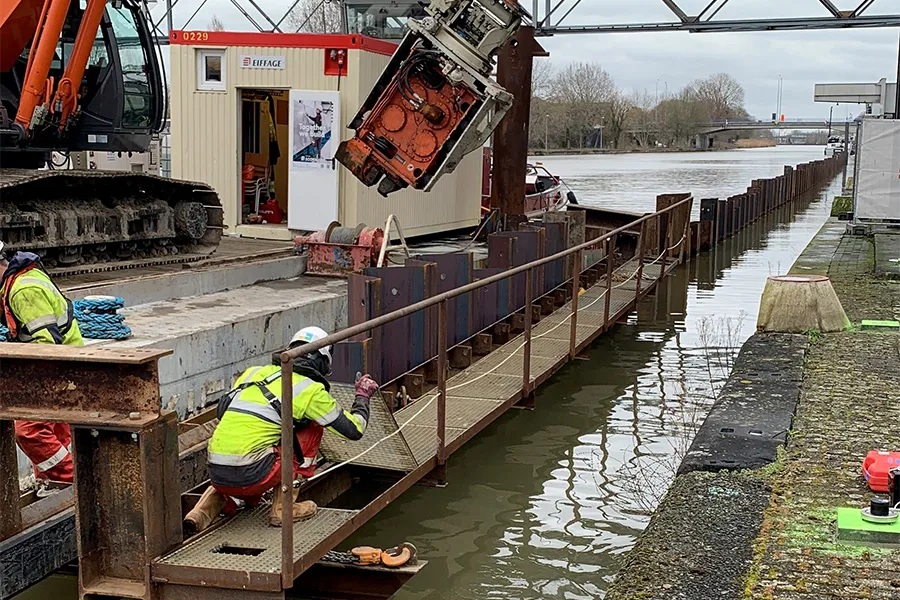
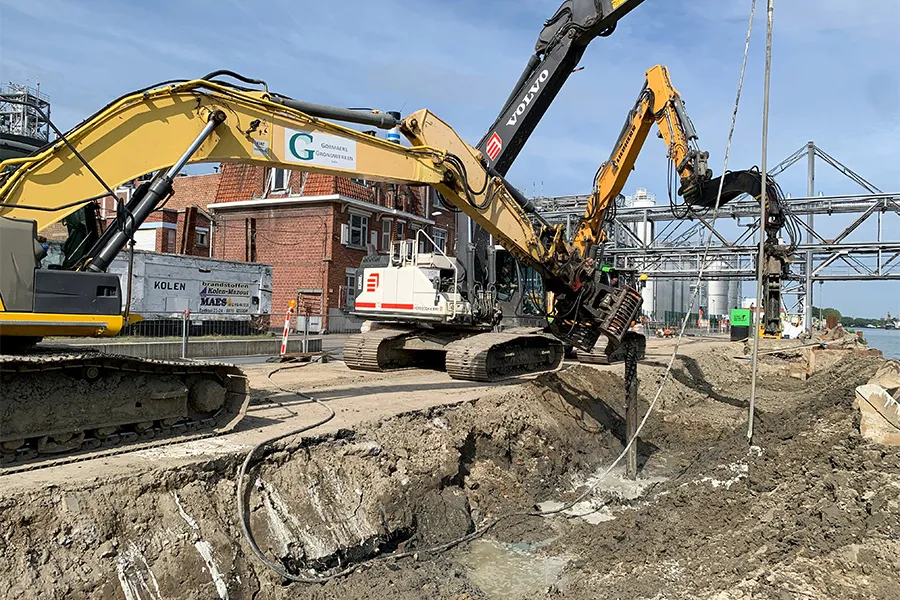
The first step is to demolish the old groyne and existing quay wall. The old tree trunks, used as piles at the time and buried deep in the ground, are loosened and removed using a crane fitted with a vibratory hammer. The resulting cavities are immediately filled with a grout mixture to prevent excessive ground loosening.
The next step in building the new quay wall is to drive in steel sheet piles, on which a new concrete capping beam will be built. New ground anchors will provide the new quay wall with its long-term stability.
Challenges
Building the quay wall presents the contractor with additional challenges at every stage. In the first phase, the team is investigating 3 pipeline bridges built by Cargill in 1960. The investigation assessed the impact of these bridges on the old quay walls and determined how to ensure the stability of the future pipeline bridges. It was soon decided to strengthen the existing foundations with micropiles. These steel drill casings are drilled into the ground in sections and filled with grout.
The second phase of the work involves pipe jacking a ‘siphon’ from the left bank to the right bank of the canal. This is needed to discharge overflow water into the nearby stream, ‘De Manel’, during heavy rainfall. A jacking pit will be built on the left bank and a reception pit on the right bank. From the jacking pit, special equipment will bore a passage beneath the canal bed towards the reception pit. As the boring progresses, concrete sewer pipes with a diameter of 1000 mm will be jacked through beneath the canal and connected at the same time.
In the third phase, the existing foundation of a heavy-duty loading crane alongside the VandenAvenne quay wall will be investigated. Here too, a thorough stability study will determine the best way to prevent this old foundation from subsiding. Herbosch-Kiere will again ensure a flawless result.
Dredging will then deepen the canal further for shipping. The bed will be protected with rubble stone covered in concrete. A specialist diving team will carry out this work.
Unknown factors
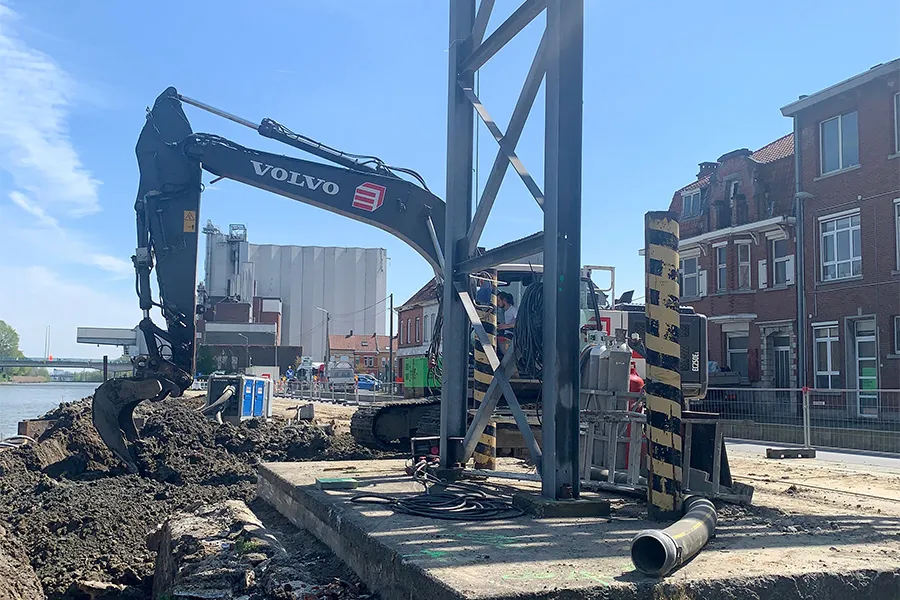
According to Koen Van Huffel, the total project has a budget of 4.5 million euros. Preliminary studies, investigations and preparations account for a significant share of the cost. Given the age of the existing quay wall and the presence of pipeline bridges and a heavy-duty loading crane belonging to Vandenavenne, unexpected situations are a frequent occurrence. Fortunately, Herbosch-Kiere has extensive experience with projects of this kind and can quickly find a solution.
Safety and minimising disruption to the local community are central
At Herbosch-Kiere, the safety of employees and respect for the surrounding area come first. At the start of each project, the client appoints an external health and safety coordinator. Herbosch Kiere always aims to foster good cooperation and a relationship of trust between all parties involved: contractors, designers, clients, businesses and local residents.
Before work began, a condition survey was carried out of the public realm and nearby buildings. To prevent vibration damage during pile driving, the company continuously monitors vibration levels so that it can intervene in good time. “We are confident that, together with our motivated team, we will successfully complete this project within the agreed timeframe,” concludes Koen Van Huffel. ■
Een zakelijke vraag aan Herbosch-Kiere? Get in touch
Companies in this story

Keep following this
Get an email when a new story is published. No account needed.
- ThemeFuture-proofing roads and railways
- SubjectHydraulic engineering
- CompanyHerbosch-Kiere







