









Thousands of micropiles support the modernisation of line 162
Text Philippe Selke Beeld Franki Foundations
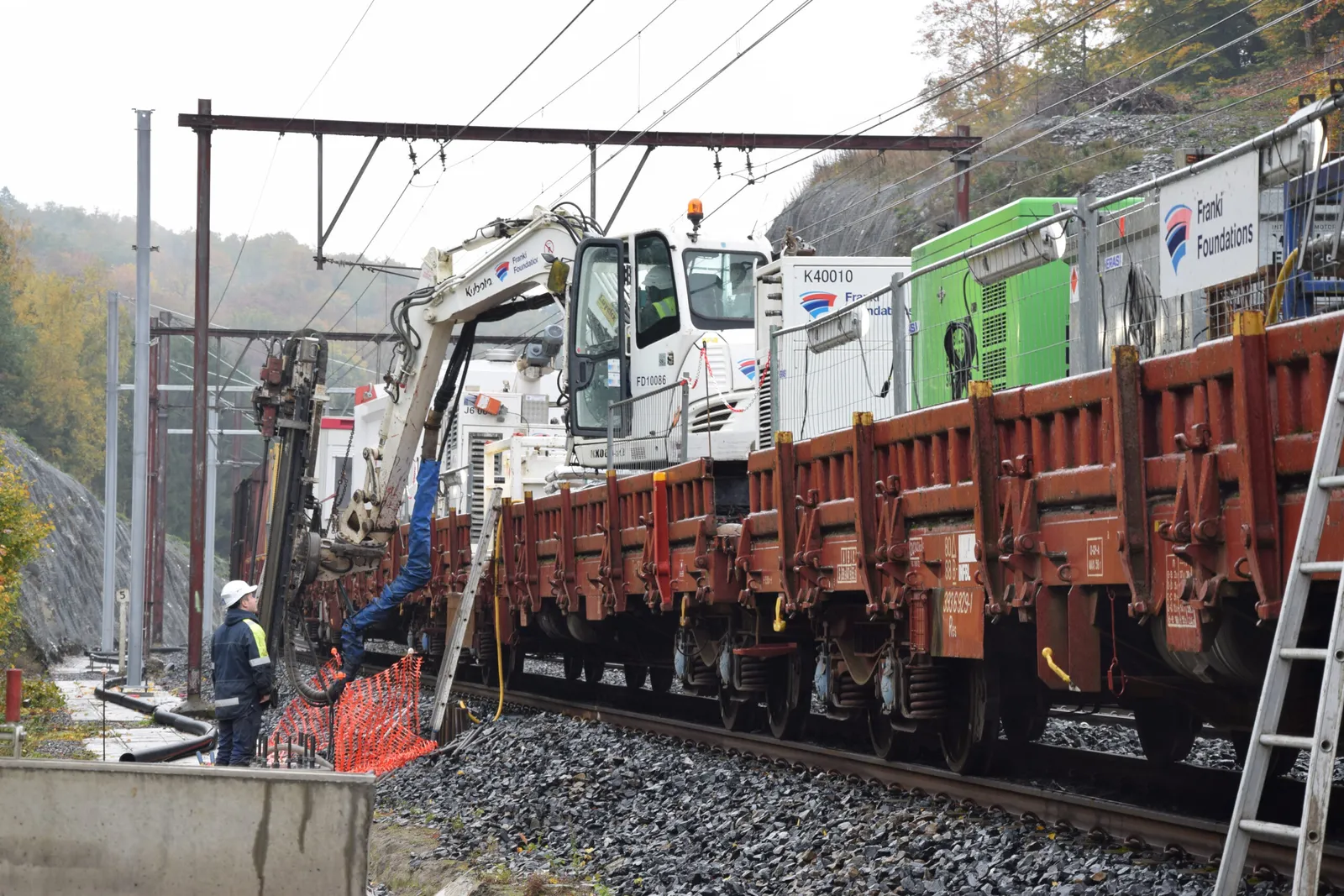
Line 162, linking Namur via Arlon to the Luxembourg border, is part of a major modernisation programme being carried out by Infrabel as part of the “As 3” project between Brussels and Luxembourg. The work involves renewing the railway infrastructure, modernising the electrical installations and improving the line’s performance. Franki Foundations is working on several sections of the project as a subcontractor to SOCOGETRA. The company is installing the foundations needed for the new overhead line equipment and technical cable troughs, work that will be invisible once complete but is essential to the long-term durability of the railway infrastructure.
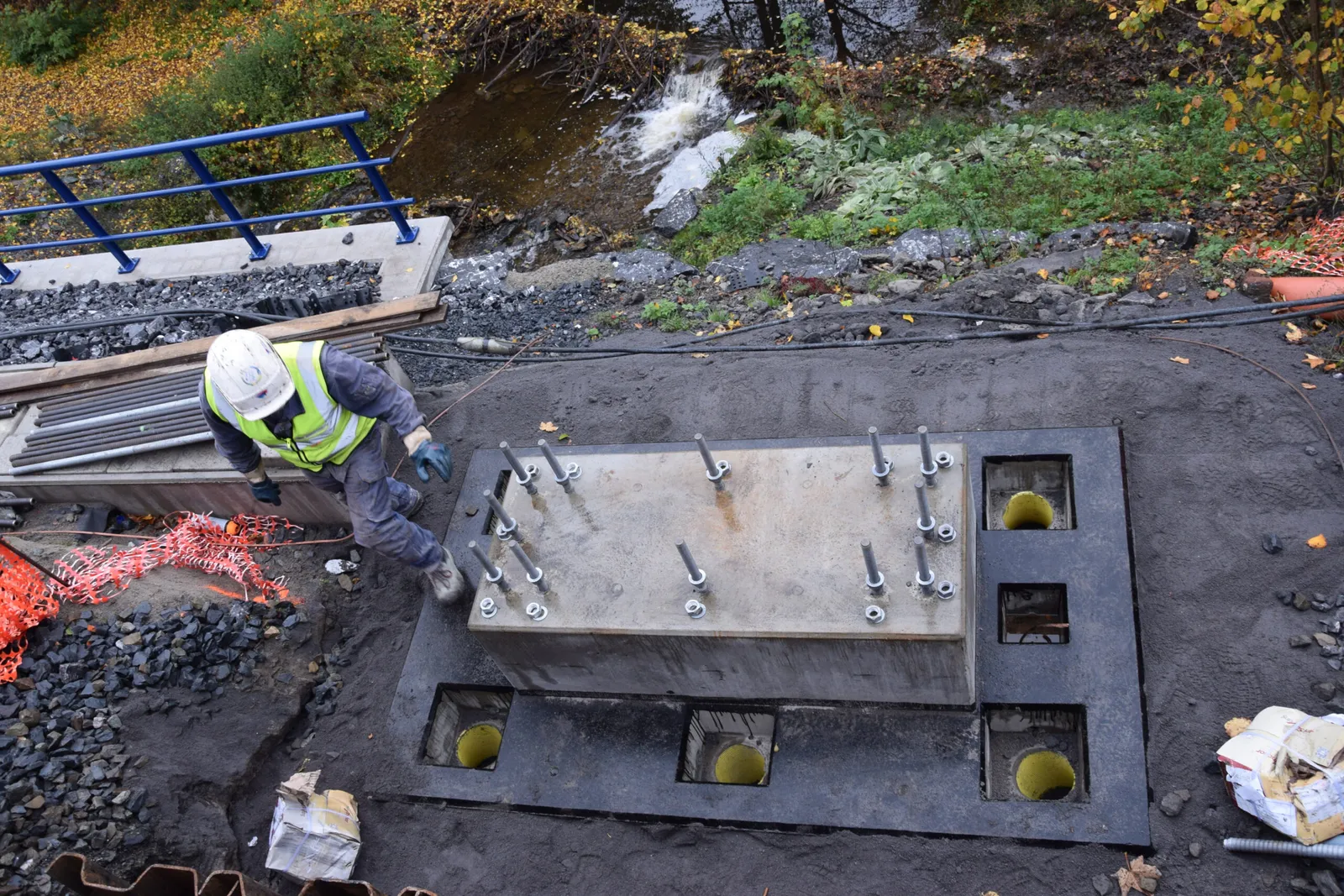
“Our work involves drilling micropiles to support the foundations for the new overhead line equipment and the technical cable troughs on either side of the track,” explains Olivier Vancoppenolle, Project Manager at Franki Foundations.
The troughs house the cables and conduits needed for railway operations. Each prefabricated section rests on a micropile. Depending on the loads to be supported, between three and seven micropiles are required for the overhead line equipment foundations. Franki Foundations drills through the designated openings in the concrete blocks installed beforehand.
Over three years, Franki Foundations installed around 1,000 micropiles for the overhead line equipment along the section between Grupont and Hatrival, working in parallel with other sections. This involved almost 9,500 m of drilling. The team also installed around 3,250 micropiles for the technical cable troughs, requiring almost 10,000 m of additional drilling.
A mobile worksite
The work is carried out from a work train comprising a locomotive and several wagons housing all the necessary equipment. “The locomotive positions the train exactly where a micropile needs to be drilled. We carry out all the work directly from the train, without unloading the equipment,” explains Olivier Vancoppenolle.
This set-up enables efficient work on a double-track railway, with only one track closed at a time. The drilling team comprises four people: a drilling operator and three assistants responsible for supplying materials and monitoring the work. The work is part of a complex schedule in which several specialist companies take turns working on the same section.
Continuous adaptation to ground conditions
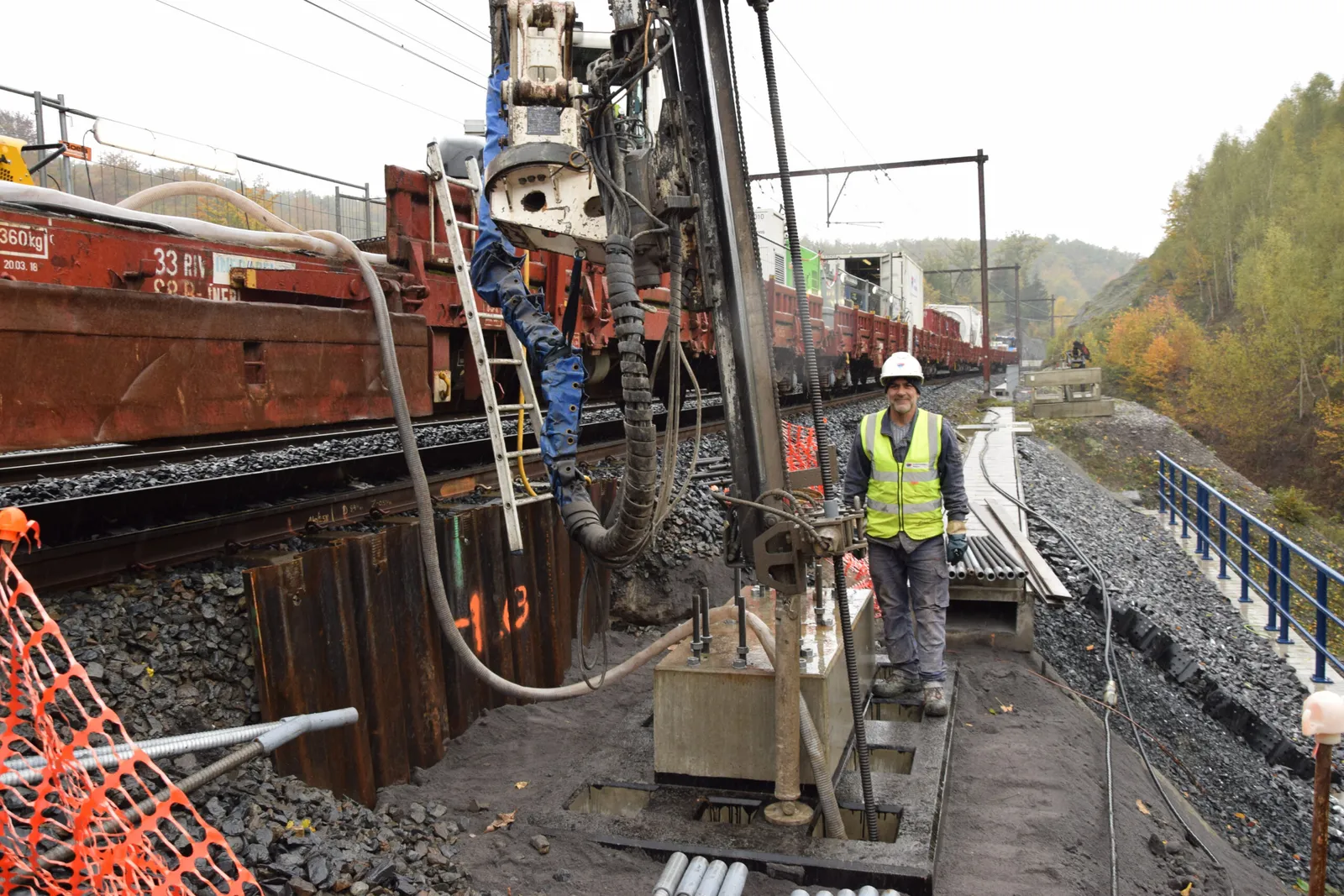
The main technical challenge is the presence of old railway embankments, whose thickness varies considerably from one section to another. For the overhead line equipment, the aim is to anchor the micropiles in rock to ensure the stability of the future installations.
Despite the geotechnical surveys carried out beforehand, the teams regularly have to adjust drilling depths to suit the actual conditions on site. “We adjust the length of the micropiles according to what we encounter during drilling. The contrast between the railway fill and the rock is clearly perceptible to the operator,” says Olivier Vancoppenolle. With self-drilling micropiles, this flexibility is possible because drill rods are added incrementally and then left in place as permanent reinforcement.
Safety and keeping to schedule
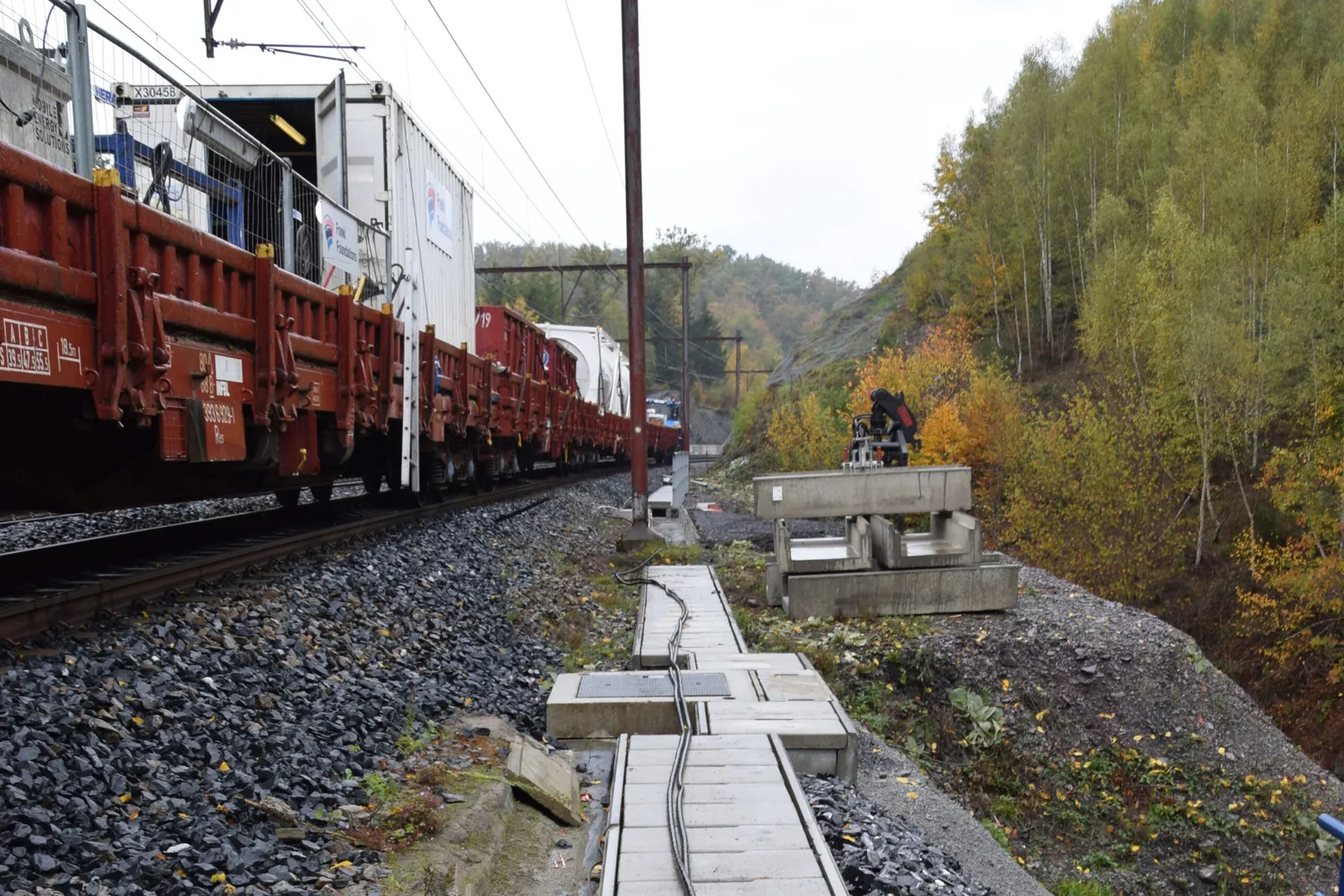
Working in a railway environment also entails strict safety requirements. The teams are specially trained to work near operational tracks, and the equipment is adapted to prevent any risk of encroaching on the open track. In addition to these restrictions, the schedule is particularly tight. “Track possessions are planned well in advance by Infrabel. The work must be completed within these time windows,” stresses Olivier Vancoppenolle.
Franki Foundations has been working on various sections of line 162 for almost ten years and continues to work on new sections. A modest but essential contribution to the gradual modernisation of this strategic railway line.
Question about this story? Ask your question
Keep following this
Get an email when a new story is published. No account needed.
- ThemeFuture-proofing roads and railways
- SubjectGeneral







