









New contactless and mobile technology measures forces on inland vessel during lockage
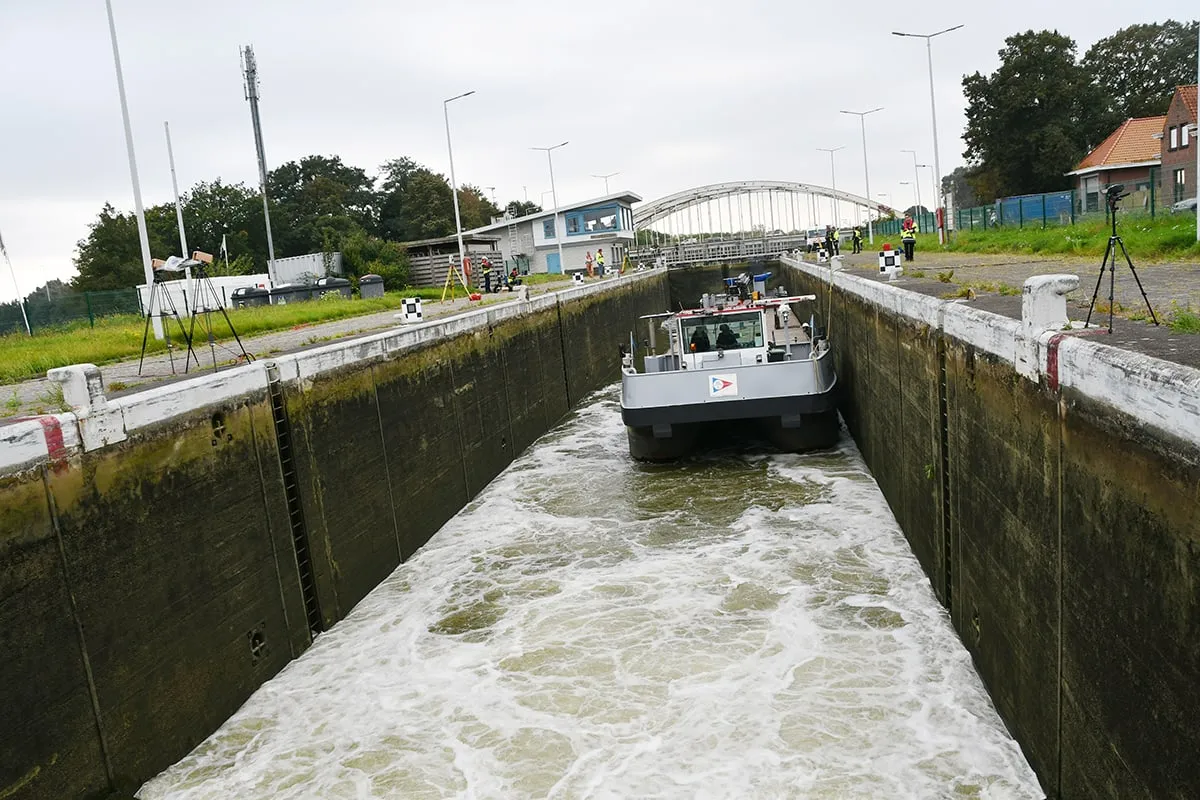
Experiment in Viersel lock delivers highly accurate measurements
Two new contactless and mobile measurement systems can measure the forces on an inland vessel during lockage with great accuracy. This is demonstrated by the results of experiments carried out by the Flanders Hydraulics Research (WL), part of the Department of Mobility and Public Works (MOW), in autumn 2023 in Viersel lock. The two technologies were tested in a proof of concept: the first used photogrammetry and the second an infrared-signal setup. The experiment was carried out in collaboration with Apixa, Iv-Infra and De Vlaamse Waterweg nv (DVW), with support from the Flemish Government’s Innovative Public Procurement Programme (PIO).
Jeroen Vercruysse, project leader at Flanders Hydraulics Research: “In this experiment, we investigated how innovative technology can be used to optimise the safety and efficiency of Flemish locks and improve the flow of shipping. Now that the final report is complete, we are very pleased with the results, which are as accurate as, or even more accurate than, the reference measurements. Together with De Vlaamse Waterweg, we are now considering the options for an operational measurement system.”
Forces during lockage
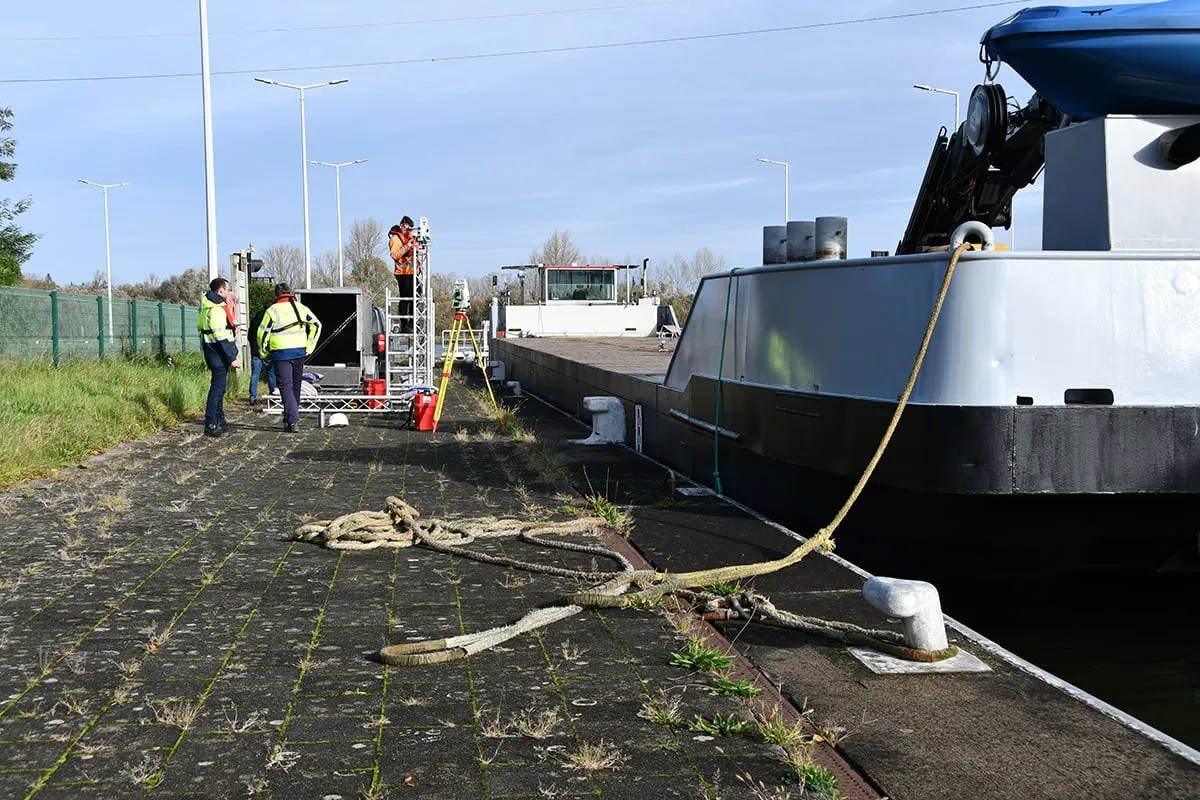
When a vessel needs to enter a reach of a canal or river with a higher or lower water level, it does so through a lock. This process is also known as ‘lockage’. During lockage, a vessel is subject to forces caused by water flowing in or out, or by water moving within the lock chamber. The vessel is therefore secured with mooring lines or thick cables. It is important that these forces remain within safe limits, as the lines could otherwise break. For this reason, WL, a NeXperta division of the Department of Mobility and Public Works (MOW), investigated whether and how contactless and mobile measurement technology can accurately measure the forces on a vessel during lockage.
Proofs of concept using photogrammetric measurement and infrared signals
Together with delivery partners Apixa and Iv-Infra, WL developed two proofs of concept using different methods:
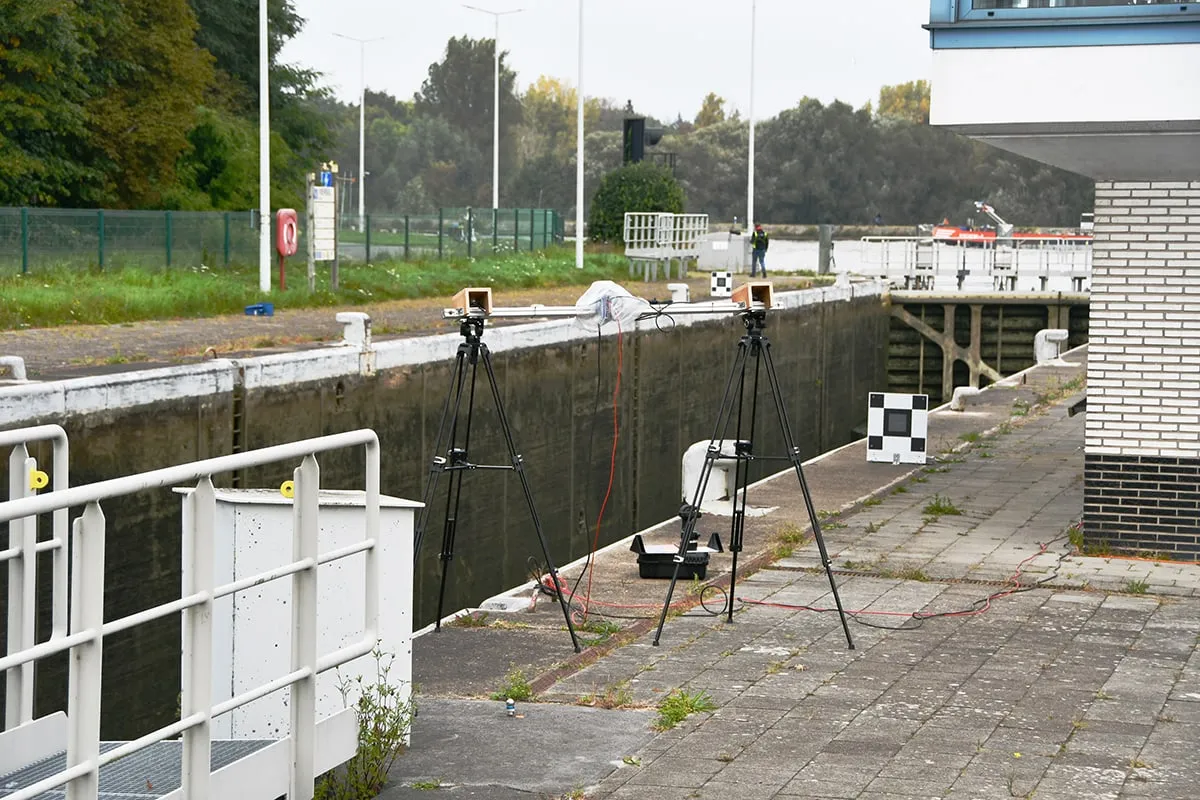
- Apixa carried out a photogrammetric survey of the vessel’s bow and stern. Four cameras tracked different points on the bow and stern over time, making it possible to measure the vessel’s movement accurately.
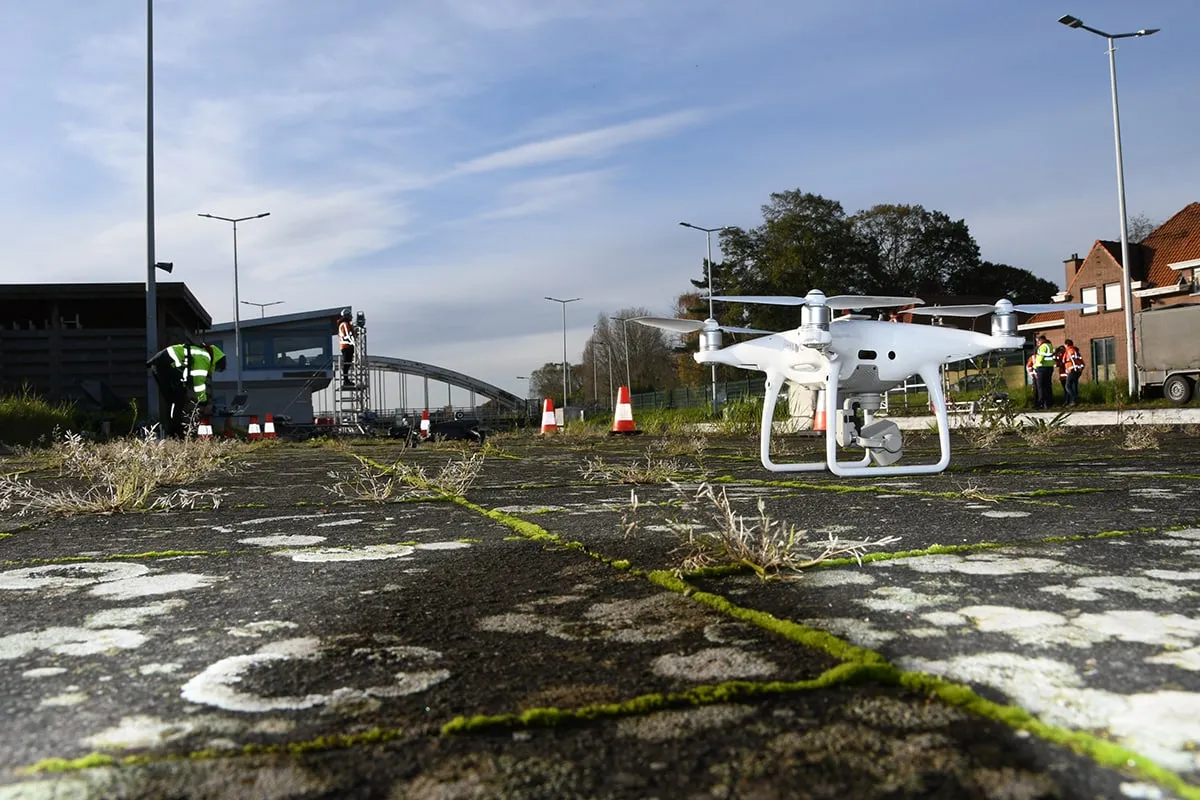
- Iv-Infra used drones to place prisms on the vessel. The exact position of these prisms was measured during lockage using infrared signals emitted by total stations on the quay. The total stations continued to track the signals over time.
In each case, researchers were able to measure a vessel’s movements and inclinations in a lock chamber during lockage efficiently and safely from the quay. These movements and inclinations are a good indicator of the forces acting on a vessel.
Experiment in Viersel demonstrates the potential of the technologies
After both systems were successfully tested in a simulated setting in spring 2023, the actual proof of concept took place in autumn 2023. Measurements were carried out in Sluis van Viersel, which connects the Albert Canal to the Netekanaal, in collaboration with De Vlaamse Waterweg nv, on a vessel operated by Blue Line Logistics.
The results from the measurement systems were compared with reference measurements taken at the same time. The final report has now been published. The evaluation shows that the quality of both measurement systems is comparable to, or even better than, that of the reference measurements.
Furthermore, it had been expected that a full photogrammetric survey would require a very complex setup and AI-supported processing, which was beyond the scope of a proof of concept. However, Apixa’s setup demonstrated that an efficient solution is possible.
Long-term potential
As a next step, WL and DVW will consider the options for an operational measurement system. Filip Boelaert, Secretary-General of the Department of Mobility and Public Works: “Both systems put Flemish expertise in locks on the world map. This innovative measurement system offers significant added value for validating and optimising our Flemish locks, and could also play an important supporting role in remote, unmanned and smart lock operation. This methodology would also add significant value to the development of new models and the updating of criteria.”
Innovative Public Procurement Programme
Flanders Hydraulics Research was able to rely on support from the Innovative Public Procurement Programme (PIO) at VLAIO (Agency for Innovation and Entrepreneurship) to develop this measurement infrastructure. Through innovative public procurement, PIO creates additional opportunities to renew the operations of the Flemish public sector and provide innovative responses to numerous societal challenges, working together with businesses and research centres.
“Flemish public authorities can use their purchasing power strategically to commission the development of innovative solutions and create market opportunities for businesses. This gives businesses their first customer experience and the opportunity to test and refine their new technologies and, if successful, scale them up and bring them to market. A win-win situation,” says Mark Andries, Director-General of VLAIO.
Question about this story? Ask your question
Keep following this
Get an email when a new story is published. No account needed.
- ThemeStrengthening waterways and coastlines
- SubjectHydraulic engineering







