









Major lock project showcases steel contractor’s versatility
Text Philippe SelkeImage TMI / SOFICO
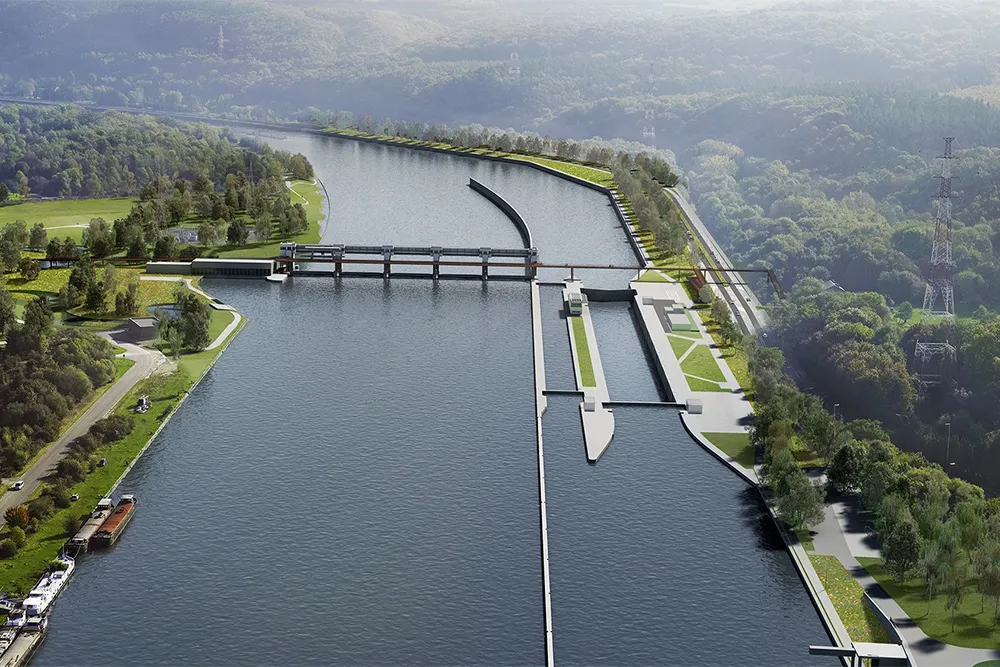
Since 2019, steel contractor Techno Métal Industrie (TMI) has been involved in an exceptional project, both in terms of its duration and the scope of the contract. It brings together several of the Walloon company’s specialist fields: the manufacture and installation of lock gates, a footbridge, metalwork (railings), steel building structures and mechanically welded components. Grégory Cimino, project manager at TMI, explains the metalworking involved in widening the Ampsin-Neuville lock. The new infrastructure is scheduled to enter service in the first quarter of 2024.
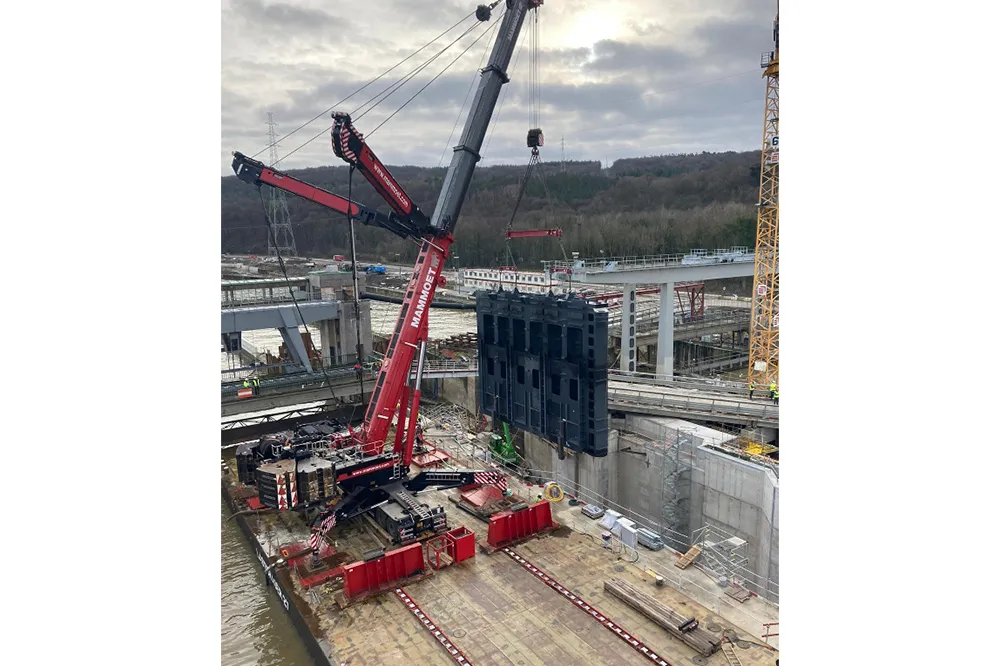
Following the refurbishment of the locks at Grands Malades (Namur), Andenne-Seilles, Ivoz-Ramet and Lanaye, this project is the final missing link in improving navigability on the Meuse between Namur and Liège. Each lock site must include a lock chamber at least 225 m long and 25 m wide. At Ampsin, the works were carefully phased to minimise disruption to shipping: first, a new medium-sized lock (E2) was built alongside the existing lock; the latter was then demolished and replaced with a new large lock (E1).
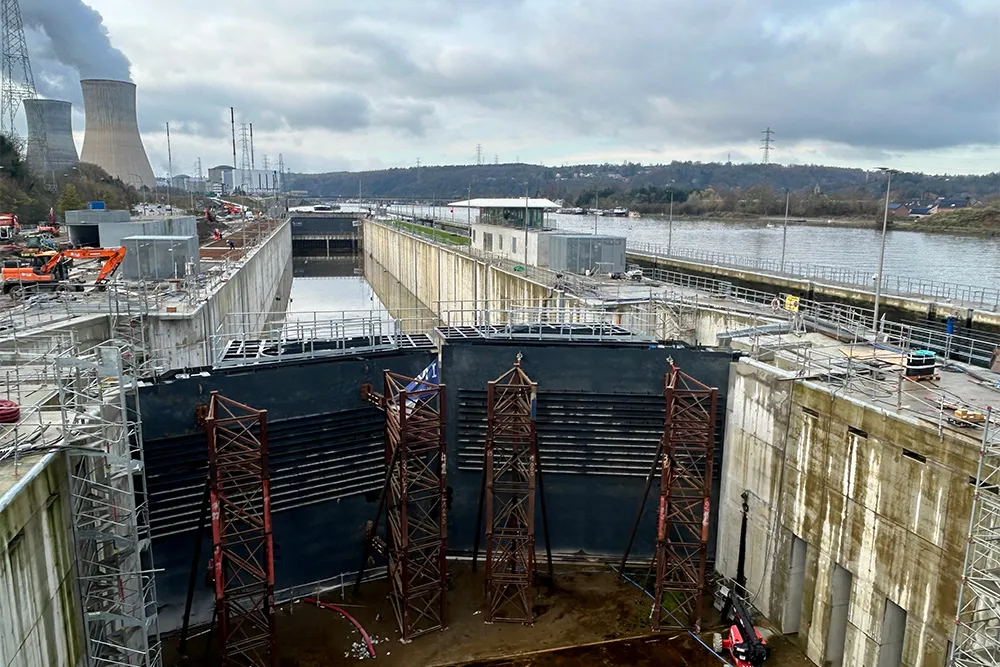
In this context, the work entrusted to TMI by TM Duchêne-Franki on behalf of SOFICO went beyond manufacturing and installing the four lock gates: two single-leaf gates installed upstream and downstream of lock E2 in 2021, a mitre gate and a flap gate installed for the large lock E1 in May 2023. The contract also covered a cycle and pedestrian bridge over the Meuse, the steel structure for the control building and four technical pavilions, 2.3 km of railings and the gate hinges.
Heavy work
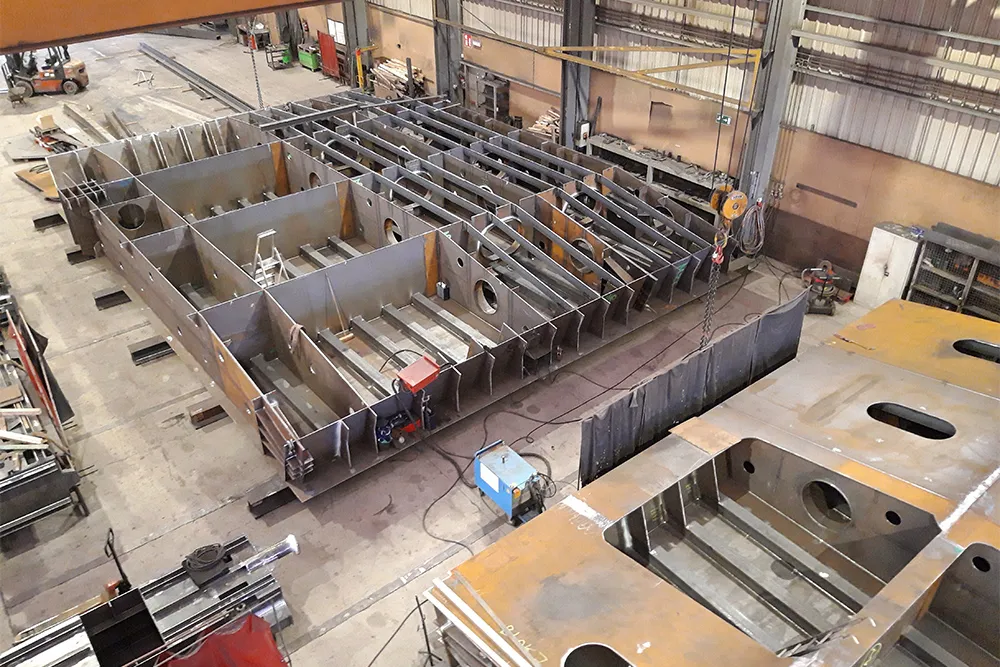
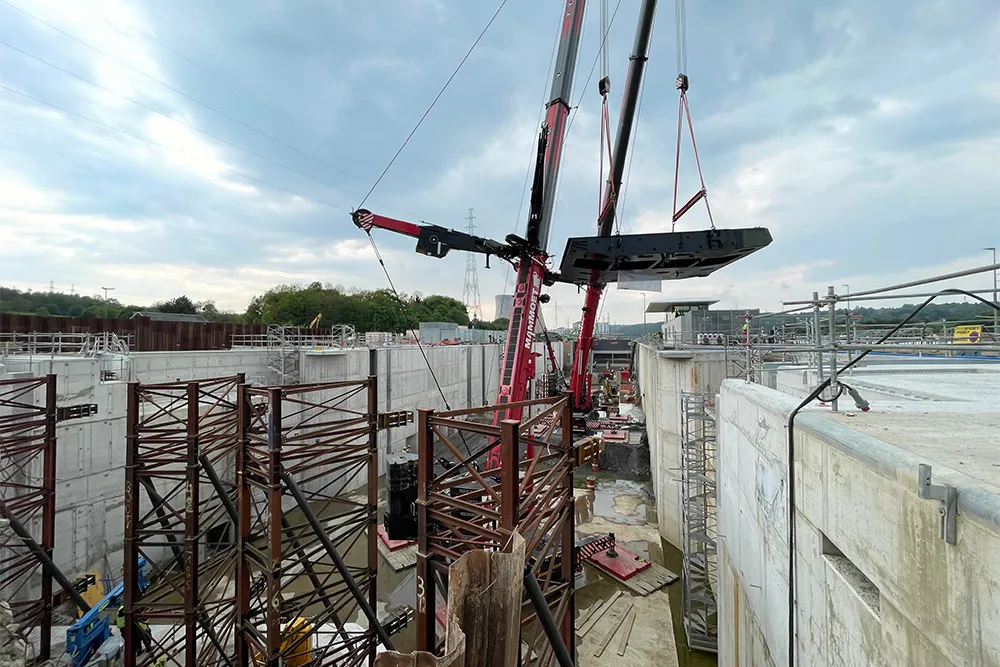
As Grégory Cimino explains, manufacturing and installing the various lock gates and their hinges was the biggest challenge. “Whether flap gates or mitre gates, each gate weighs 90 tonnes. They were all manufactured at our workshops in Seilles before being transported to the site by water. The gates for lock E2 were installed using a crane mounted on a pontoon, which is unusual, as the gates for lock E1 were installed using two cranes positioned inside the lock chamber itself.”
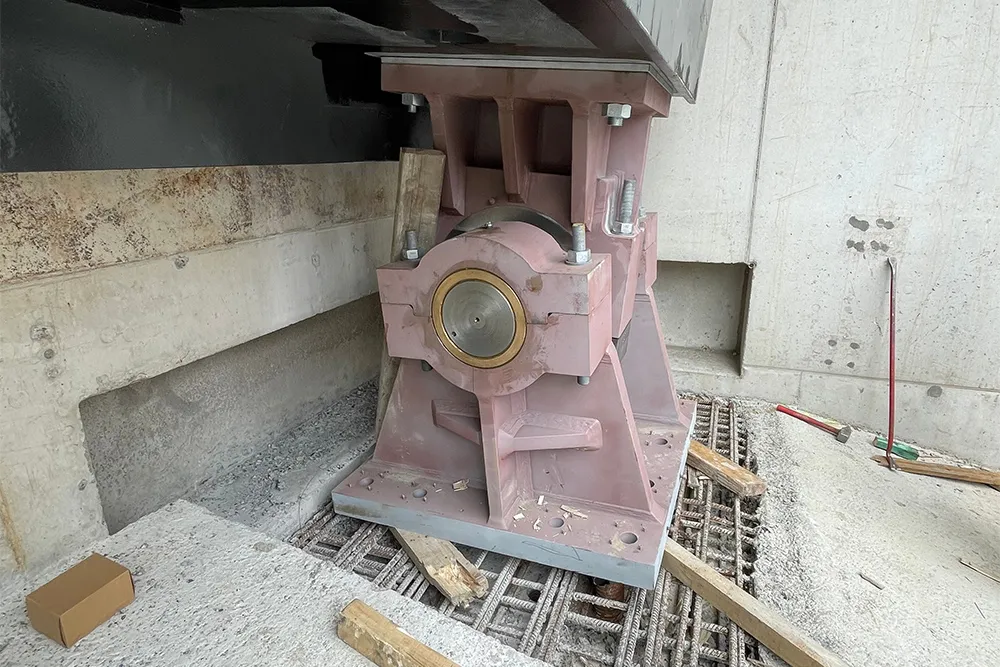
Although the lock gates presented no particular technical challenge despite their exceptional dimensions, with each leaf of the mitre gate measuring 15 m long and 10.5 m high, the same cannot be said of their hinges and the connections to the hydraulic rams. Each type of gate operates differently: the flap gate, for example, pivots underwater on hinges at the bottom, allowing boats to pass over it. The gates were modelled by engineering consultancy Tractebel, which supported the client throughout the project, while TMI carried out all the mechanically welded work on the hinges, which are due to be installed at the end of 2023. Grégory Cimino says: “We’re close to a thousand pages of calculation notes, with every component checked for both static strength and fatigue resistance so that it can withstand 400,000 wear cycles. The connection between the mechanical components and the metal structure is the most delicate part of the project, since the gates themselves normally pose no risk at all. Don’t assume that something gets more complex simply because it is bigger and heavier …”
Steel footbridge, railings and building structures
The 620-metre cycle and pedestrian bridge connects the right and left banks of the Meuse, crossing the N90, the lock, the dam and the fish ladder. It was manufactured at TMI’s workshops. Installation began in 2020 and is now being completed with the welding of the final sections.
The footbridge is made of Corten steel, primarily for aesthetic reasons, and weighs no less than 1,200 tonnes. Stairways lead down to the quays and up to the control building. In a sense, the latter is the site’s control tower. TMI built its steel structure, as well as those of the four small technical buildings housing the hydraulic ram systems. Finally, TMI was also responsible for installing more than 2,300 metres of galvanised railings along the locks, of which around 200 m are still to be installed.
The specific phasing meant that the work was carried out in sequence rather than by type. For example, the technical pavilions and railings had to be completed according to the schedule for lock E2 entering service, with lock E1 to follow afterwards. This left Grégory Cimino with a huge amount of coordination to handle, acting as the link between the client and TMI’s various internal departments. He has the final word: “This is one of the biggest projects since TMI was founded. Installing all the lock components cost me a few sleepless nights, but in the end everything went smoothly. The experience we have gained on this project will be invaluable for future work!”
Question about this story? Ask your question
Keep following this
Get an email when a new story is published. No account needed.
- ThemeStrengthening waterways and coastlines
- SubjectHydraulic engineering







