De Vlaamse Waterweg nv clears dwarf duckweed with innovative ‘waterbull’
Since late August, a significant amount of dwarf duckweed has been present on the IJzer and the Ieper-IJzer Canal. De Vlaamse Waterweg nv has developed an innovative ‘waterbull’ with contractor Braet nv to clear the duckweed.
Invasive alien species
Dwarf duckweed is an invasive alien species from America that has been found on our waterways for several years. It is visible as a green layer floating on the water and is not native to Flanders.
In autumn, the plant stores starch, increasing its specific weight, and then sinks to the bottom to overwinter before resurfacing in spring. It thrives in warm, nutrient-rich water that is still or slow-moving. Given the hot summers, it is no surprise that dwarf duckweed is becoming increasingly common on our Flemish waterways.
Innovative ‘waterbull’
Several machines have already been built in the Netherlands in response to similar problems. Following a thorough study, the waterway authority decided to combine these existing technologies with the contractor to create the ‘waterbull’.
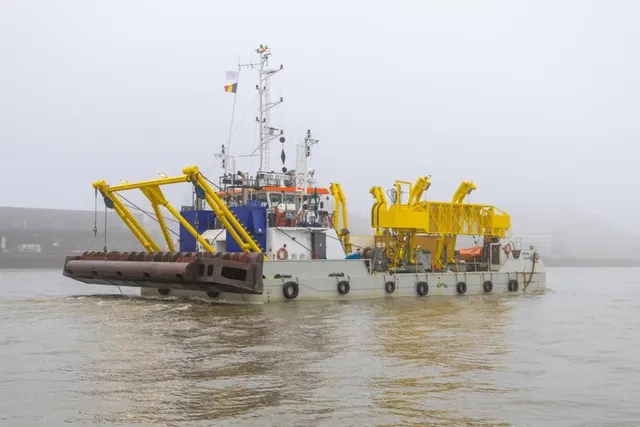
The ‘waterbull’ consists of a powerful boat fitted with collection plates at the bow. These plates gather the dwarf duckweed together. Because it physically resembles a conventional bulldozer, the invention was dubbed the ‘waterbull’.
The water scoop is 1m high and consists of three identical sections, each 2 metres wide. The angled outer sections allow around 6 metres of the navigation channel to be cleared at a time. The whole assembly can be adjusted in height using an electric winch, to collect as much dwarf duckweed as possible. The structure was developed in the workshops of Braet nv, a contractor based in Nieuwpoort and a member of Vlaamse Waterbouwers.
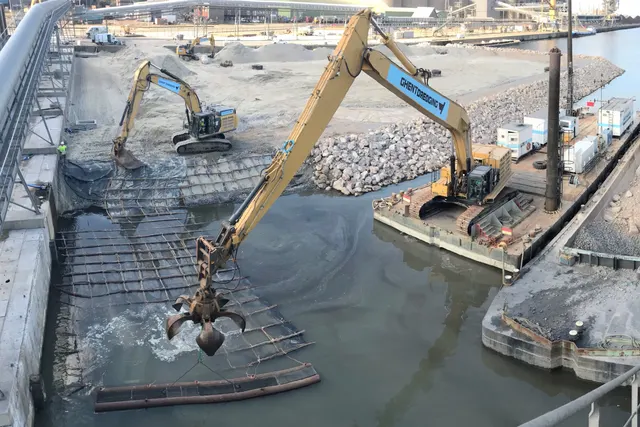
Once the ‘waterbull’ has finished its work, an excavator scoops up the gathered duckweed, which is then taken in waste containers to a processing plant.
Successful pilot project
The first clearance operations with the ‘waterbull’ have already proved successful. In just two weeks, De Vlaamse Waterweg nv removed no less than 50 tonnes of dwarf duckweed. Around 1,500 kg of duckweed floats on an area of water the size of a football pitch, so the amount cleared would have covered around 33 football pitches.
As dwarf duckweed can overwinter on the bottom, systematic mechanical removal is currently the only worthwhile long-term solution, and the ‘Waterbull’ appears to be ideal for the job. Want to see exactly how De Vlaamse Waterweg nv operates and what the ‘waterbull’ looks like? Watch the first footage of this innovative tool in action here.
A solution for other alien species too
The ‘waterbull’ is not only effective against dwarf duckweed: the mesh size of the collection plates can easily be adjusted to remove other invasive alien species as well. The latest invasive species to be spotted is watercrassula, an aquatic plant with a completely different structure from dwarf duckweed, but no less harmful. This plant was also removed from the water during clearance operations with the ‘Waterbull’, along with the dwarf duckweed. The machine is therefore versatile, enabling De Vlaamse Waterweg nv to remove even more invasive alien species from Flemish waterways in the long term.
Question about this story? Ask your question
Keep following this
Get an email when a new story is published. No account needed.
- ThemeStrengthening waterways and coastlines
- SubjectHydraulic engineering