









Construction of overflow dyke in Wal-Zwijn flood control area takes shape
Text Niels Rouvrois Beeld Herbosch-Kiere
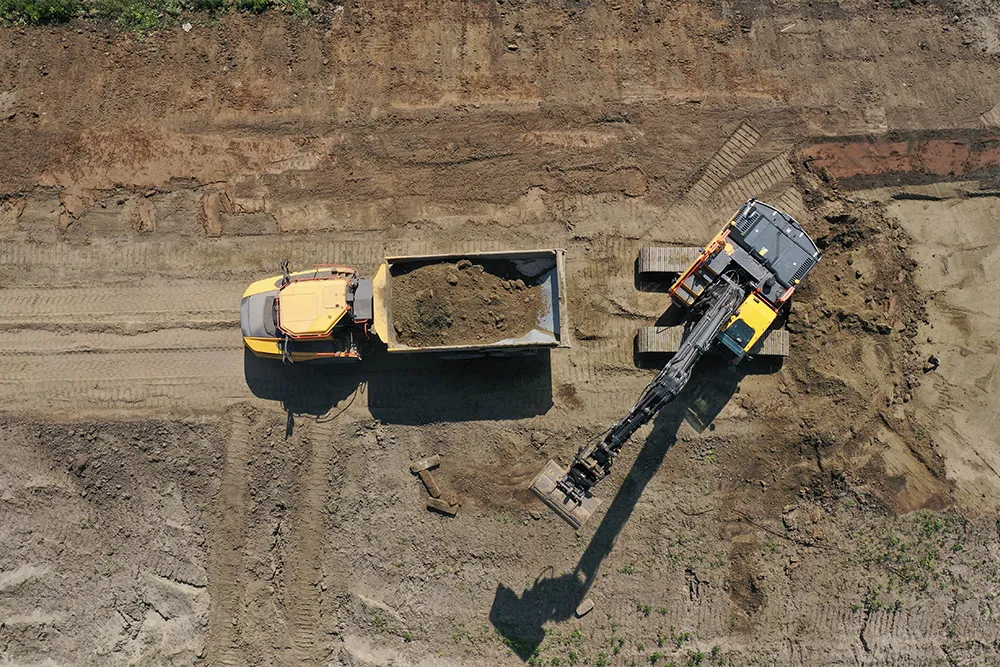
De Vlaamse Waterweg began construction of the overflow dyke in the Wal-Zwijn controlled flood area in February. Following the earlier completion of the ring dyke, work is now nearing completion on the flood area's inlet and outlet sluice. Meanwhile, phase 3, construction of the overflow dyke, is also well under way. For both phase 1 (ring dyke) and phase 3 (overflow dyke), De Vlaamse Waterweg drew on the expertise of experienced water engineering contractor Herbosch-Kiere.
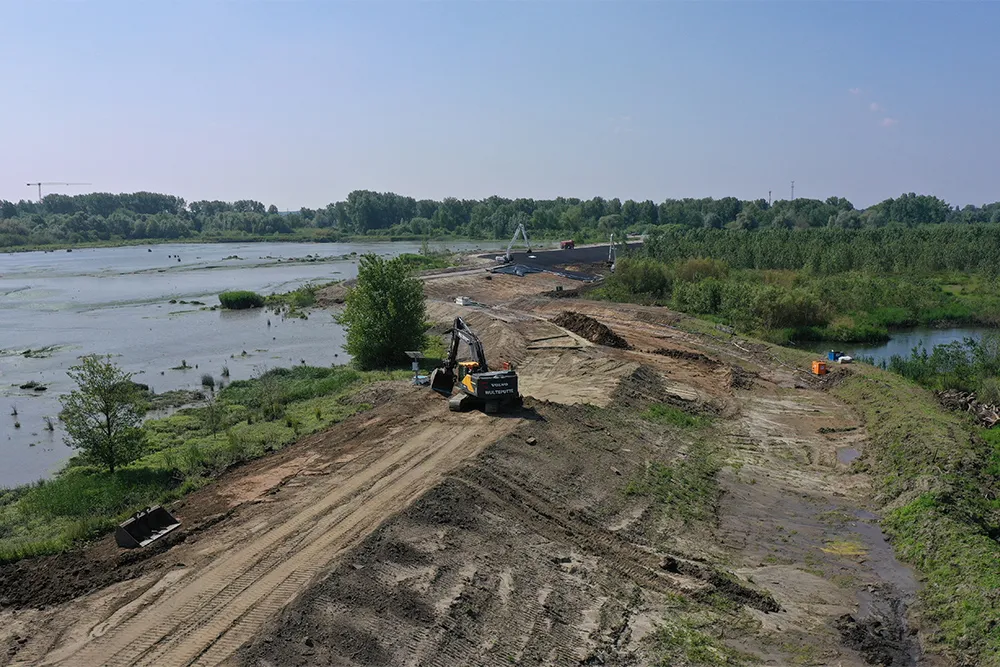
The area around Hamme has long been highly prone to flooding. De Vlaamse Waterweg is changing that by giving the Scheldt more room to flow in and out at Wal-Zwijn. The Wal-Zwijn controlled flood area and the previously created Groot Schoor depoldering area will store excess water during storm tides. A ring dyke was built along the western edge of the Wal-Zwijn controlled flood area during an earlier phase of the works, to keep the villages, fields and grassland further inland dry.
“The ring dyke holds back water flowing into the flood area during storm tides,” says Geert Baert, project manager at Herbosch-Kiere. “The ring dyke was completed in 2021. Construction of the inlet and outlet sluice was not part of our contract, but Herbosch-Kiere is carrying out phase 3, construction of the overflow dyke.
So we are still making a substantial contribution to this project.”
Work is now nearing completion on the inlet and outlet sluices for the controlled flood area with reduced tides (GOG-GGG). In a GOG-GGG, a small amount of Scheldt water flows into and out of the area twice a day through the inlet sluices, in time with the ebb and flow. This creates a landscape of valuable mudflats and salt marshes, which help combat the effects of climate change.
GOSA
Some trees had to be felled to make way for the new overflow dyke, as it will be wider than the existing steep dyke. Once the area is operational, Scheldt water will flow in and out daily, in time with the ebb and flow. This will create highly valuable tidal habitats. “We started clearing the woodland in February, and from mid-March we began removing the old towpath,” says Joran Haegebaert, site manager at Herbosch-Kiere. “We then started the earthworks for the overflow dyke.”
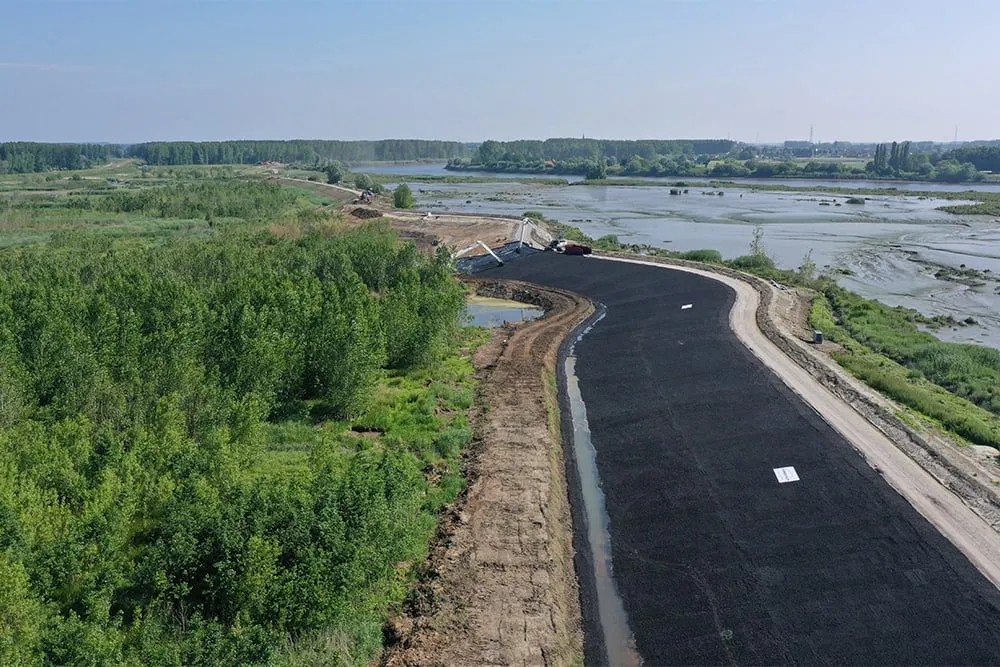
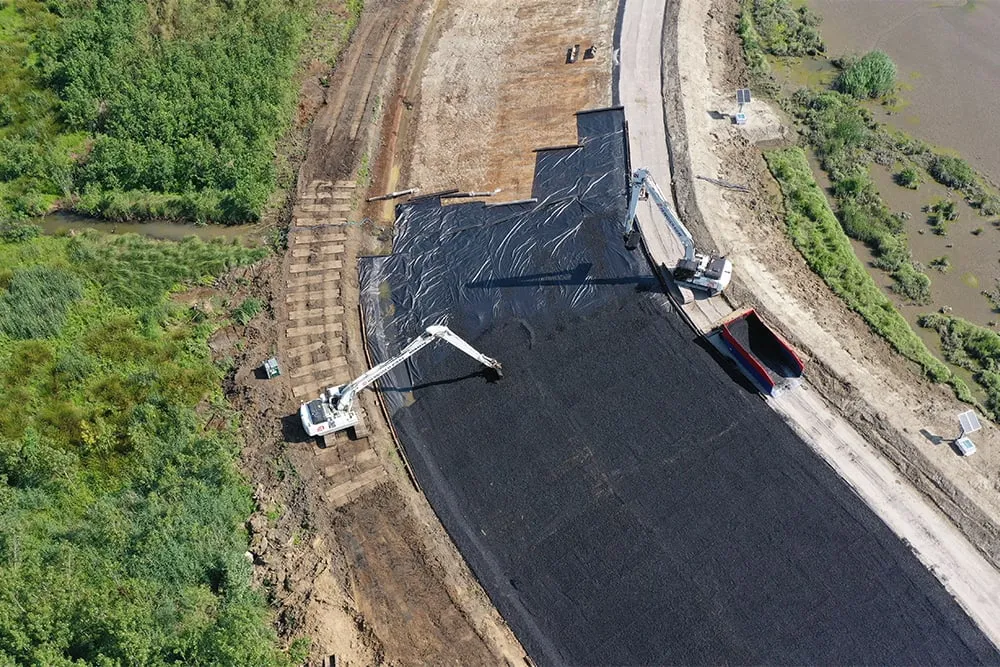
Work on the installation of fibre-reinforced open stone asphalt (GOSA) began at the end of May. Geert Baert says: “It had been a while since we last worked with GOSA, but we have enough staff with the necessary experience. The main challenge on this project is not so much the technical execution as the logistics. The heavy rainfall in recent months has been far from ideal for earthworks, and the low-loaders have to manoeuvre along narrow, unpaved tracks. The bad weather has caused some delays, but there is nothing we can do about that. On site, everything possible is being done to keep operations going.”
Once the works are complete, the overflow dyke will have a completely new asphalt towpath, allowing cyclists and pedestrians to use it safely again. The works are due to be completed in 2026. “We are also taking care of the adjacent roadworks, covering around 20,000 m² in total,” says Geert Baert. “Being able to carry out both the water engineering and roadworks, drawing on the relevant expertise and experience, is clearly a major advantage for the client. De Vlaamse Waterweg knows us very well and knows that a project is in safe hands with Herbosch-Kiere. Thanks to our extensive experience, capacity, hands-on approach and instinct for finding solutions, we can take on larger and more complex projects without difficulty.”
Sigma Plan
The works at the Wal-Zwijn flood area form part of the wider Sigma Plan. Its aim is to better protect Flanders against flooding from the Scheldt and its tributaries, while also boosting the valuable natural environment along the Scheldt. The Sigma Plan is being implemented by De Vlaamse Waterweg nv and the Agency for Nature and Forests. This will protect the whole of Flanders against flooding from these tidal rivers during storm tides.
Een zakelijke vraag aan Herbosch-Kiere? Get in touch
Companies in this story

Keep following this
Get an email when a new story is published. No account needed.
- ThemeStrengthening waterways and coastlines
- SubjectHydraulic engineering
- CompanyHerbosch-Kiere







