









Sewerage & underground infrastructure
The move towards low-carbon sewerage is under way
Text De Bonte GroupImage De Bonte Group
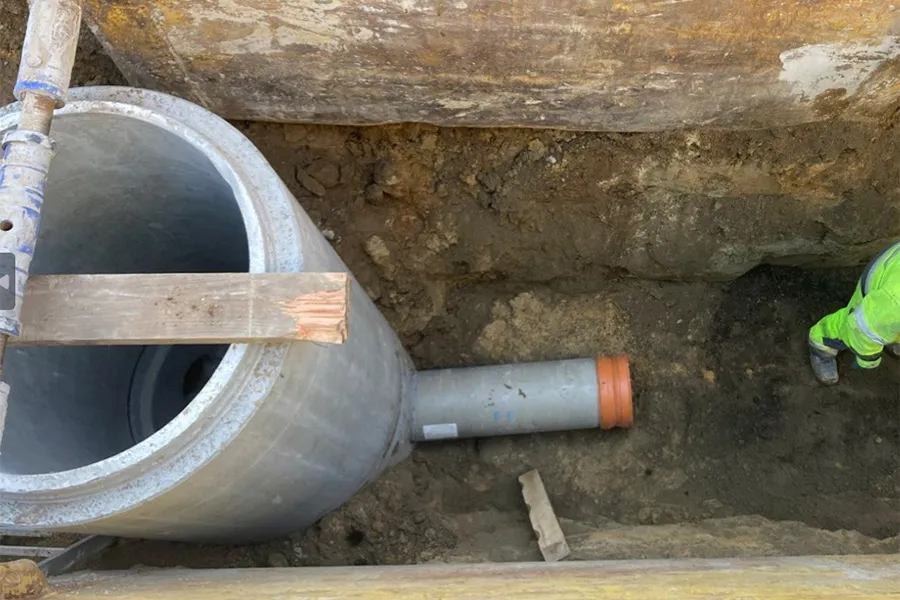
Around a year and a half ago, the revolutionary THIOTUBE sewerage system made from sulphur concrete entered the market, with DN250mm pipes for 2DWA. Thanks to pioneering partners who joined the fight to make sewerage infrastructure more sustainable (and whom we would like to thank warmly here), many impressive projects have since been completed. Despite some initial challenges adapting to the new system during installation, the material has proved its merits in the most extreme conditions.
The robust pipes (class 240) were installed flawlessly at depths of up to 5 m by contractor BESIX Infra, commissioned by or working with Aquafin and engineering consultancies Irtas and Sweco, in the municipalities of Sint-Niklaas, Hamme and Sint-Gillis-Waas. The pipes have also been installed successfully in Brakel (Aquafin/Arcadis), Puurs-Sint-Amands (Pidpa/Van Opstal) and, for the city of Lokeren, for example (SWBO). Fluvius recently used the 100% circular pipes with POM Limburg and engineering consultancy Geotec for the first circular SME zone in Voeren, a perfect match. Farys can now also count a sulphur-concrete sewer on its books in Lierde (engineering consultancy Infraplan).
De Bonte Group has closely monitored all these projects, evaluating the experience in close consultation with stakeholders and making adjustments where necessary. These intermunicipal and municipal sewer operators can rest assured: the functional reliability of their new system of THIOTUBE pipes and IDEAL inspection chambers from De Bonte Group is guaranteed, with an exceptionally low environmental impact.
Winning the innovation competition at a renowned trade fair in Rennes, France, has also sparked international interest. The first concrete steps are now being taken towards initial projects in France and the Netherlands.
EXTENSIVE R&D
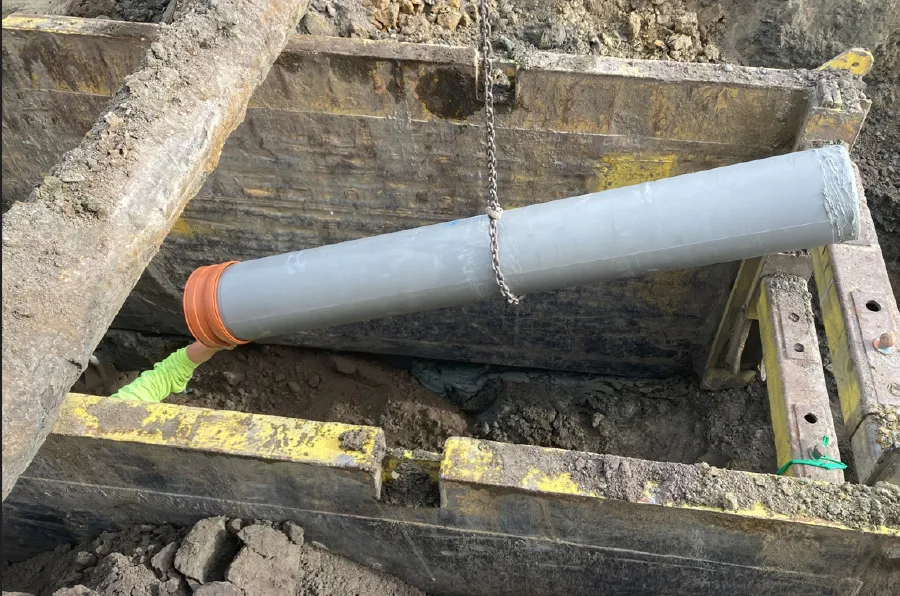
Meanwhile, De Bonte Group’s R&D department has been hard at work. Efforts have focused on expanding production capacity and developing the DN300. The first DN300 pipes are now being installed by contractor Adams, commissioned by Pidpa / Sint-Katelijne-Waver / engineering consultancy France.
SUSTAINABLE INSTALLATION
A sustainable pipeline combines a sustainable product with sustainable installation. In recent weeks, a trial trench was therefore dug at one of De Bonte Group’s 5 production sites in Belgium to optimise pipe installation with partner contractors. The trial trench will also be made available to the sector and various platforms (Vlario, OCW, sewer operators, etc.) to analyse, evaluate and optimise installation methods, as well as inspection and testing methods.
ENVIRONMENTAL IMPACT
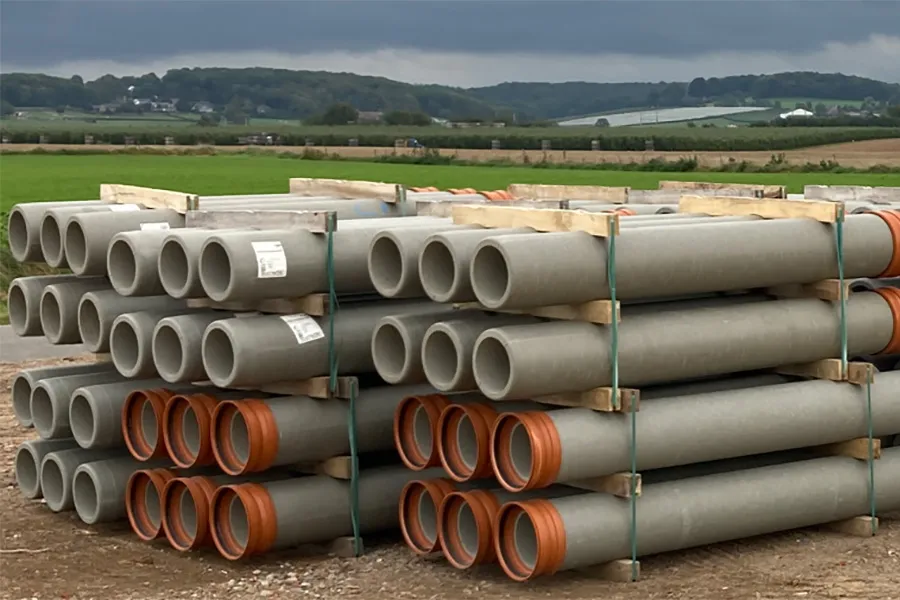
It is gradually becoming clear to everyone that our planet is under pressure. Yet even in infrastructure, there is still an almost exclusive reliance on conventional solutions. Humanity is naturally resistant to change. But if ecological transitions and wider transformations are to succeed, tinkering at the margins will not be enough. We will need disruptive solutions. Sulphur concrete is one such solution. According to TU Delft, 67% of the CO2 emissions from an infrastructure project are attributable to the materials used, so THIOTUBE pipes can make a significant difference in the transition to a low-carbon economy. Their 100% circularity is an added bonus in the effort to stop ‘plundering the planet’.
SUSTAINABLE PROCUREMENT
The THIOTUBE system was the first, and remains the only one, to have an EPD (Environmental Product Declaration), an environmental passport, available from the outset. The sector has since developed a PCR (Product Category Rule) under the Vlario banner, which is intended to regulate and standardise the definition of environmental impact. In time, this should lead to a TOTEM-infra tool that incorporates environmental impact into tendering. We are certainly looking forward to the first sustainable tenders.
Question about this story? Ask your question
Keep following this
Get an email when a new story is published. No account needed.
- ThemeRenewing pipelines and sewers
- SubjectSewerage & underground infrastructure







