









Sewerage & underground infrastructure
Strengthening water-sensitive residential areas without slowing densification
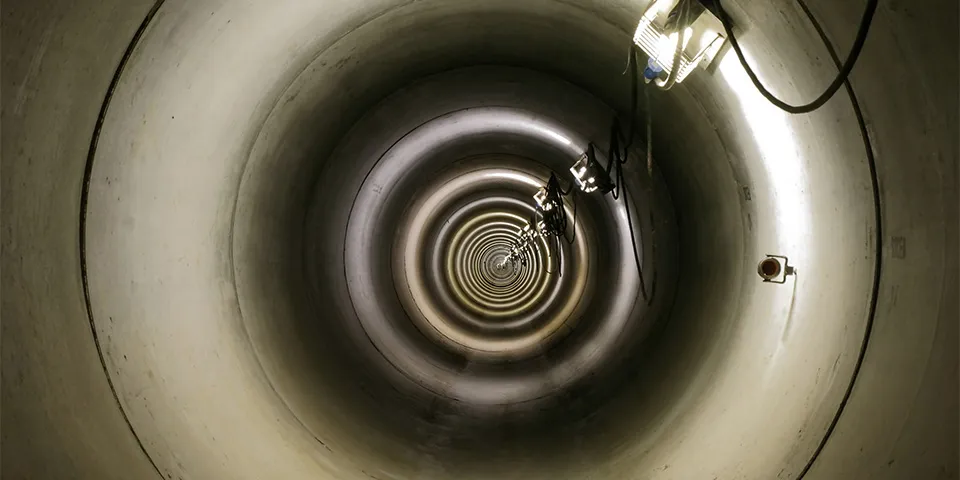
Aquafin recently announced that it plans to use private rainwater tanks in the fight against drought and heavy rainfall. Sensors and automatic controls can empty private tanks when heavy rain is forecast. With this initiative, Aquafin aims to make innovative use of rainwater harvesting and existing storage capacity to combat the effects of climate change.
“The new Flemish Government would do well to encourage innovations in water management, recycling and storage by removing regulatory barriers and investing in research and technical support,” says the Flemish Confederation of Construction. “The precarious water situation in many residential areas calls for urgent nature-based and engineering measures. Making residential areas liveable is a priority if we are to attract more families to them. Since densification is central to the government’s spatial plans, creative solutions to strengthen water-sensitive residential areas are becoming increasingly important.”
The government has long identified many residential areas as being at very high risk of flooding. The Flemish Confederation of Construction says: “Measures to promote flood-resilient construction are an essential part of a sound approach. Prior analysis is necessary not only to anticipate risks, but also the administrative planning-permission process needs to be reviewed. At present, it acts as a barrier, even though incorporating extensive nature-based engineering measures can help a project avoid water-related problems.”
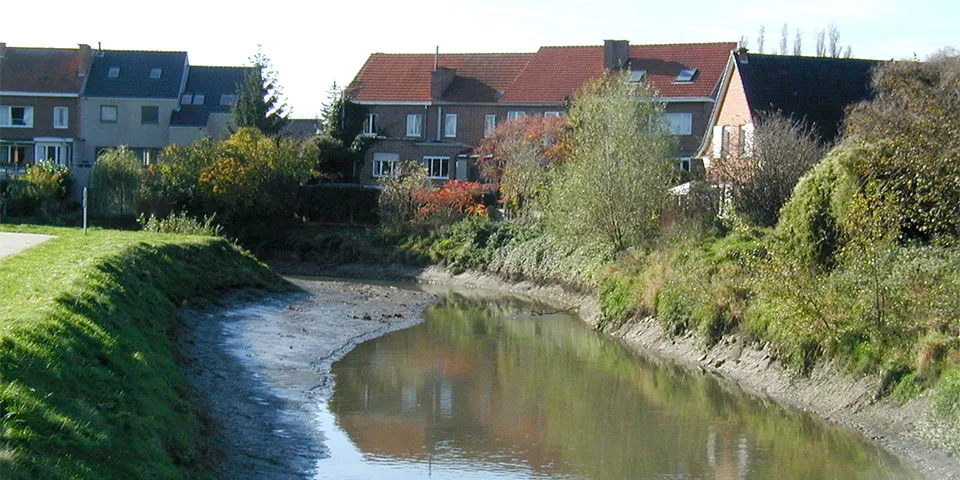
Water management and treatment remain at the heart of VCB’s work.
Thoughtful, flood-resilient densification
With its ‘map of flood-prone areas’, the Flemish Government indicates the extent to which a residential area needs to prepare for flooding. Diest, Grimbergen, Aarschot, Merksem, Maasmechelen and municipalities in the Dender region, among others, regularly make the news because of flooding. The maps use dark and light blue to show which plots and streets face greater or lower risks. This makes clear that water management is a crucial consideration in the planned wave of densification in these areas.
As the population continues to grow and the climate changes, current government budgets are not sufficient to cover water management and sewerage works. The introduction of the water assessment, the requirement to collect rainwater for new-build projects and the Sigmaplan all show that the Flemish Government recognises the need for action. At the same time, densification in water-sensitive locations requires a strong focus on flood-resilient construction techniques. The Flemish Confederation of Construction says: “This also means that planning authorities need to adapt their administrative procedures and be prepared to grant planning permission in water-sensitive areas on the basis of sound studies and preparation. There is still resistance to this approach, which is holding things back.”
Slowing water infiltration as the guiding principle
Water management, an important part of ‘green construction’, is no longer a niche concern, but a necessity. This is particularly true in residential areas that have been prone to flooding in recent decades because of soil sealing. “Construction measures have long made it possible to preserve the permeability of the soil, while the creation of wadis helps temporarily store water during peak rainfall,” says the Flemish Confederation of Construction. “Slow infiltration through green roofs connected to rainwater cisterns and soakaways can go some way towards addressing the problem. The collected rainwater can also be used for domestic purposes.”
Soil permeability can be improved using a range of techniques, such as depaving squares or providing planting beds along streets, or so-called ‘rain gardens’, which can serve as temporary basins for excess rainwater. “In addition, landscape design and the choice of materials can promote water absorption, evaporation and infiltration. As a result, less water flows into the sewer system. In many residential areas, the system is undersized, and the provision of a separate sewerage system for rainwater and wastewater is also becoming essential,” concludes the Flemish Confederation of Construction.
Flemish Confederation of Construction
Lombardstraat 34-42, 1000 Brussels
T +32 2 545 57 49
www.vcb.be/
Question about this story? Ask your question
Keep following this
Get an email when a new story is published. No account needed.
- ThemeRenewing pipelines and sewers
- SubjectSewerage & underground infrastructure







