









Sewerage & underground infrastructure
Specialist devises tailored solution for cleaning porous concrete sewer pipes
Sewer maintenance holds no secrets for Group Peeters of Herentals, a specialist in industrial cleaning.
As well as its core services, including cleaning, visual inspections, leak tests and renovation, the family business can also remove concrete from pipes and carry out accredited deformation tests and other bespoke work. “The recent use of porous concrete sewer pipes, which are helping to combat falling groundwater levels, also presents new challenges,” the company says.
Group Peeters’ main customers are industrial businesses around the ports of Antwerp, Ghent and Rotterdam. The company offers complete solutions for cleaning, waste management, blasting and painting, and sewer management. The latter activity has grown significantly in recent years, both in scope and in the range of solutions available for every problem.
As a VCA P-, ISO 9001-, ISO 14001- and ISO 17025-certified company, operating exclusively SIR-approved vehicles with ADR certification, Group Peeters always sets the bar high. This was also the case when, a few years ago, it was first asked to devise a solution to remove internal sludge from porous concrete sewer pipes and clear their pores to restore their drainage function.
Rotating nozzles
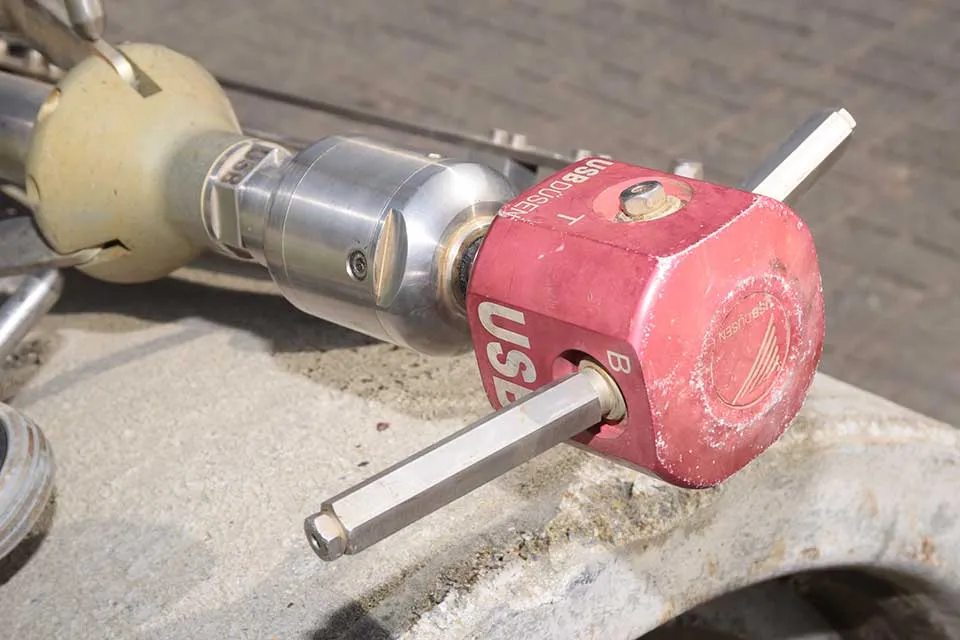
“Rotating nozzles are rarely used in sewers, as they were originally designed to remove hard deposits, such as limescale, iron deposits or coatings, at higher pressures of 250-3,000 bar. Sewers, by contrast, need to be cleared of sludge, traditionally using a fixed nozzle at low pressure and high flow, which carries the sludge towards the suction hose,” explains Ken Wuyts, Business Unit Manager at Group Peeters. “But porous concrete pipes can lose their drainage effect. So we looked at using rotating nozzles. By carefully positioning several lances on the rotating head, both in relation to the pipe wall and to one another, we create a significant local vacuum. This vacuum draws the sludge loosened by the first row of lances out of the pores, after which the second row of lances carries it away. The head is mounted on a centraliser, a guide system custom-made for the pipe that maintains a constant distance between the lances and the wall.”
The rotating heads are powered by water or compressed air, or are oil-braked. Ken Wuyts: “For different diameters and types of contamination, operators can switch between different drive systems. We have developed tables that operators can consult to achieve the best results in every situation. Although we have made significant progress in developing a solution, we remain open to input from all stakeholders so that we can work together to provide the best possible service.”
Question about this story? Ask your question
Keep following this
Get an email when a new story is published. No account needed.
- ThemeRenewing pipelines and sewers
- SubjectSewerage & underground infrastructure







