









Sewerage & underground infrastructure
Soil remediation and archaeology under one roof for the Gedempte Zuiderdokken development
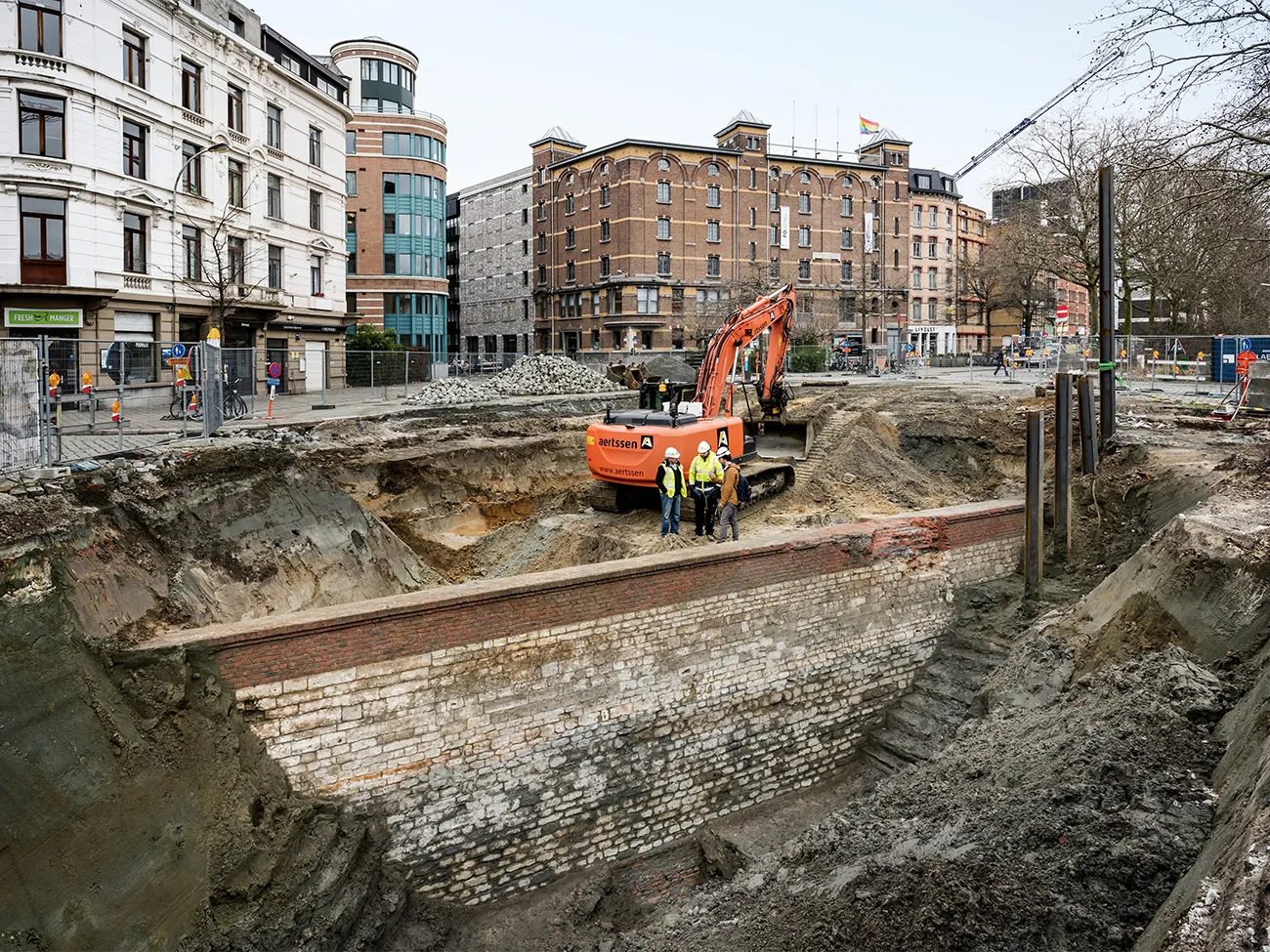
The transformation of the Gedempte Zuiderdokken in Antwerp is gathering pace. The car parks are moving underground to make way for a vast urban park: Dok Zuid.
Contractor Van Laere has called on ABO to carry out soil investigations and supervise the earthworks in response to the soil contamination encountered. ABO is also responsible for the archaeological investigation. Alongside the old dock walls, the consultancy discovered, among other things, exceptionally well-preserved remains of the 16th-century citadel wall, and a mortar weighing no less than 70 kg, used during the siege of Antwerp in the 19th century.
Het Zuid is now one of Antwerp’s leading districts, while the Gedempte Zuiderdokken is best known as a grey car park. Dok Zuid is set to change that for good. The first step towards creating the park is to move the car parks underground. They will be located exactly within the boundaries of the former Kooldok and Steendok. The first car park, Parking Steendok, was completed at the end of last year. Van Laere is now hard at work on Parking Kooldok, after which work can begin on the park.
Contaminated silt layer
ABO nv, part of ABO-Group, was involved in this urban development project from the design stage. The certified soil remediation expert prepared the soil movement study to assess the quality of the soil to be excavated from this former harbour dock. “At a depth of around 8 m, at the level of the former dock bed, we found a silt layer heavily contaminated with heavy metals and PAHs. We then carried out a descriptive soil investigation to map the silt layer in detail,” explains Toon Moeskops, project manager at ABO.
During the construction phase, Van Laere appointed ABO to supervise the soil movement and dewatering works. “The silt layer was so heavily contaminated that it had to be removed for further treatment. As soil remediation experts, our task is to monitor the level of the silt layer closely during excavation, so that only the contaminated layer is removed. The groundwater level also needs to be lowered to create the 8 m-deep excavation pit. Given the known groundwater contamination in the city centre, we monitor groundwater quality to ensure that the contamination is not spreading,” says Toon Moeskops.
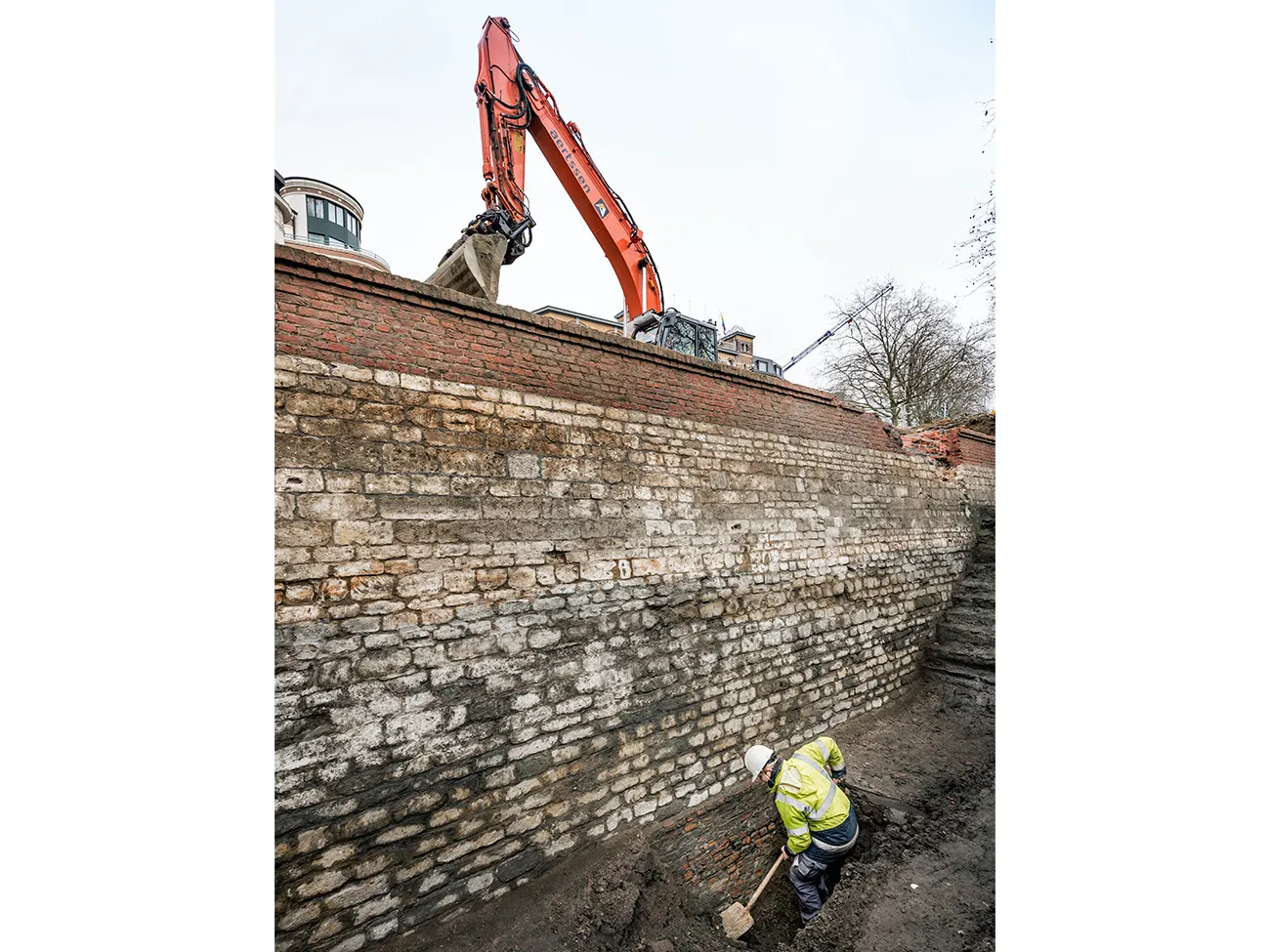
Archaeological and geophysical investigation
Legislation requires an archaeological investigation whenever earthworks are carried out, particularly in a historic city centre. For several years, ABO has had the expertise to oversee the entire archaeological process. “We started with a desk-based study, using historical maps and information from previous excavations to determine which archaeological features we could expect to find underground,” says Maarten Praet, archaeologist at ABO nv. During work on Kooldok, ABO also carried out a geophysical survey using ground-penetrating radar to pinpoint the exact locations of the old dock walls, allowing Van Laere to plan the excavation works precisely and avoid encountering unexpected structures. The architects will use the scans to show the dock walls in the new park. “Thanks to this non-invasive method, we did not have to disrupt work on site,” says Maarten Praet.
During the excavation works, ABO thoroughly investigated the 19th-century dock dating from the Napoleonic era. The old dock walls will remain visible on level -1 of the underground car park. “At the entrance and exit of Parking Steendok, we also found remains of the 16th-century citadel wall. In some places, the wall was preserved to a height of 8 metres, which is quite unique,” adds Maarten Praet. After recording and collecting several marked bricks, the dock walls were removed to make way for the entrance and exit.
Alongside the citadel wall, ABO made several other notable finds, including a 19th-century mortar weighing no less than 70 kg, which was used to fire on Antwerp during the siege. After conservation, the mortar will be displayed in the city museum. Cannonballs and musket balls were also found, providing a vivid picture of the military history of the vanished citadel.”
Combining expertise
During construction, close coordination with the contractor was essential, as both the removal of the silt layer and the archaeological investigation had to be carried out between and during the different project phases. “It is therefore a major advantage for the contractor that we can combine all these disciplines,” says Toon Moeskops. “And as a company, we are delighted to bring together our expertise as soil remediation experts and as an archaeological and geophysical investigation consultancy on this project. ABO is involved in many large-scale urban development projects in Antwerp, and the Gedempte Zuiderdokken are a fine addition to our track record.”
ABO is currently supervising the soil movement works and archaeological investigation for the construction of the second car park, Parking Kooldok. ABO’s work at this site is due to be completed by the end of this year.
Question about this story? Ask your question
Keep following this
Get an email when a new story is published. No account needed.
- ThemeUsing and protecting the subsurface
- SubjectSewerage & underground infrastructure







