









Sewerage & underground infrastructure
Separate sewerage now a reality in Oudenaarde’s Rietgracht
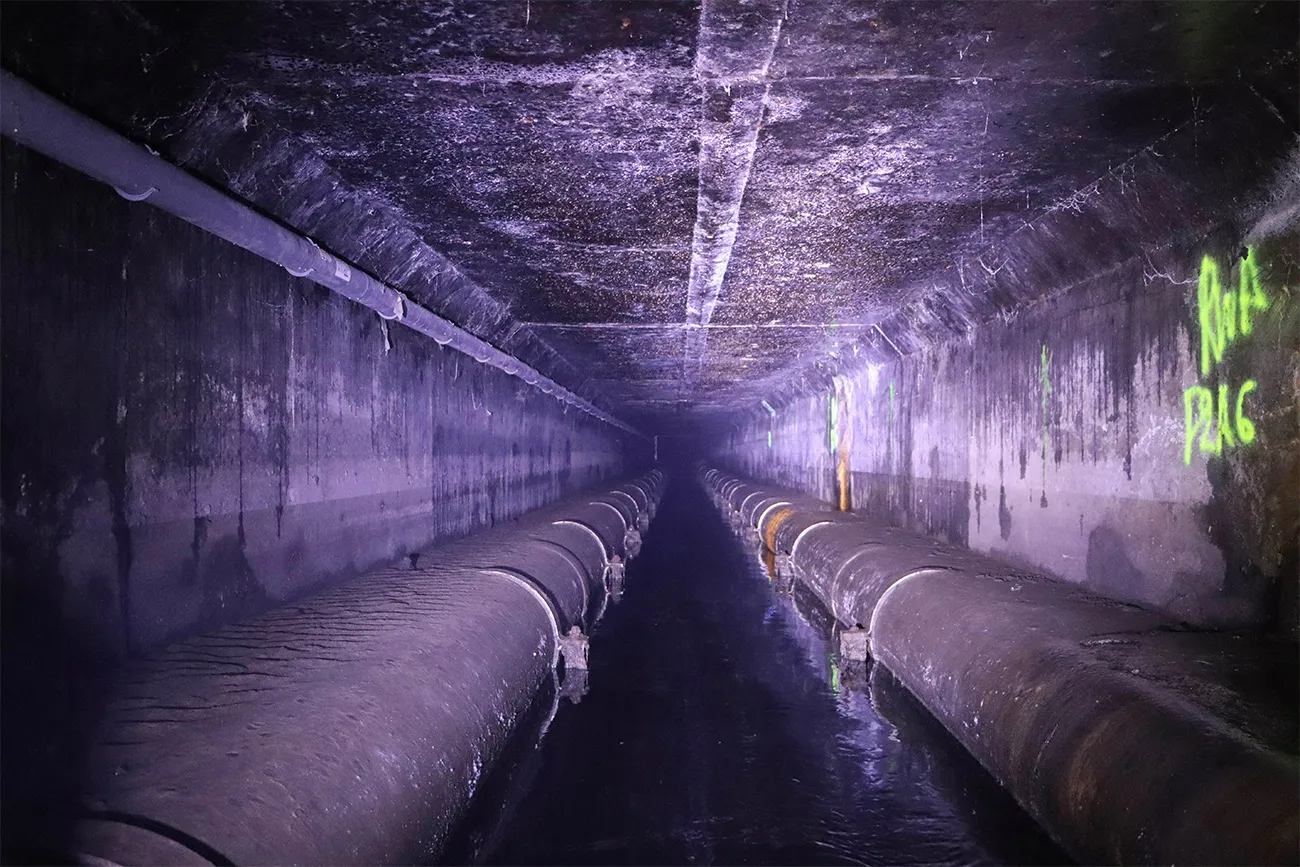
In the centre of Oudenaarde, Smet-Tunnelling of the Smet Group and main contractor Persyn joined forces to install separate wastewater and stormwater drainage in the Rietgracht. A new wastewater sewer was installed in the existing culvert over a length of approximately 2.5 km. “A particularly challenging assignment, but that is precisely why it was right up Smet-Tunnelling’s street,” says Elly Van Der Schraelen, project manager at Smet-Tunnelling, a specialist in renovating and installing pipe systems, as well as pipe jacking.
In the centre of Oudenaarde, an old culvert carrying the Rietgracht was still being used as a sewer, with both wastewater and stormwater discharged into the culverted watercourse. Commissioned by Aquafin, the project aimed to install a wastewater sewer (DWA, or dry-weather flow) in the existing culvert, separating wastewater from the stream so that only stormwater would flow into it. In the first phase, the entire culvert was cleaned and inspected. A new flow channel was then created for stormwater, GRP DWA channels were installed in the culvert, and wastewater connections were redirected to the DWA channels. Inspection chambers were also installed to enable future checks and interventions on the new sewer.
Complete separation
“The Rietgracht was culverted in the early 1970s, and since then everything has flowed together along a 2.5 km stretch, both wastewater and stormwater,” explains Elly Van Der Schraelen. “A study showed that fully separating DWA and RWA was the best solution. As subcontractor and specialist in renovating and installing pipe systems, Smet-Tunnelling worked with Persyn on the sewerage section. While Persyn focused mainly on the concrete works, creating a new flow channel and all the above-ground construction, Smet-Tunnelling was responsible for cleaning the culverted Rietgracht, diverting the water flow, carrying out the disconnection study and installing the new DWA pipe in the culvert.”
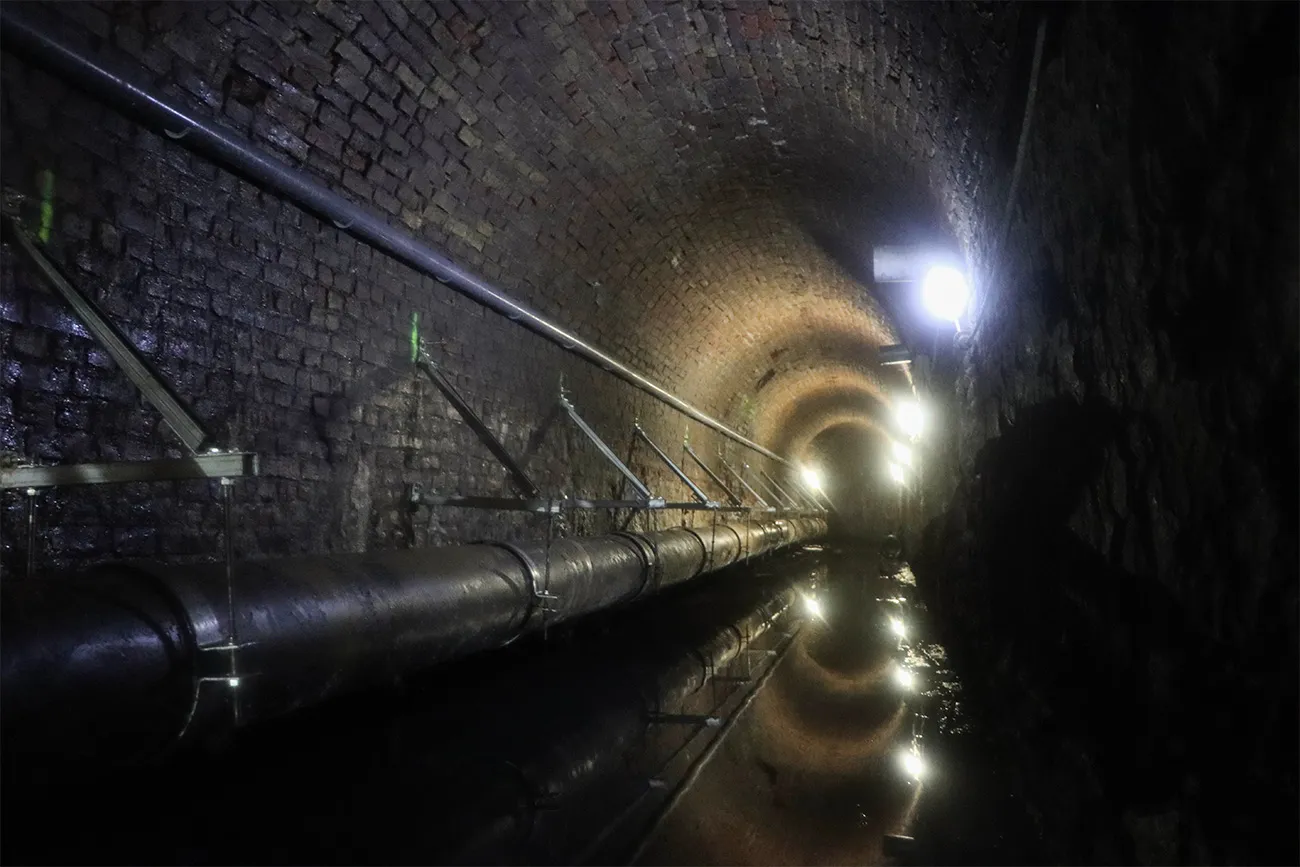
This atypical sewerage project presented Smet-Tunnelling with a number of challenges. Elly Van Der Schraelen: “There was twice as much silt in the culvert as expected. Pumping out the incoming flow was also highly complex. After a thorough clean, the culvert was inspected for defects in both the concrete section and the masonry section, and the connections were also located. Whenever we found a connection, we had to determine whether it was DWA or RWA. Where this was unclear, we traced the connection back to the house or building to establish its type. It was quite a puzzle to piece together.”
Phased approach
The project was divided into 8 phases, with the collector installed first in each phase. Elly Van Der Schraelen: “In 4 phases, the collector was suspended from threaded rods so that it could ultimately be cast into the new flow channels. In the remaining phases, the collector was suspended from the walls with brackets, because the flow channel there was much lower than the pipe profile. The bends were laminated on site using glass-fibre-reinforced polyester resin. We also had to allow for a range of materials in the incoming connections: vitrified clay, PVC, concrete and PE.”
Knowledge and experience
The final inspections and adjustments were carried out at the end of 2022. Smet-Tunnelling looks back on the project with great satisfaction. “It was certainly no conventional sewerage project. The client also chose to make part of the Rietgracht accessible to the public, along the lines of the ruien in Antwerp. Smet-Tunnelling can draw on a wealth of knowledge and experience to bring complex projects like this to a successful conclusion. We have our own design department. Another important point is that we have a team dedicated specifically to these unusual sewerage projects,” concludes Elly Van Der Schraelen.
Question about this story? Ask your question
Keep following this
Get an email when a new story is published. No account needed.
- ThemeExtending the life of bridges and tunnels
- SubjectSewerage & underground infrastructure







