









Sewerage & underground infrastructure
Revolutionary low-carbon sewer pipe: cement-free, circular and easy to install
Text Niels Rouvrois Beeld De Bonte Group
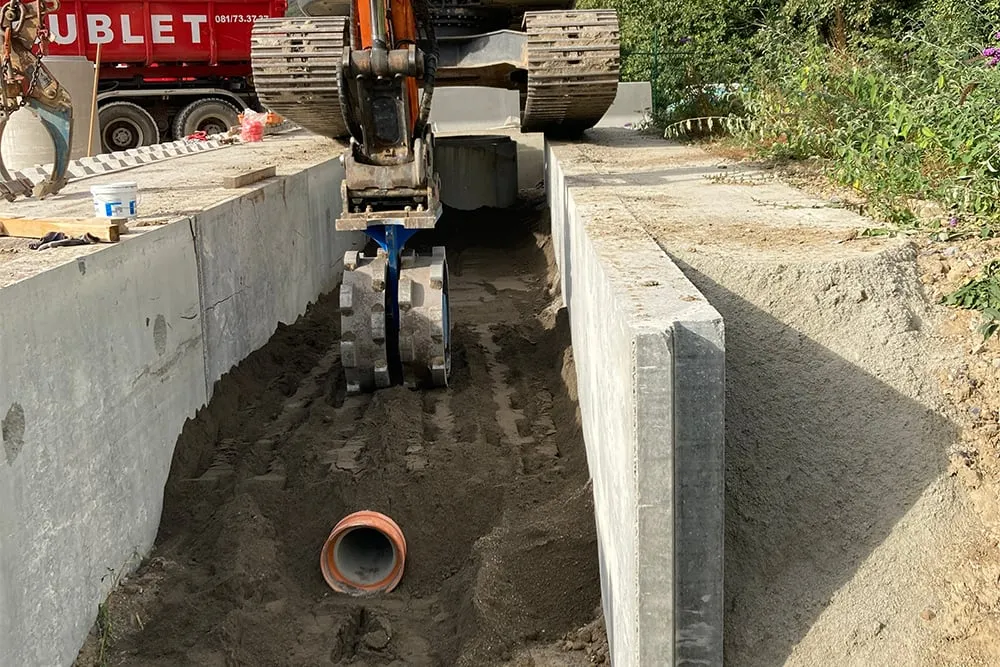
In 2021, De Bonte Group launched THIOTUBE®, the first cement-free sewer pipe. Four years on, it already has a string of impressive project references to its name, and installation has been made even easier. “Because installing these sustainable pipes, with their circular joint, requires particular care, we have worked closely with the sewerage sector to go the extra mile and ensure that installation is sustainable too,” says Joeri Hamal, business development manager at De Bonte Group.
It is no secret that De Bonte Group is constantly looking for innovative, sustainable solutions, challenging the sector to do things differently and better. This led to the development of a revolutionary new type of concrete: sulphur concrete, or THIOCRETE®. In this concrete, sulphur replaces cement and water as the binder. The THIOTUBE® sewer pipe, together with THIOTRACK® railway sleepers, is the flagship product of the THIOCRETE® range. It combines the robustness of a conventional concrete pipe with the acid resistance of a plastic or ceramic pipe.
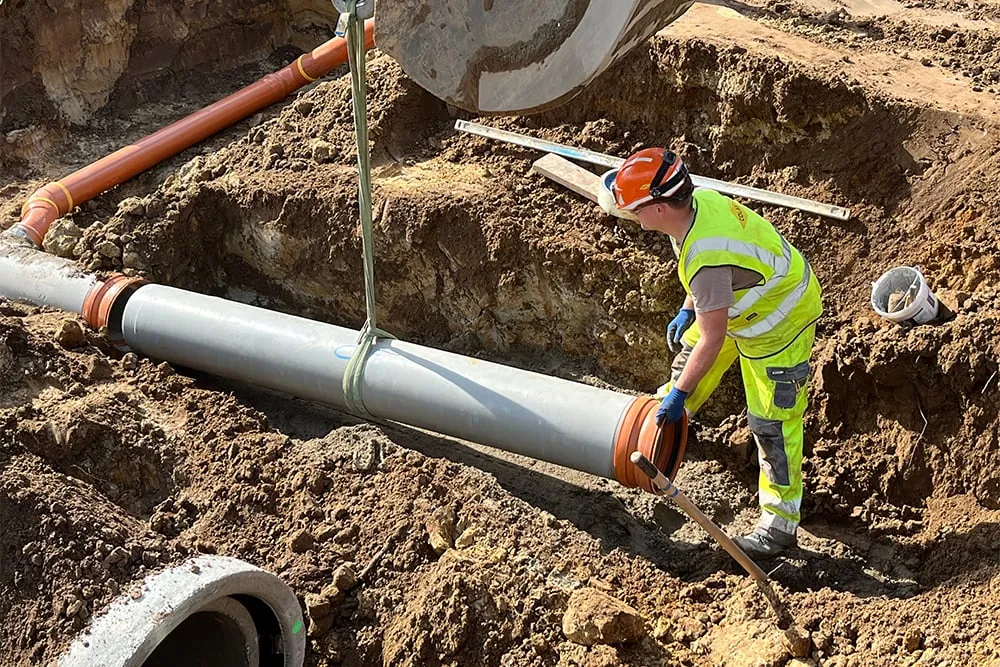
The pipe meets all prescribed functional and technical requirements, is durable and chemically resistant, and is ideally suited to wastewater. Using cement-free sulphur concrete keeps its climate and environmental impact extremely low. But it is at the end of its life that the material will really make a difference: it is 100% circular, with no loss of value. The first projects soon followed. Around eight kilometres of these robust pipes have now been installed across some sixteen projects.
Sustainable installation
Joeri Hamal: “After the first projects, contractors told us they were encountering problems installing our pipes. We immediately paused to investigate and resolve the issue together with sewer managers and contractors. THIOTUBE® uses a polypropylene joint that we developed ourselves, designed for circularity, rather than the conventional spigot-and-socket joint. This can lead to differential settlement or radial movement during installation.”
“Why? With a conventional rigid joint, the pipes fit into one another and therefore support one another. A poorly prepared bedding is less likely to cause settlement in this case. However, the seal will creep over time, which can lead to leaks that are not detected during handover. By contrast, our joint allows settlement if the pipe is not installed carefully, so it is crucial to provide uniform load-bearing support beneath the entire length of the pipe. We worked with the sector to refine the method for achieving this.”
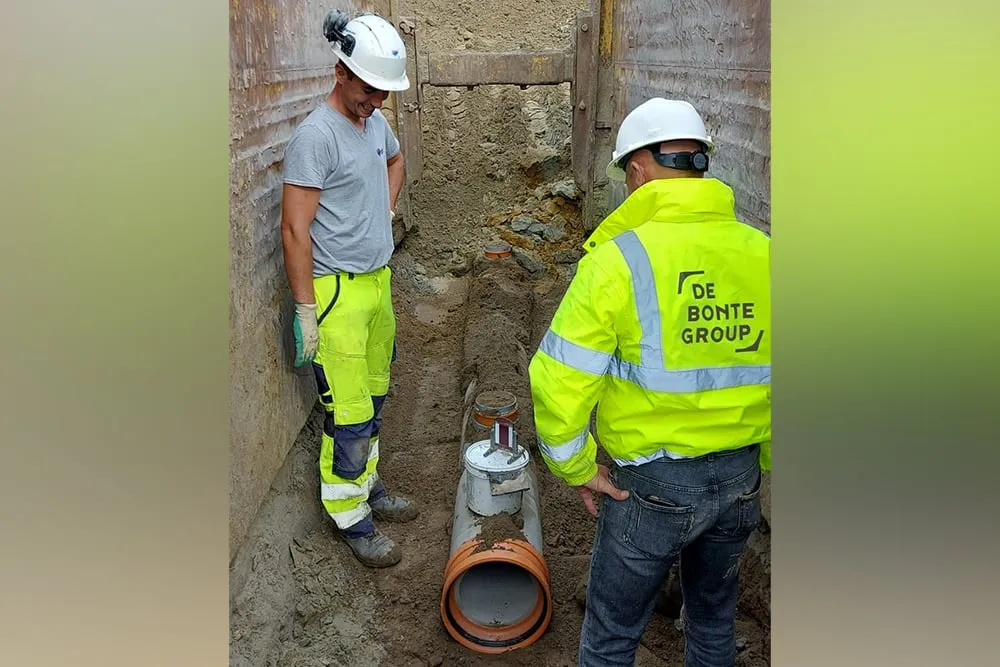
A durable pipeline is, after all, a combination of a durable product and sustainable installation. That is why De Bonte Group built a test trench at one of its five production sites in Belgium, where it worked with contractor partners to optimise pipe installation. The test trench is also available to the sector and various organisations (Vlario, OCW, sewer managers, etc.) to analyse, evaluate and optimise installation methods, as well as inspection and testing methods.
Close project monitoring
De Bonte Group also closely monitors every project to ensure correct installation. In close consultation with stakeholders, experience is reviewed and adjustments are made where necessary. Joeri Hamal: “Intermunicipal and municipal sewer managers can rest assured that the functional reliability of their new system of THIOTUBE® pipes and IDEAL inspection chambers from De Bonte Group is guaranteed, with an extremely low environmental impact.”
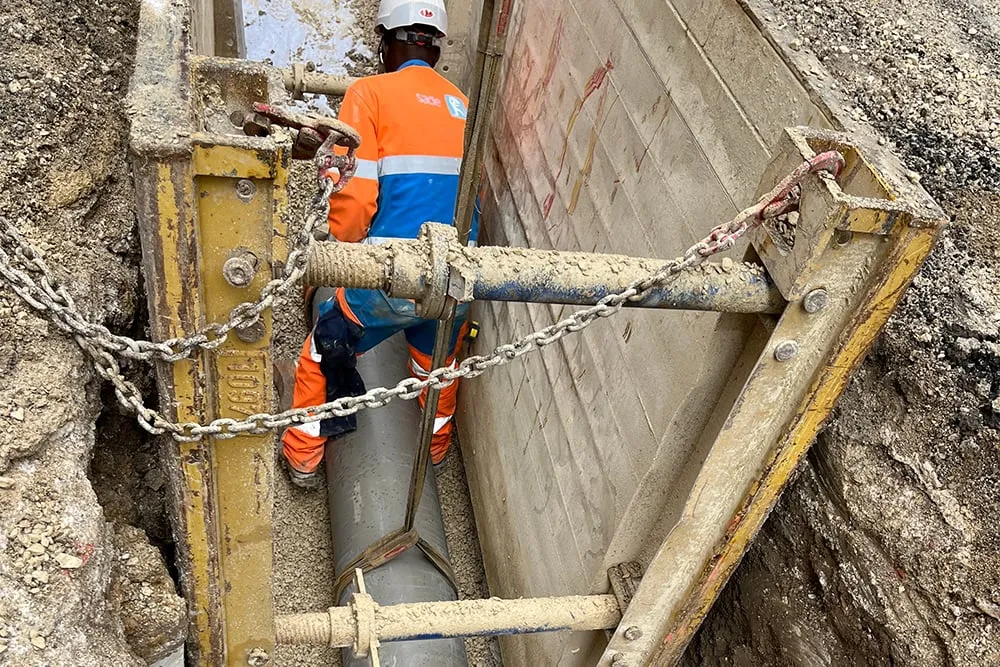
Taking a step back and getting everyone on the same page about installing the THIOTUBE® system proved to be a winning move. “Working with all stakeholders made it clear that, despite the teething problems, there is strong support for our low-carbon products.” Kenny, a pipe installer at BESIX-Infra, wholeheartedly agrees: “THIOTUBE® is a great material to work with. I feel comfortable using it, and productivity is comparable to other materials.”
Across the border
Today, both the product and its installation are fully developed, resulting in impressive new projects such as the reconstruction of Catershoflaan in Antwerp with Colas, and a section of the N10 between Lier and Aarschot with Stadsbader. “We are seeing contractors and clients place ever greater confidence in THIOTUBE®. And things are moving forward: we are now active across the border in France too. The first site is already under way in Epernay, another will soon follow near Amiens, and a project in Lille is also due to start in the summer. We are broadening our horizons and hope to play our part in the transition to a CO2-neutral society,” concludes Joeri Hamal.
Question about this story? Ask your question
Keep following this
Get an email when a new story is published. No account needed.
- ThemeRenewing pipelines and sewers
- SubjectSewerage & underground infrastructure







