









Sewerage & underground infrastructure
Pooling expertise to build an underground car park
Text and images Deschacht
A warm welcome for patients and their families is essential for a hospital. That naturally means providing sufficient parking, too. But what do you do when your underground car park is at risk of flooding? Deschacht, Galère and Lucas David found a solution tailored to the project.
The original two levels of the car park at the regional hospital in Namur are being extended to better meet patients’ needs. The new car park will cover 8,000 m² per level, providing more than 1,000 spaces: a 50% increase. Construction began in November 2022 and is divided into two phases, the first of which will be completed on 2 October. Why two phases? Because part of the car park must remain accessible to patients, staff and families.
Parking operator Effia appointed contractor Galère for this large-scale project. Galère entrusted the earthworks and drainage to Lucas David. “First, we had to demolish the original car park, which had a steel structure, and rebuild it with an additional level,” says Matthew Leroy of Lucas David. “We carried out the earthworks and drainage using Collinet-Deschacht products.”
Unexpected problems
Galère commissioned a consultancy to determine the required criteria. As the car park will be in continuous use, it has to meet stringent requirements. But water management proved to be the main challenge on site: “We had to excavate to a depth of 4.9 m, but hit groundwater at just 1.6 m,” says Matthew Leroy. “We were constantly working below the water table and needed to find a fast, durable technical solution to prevent the car park from flooding during storms.”
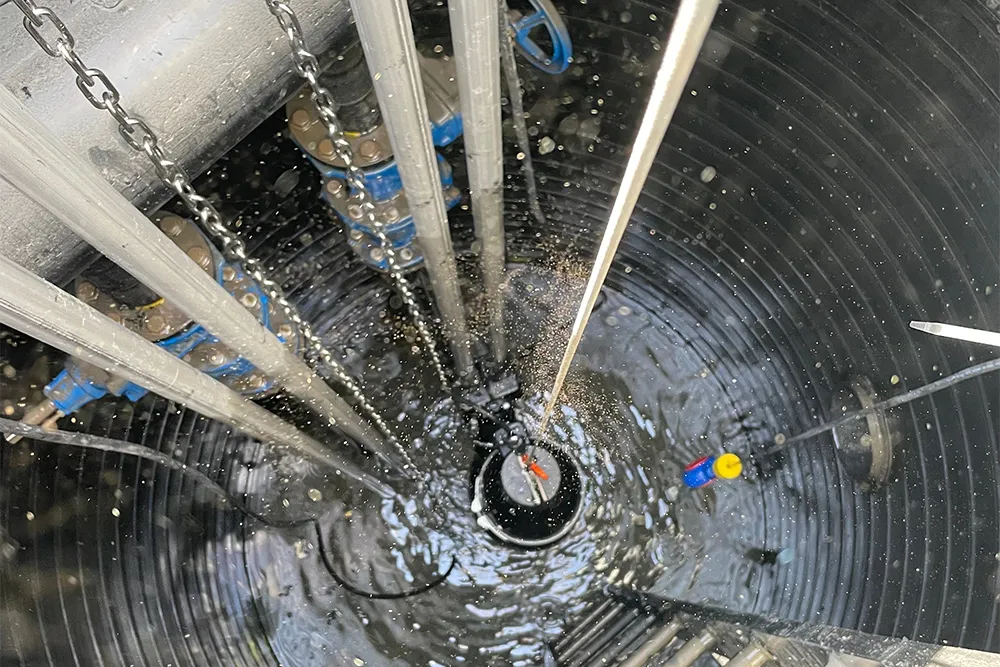
“When we consulted the engineering consultancy, it suggested a fairly straightforward solution: install two pumps so that one would keep working if the other failed,” says Laurent Demaret, project manager at Galère. “This meant installing a larger inspection chamber than planned, partly because the pumps had to be far enough apart to prevent a vortex effect. We therefore opted for a 1.8 m-diameter inspection chamber, custom-made by Collinet.”
Hydrocarbon separator and pumping station
Deschacht supplied not only a PEHD sewer network with diameters ranging from 110 to 400 and around ten custom-made polyethylene inspection chambers, but also a PEHD hydrocarbon separator and a double-walled PEHD pumping station with unusual dimensions.
“Thanks to Deschacht’s design department, the expertise of our partner Ecosolutions and the know-how of Collinet, our production workshop, we were able to meet the challenge,” says Dimitri Steilen, project manager at Deschacht. “We had to find a technical solution to the project’s challenges, including the high water table and the extremely tight delivery schedule. We also had to meet the engineering consultancy’s requirements for material quality and safety standards.”
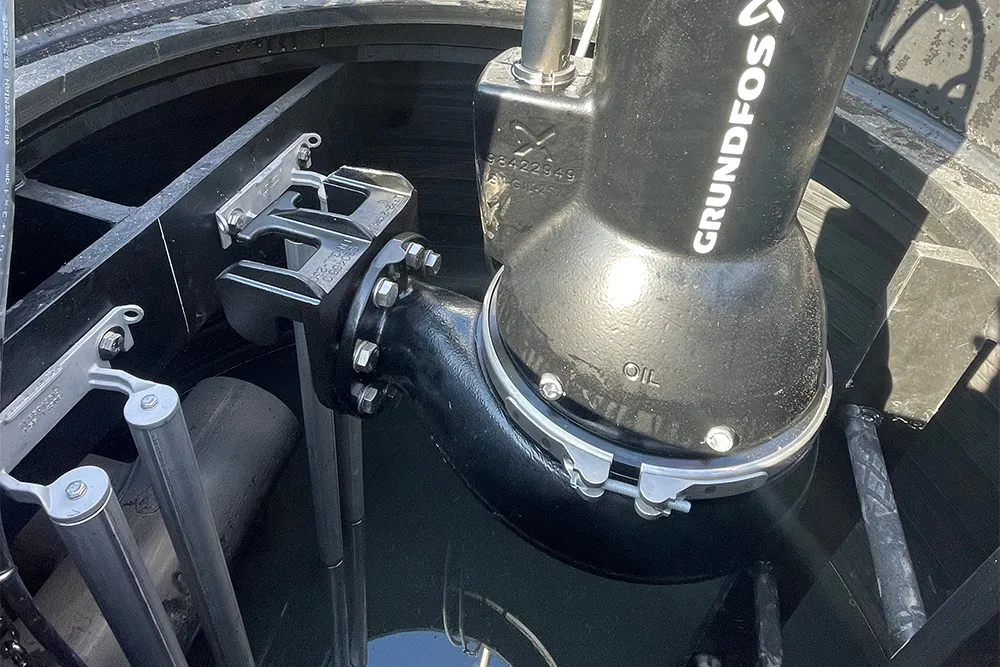
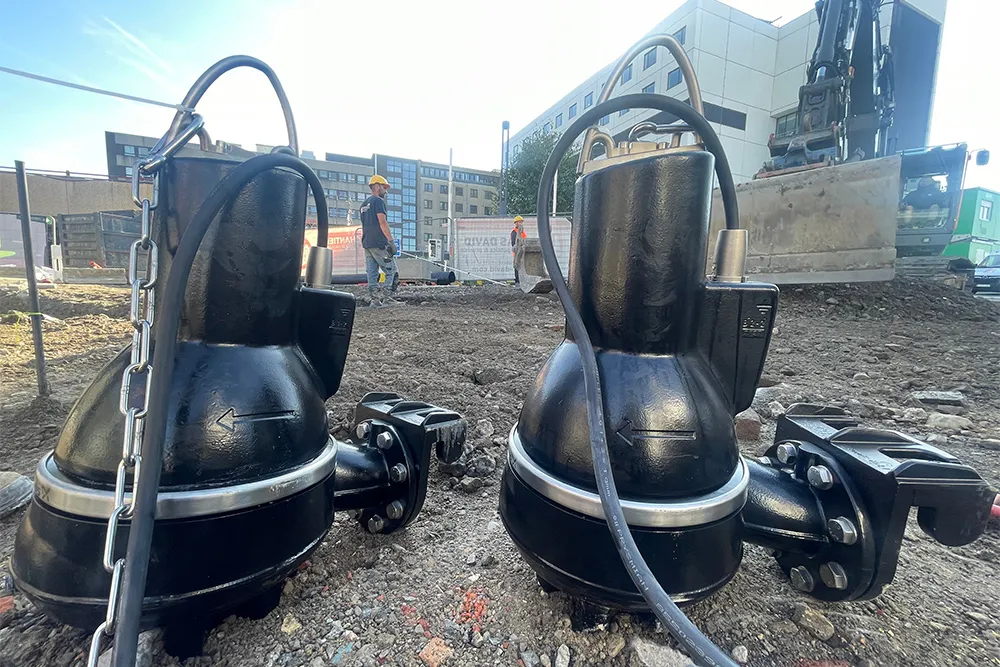
“A PEHD hydrocarbon separator was needed to treat the car park’s water before it entered the sewer. The water now flows through a pumping station, which also handles all the rainwater. For this, we used a double-walled PEHD tank with Ø1800, 5 m high, with a 4 m³ water seal and a PEHD ladder, a system with fall protection grilles, and two Grundfos pumps, each capable of handling a flow rate of 30 l/s.”
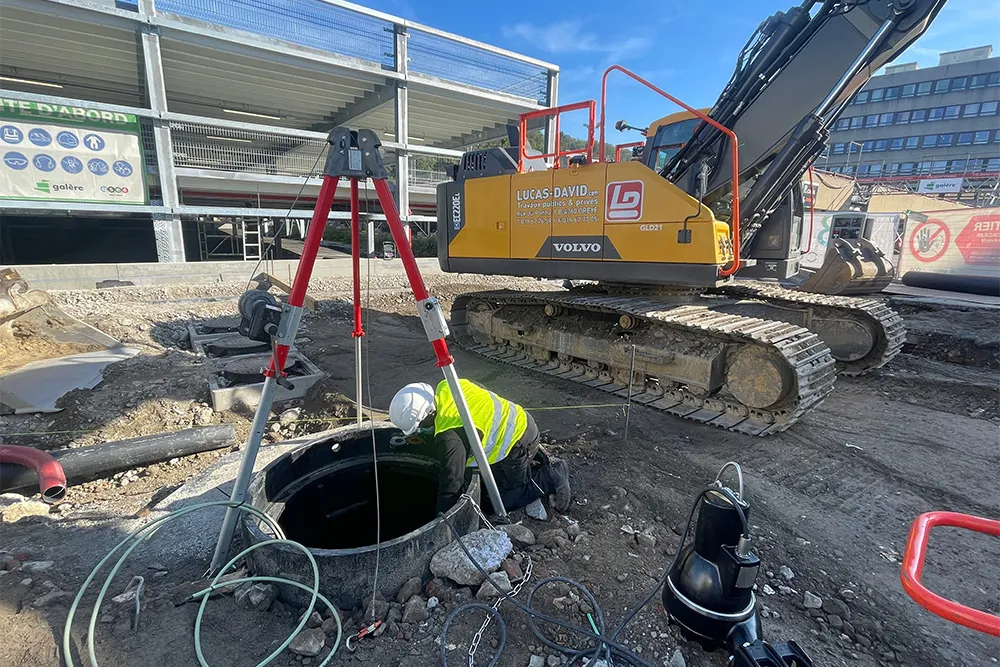
To prevent groundwater pressure from pushing the various components upwards, Lucas David installed concrete slabs along with an anchoring system and a stainless-steel hoop.
Polyethylene, an ideal material
The two key components are made of polyethylene, an excellent material for projects of this kind. “One advantage of polyethylene is that it can be used to make products to order, even on a gigantic scale,” says Dimitri Steilen. “It is also 100% watertight and can be installed faster than, for example, concrete. That was particularly useful on this site, where we had to pump out groundwater continuously.”
The hydrocarbon separator is also fitted with an alarm that will alert the client when the hydrocarbon layer reaches its maximum level and the separator needs to be emptied. The pumping station tank has a level sensor and a control cabinet, allowing the pumps to be monitored continuously. Ecosolutions also offers an annual maintenance and servicing service.
A reliable partner
When choosing a supplier, Lucas David naturally turned to Collinet-Deschacht. “We’ve been working together for almost 10 years and trust each other,” says Matthew Leroy. “We have an excellent relationship, and the sales team responds quickly when plans change. We saw that again on this particularly complex project. Polyethylene products require specialist installation and technical expertise that not everyone has, but Deschacht has mastered their installation. We have also attended training courses at Deschacht to perfect our installation of polyethylene pipes.”
Een zakelijke vraag aan Deschacht? Get in touch
Who worked on it
Parkeergarage Effia Namen in Namen
- contractorGalère
Keep following this
Get an email when a new story is published. No account needed.
- ProjectParkeergarage Effia Namen
- ThemeUsing and protecting the subsurface
- SubjectSewerage & underground infrastructure
- CompanyGalère
- CompanyDeschacht







