









Sewerage & underground infrastructure
Pipe bursting breaks and replaces Brussels sewer in a single operation
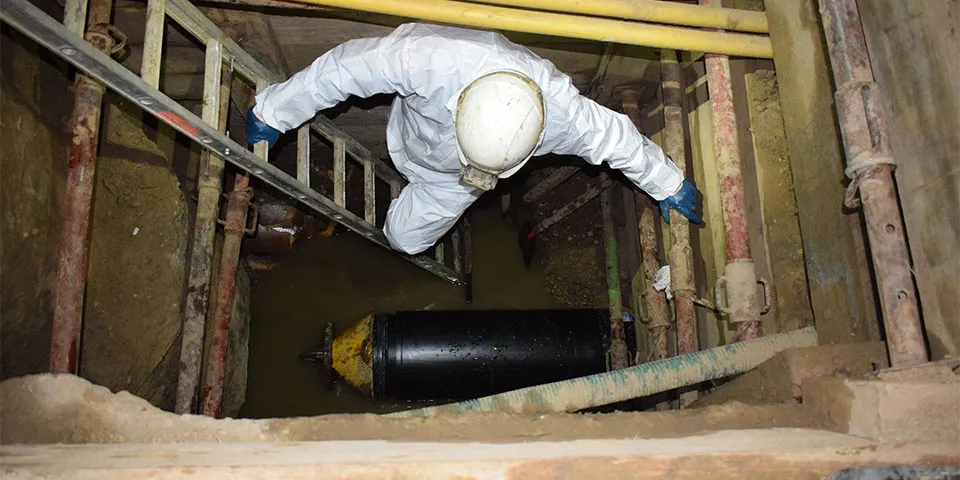
Brussels is gradually renewing all the sewers in the city. Renotec is also contributing to this enormous project. The renovation specialist from Geel renewed the sewer in Versailleslaan in Neder-Over-Heembeek using pipe bursting, an innovative, fast technique that has far less impact on the surrounding area than conventional excavation works.
When an existing pipe is severely degraded and/or deformed, pipe bursting can provide a solution for replacing it. With this semi-trenchless technique, one of Renotec’s core competencies, the existing pipe is broken up by a splitting head and pushed into the surrounding ground. At the same time, a new pipe is pulled through the broken pipeline behind the splitting head. The pipe bursting machine is set up at one end of the pipe to be replaced, and the new pipe is fed in at the other. This makes it possible to renew pipes with diameters of 200 to 800 mm over lengths of between 5 and 200 m.
The conditions in Neder-Over-Heembeek proved ideal for pipe bursting. Elly Van der Schraelen, project manager for special techniques at Renotec: “The existing vitrified clay sewer, with a diameter of 400 mm, in Versailleslaan was in a very poor state. We decided to replace the deteriorated sewer with HDPE pipes using pipe bursting. A burst head with a slightly larger diameter than the pipe pulverised the existing pipeline. At the same time, the new plastic pipe attached behind the burst head was pulled into place.”
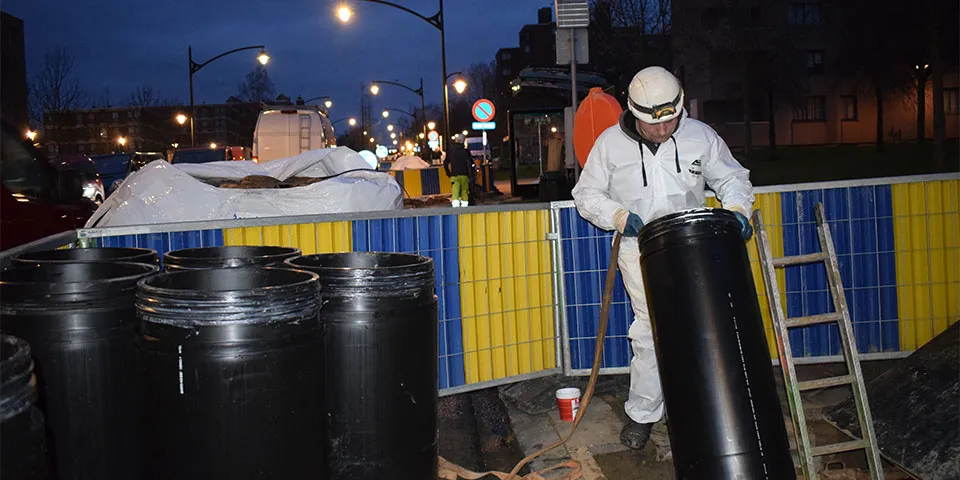
1-metre HDPE pipes
Renotec’s creativity and flexibility proved valuable on this project. “Our initial plan was to weld long pipes together above ground and pull them into the ground through large pits,” says Elly Van der Schraelen. “But the utility cables in Versailleslaan are poorly positioned, preventing us from setting up our large installation. So we opted to use short pipes, 1 m long and sometimes just 0.5 m, working from one sewer access chamber to the next, over a distance of about 30 m each time. The advantage of such short pipes is that you can work with a small machine and small pits measuring just 1.5 by 1.5 m.”
Smart joints and a camera
Pipe bursting’s innovative nature is evident in the way the joints are made and watertightness guaranteed. Elly Van der Schraelen: “As the burst head pulls one pipe into the sewer line, the next pipe is pushed against it. As soon as the socket-and-spigot joints in the wall lock together, the new sewer is watertight. These joints also prevent the edges of the pipes from protruding. This keeps friction to a minimum as the pipes are pulled through the ground.”
Because pipe bursting is carried out using a semi-trenchless method, preparation is crucial. “Before starting the work, we used a camera to inspect the old pipe, check its condition and determine the locations of the house connections,” Elly Van der Schraelen continues. “We marked these distances above ground, so we knew exactly where to dig pits to renew those connections too.”
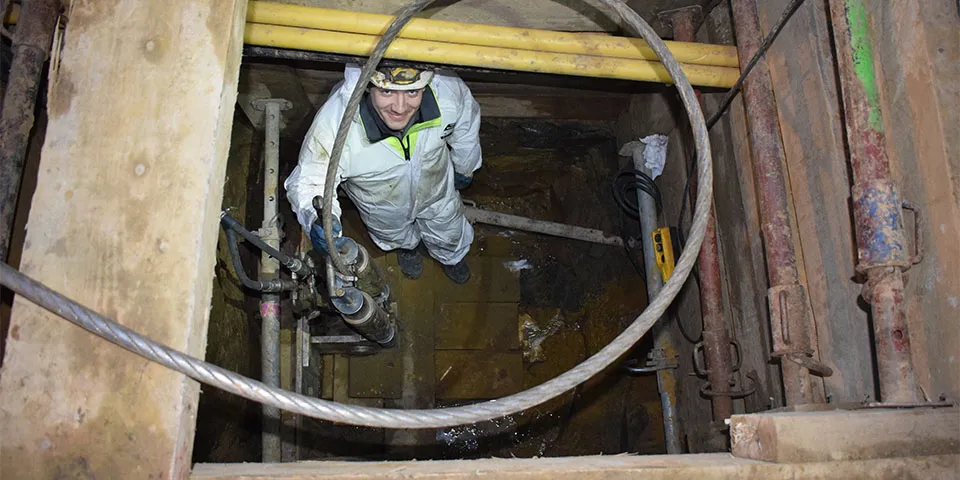
Pipe bursting’s main advantage is the minimal impact of the work on the surrounding area and traffic.
Minimal impact on the surrounding area
Pipe bursting’s main advantage is the minimal impact of the work on the surrounding area and traffic. “With conventional open-trench works, at least one lane would have to be closed here, while pavements, driveways and parking spaces would be dug up over distances of tens or even hundreds of metres. With this method, we only need to dig a few small pits in the pavement and parking lane. Versailleslaan is home to a police station, several schools and a number of bus stops. They experienced little or no disruption during the works,” concludes Elly Van der Schraelen.
Question about this story? Ask your question
Keep following this
Get an email when a new story is published. No account needed.
- ThemeRenewing pipelines and sewers
- SubjectSewerage & underground infrastructure







