









Sewerage & underground infrastructure
More investment in sewerage and wastewater treatment
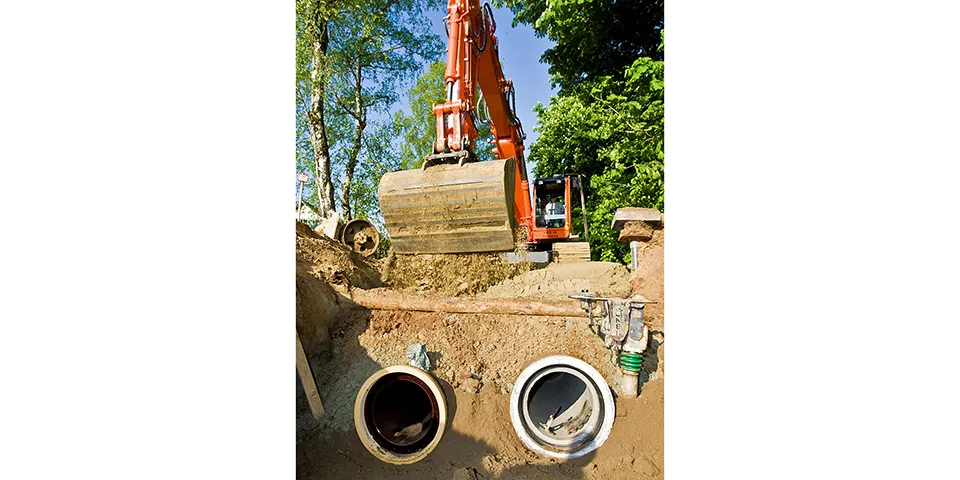
The Flemish Government recently announced that it would make an additional half a billion euros available for sewerage projects. The Flemish Confederation of Construction (VCB) welcomes this decision, as there is still a long way to go before 2027. Earlier this year, the Flemish authorities estimated that around four billion euros would be needed to meet their commitments to the public and comply with the European directive.
Strengthening the sewerage system and wastewater treatment is crucial, as untreated wastewater flows into the natural environment in 20 % of Flanders. The VCB also stresses that significant investment in water management will be needed in our towns and centres to enable high-quality densification in the future. These costs are not yet included in the budgets mentioned. The Flemish Government’s funding boost is urgently needed to get sewerage works in our region moving again. We need to maintain a steady pace to achieve a sewerage connection rate of 95 % by 2017. This rate is essential to optimise surface water quality in line with the ‘European Water Framework Directive’.
Local authorities
In this initiative, the VCB highlights the crucial role of local authorities in making this possible. This means not only strengthening and extending the existing sewerage network and installing separate systems for rainwater and wastewater, but also enabling the continued use of individual treatment systems for homes in more remote areas. Moreover, our country has underinvested in its infrastructure over recent decades, particularly compared with neighbouring countries such as the Netherlands and France. Since the mid-1990s, the government has no longer managed to offset the natural wear and tear of infrastructure through its annual investment.
Building water-resilient centres
Water management is vital in preparing our towns and centres for higher-quality densification. Greater density means even more hard surfacing in areas that are already paved and sometimes prone to waterlogging. Managing rainwater runoff will be a particular challenge in the future. High-quality densification that allows people and nature to coexist in a limited area requires extensive planning and investment in green spaces and additional water-storage capacity. This is necessary to ensure liveability and not only attract families to cities, but retain them too. At present, it remains unclear what budgetary resources our authorities will need to make available.
Question about this story? Ask your question
Keep following this
Get an email when a new story is published. No account needed.
- ThemeRenewing pipelines and sewers
- SubjectSewerage & underground infrastructure







