









Sewerage & underground infrastructure
Future-proof sewer construction with sulphur concrete
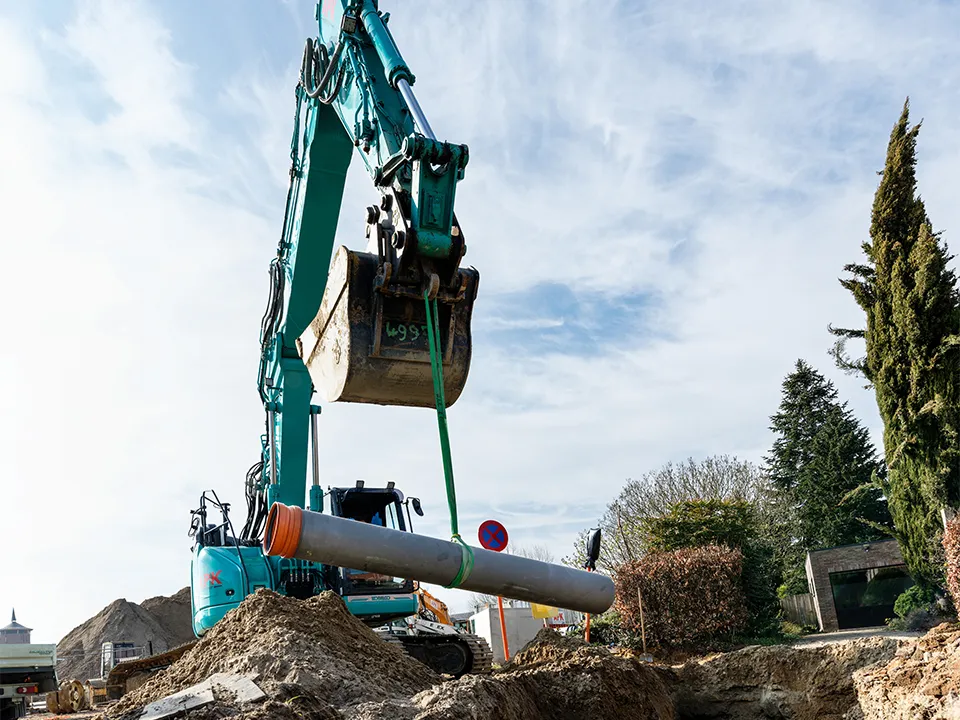
Melting concrete sounds like ‘fake news’, but it is certainly not. Sulphur concrete is an innovative material developed by De Bonte Group.
It is the new circular material for building future-proof railway or sewer infrastructure. This means that the material not only meets all technical and functional requirements, but also enables a significant contribution to the transition towards sustainable, circular sewerage or railways.
100% circular
Sulphur concrete is comparable to conventional cement concrete, except that both the cement and the water are replaced by sulphur as the binder. Sulphur concrete is produced through a physical process of melting and solidification. This process can be repeated indefinitely, meaning the material can be reused indefinitely, even for an identical application. Its 100% circularity is further guaranteed by the exclusive use of primary, high-quality raw materials. There is therefore no downcycling. The circularity of sulphur concrete is consequently not a hypothetical or complex concept, but a very clear and readily demonstrable one.
Low CO2 emissions
CO2 emissions are extremely low compared with all other commonly used materials in the sewerage sector. This is thanks to the low-energy production process and the replacement of cement and water with sulphur, a by-product of the petrochemical industry. Infrabel also wants to do its bit to support the ecological transition, and recently included environmental criteria in tenders, with sulphur concrete ultimately being selected. This marked the first steps towards gradually replacing the existing sleepers. This tender alone, for 200,000 sleepers, will save 6,000 tonnes of CO2!
No water consumption
Not a single drop of water is used throughout the production process. The use of sulphur concrete therefore also contributes to the objectives of the European Blue Deal. What better way is there to tackle drought and water scarcity than simply not using water? Avoiding water consumption in production, both as a raw material and in the production process itself, outperforms all other measures in this respect.
Service life and functionality
Because no cement is used and sulphur is also acid-resistant, sulphur concrete sewer pipes and their jointing system are acid-resistant too (pH 1-12). The material combines the chemical resistance of vitrified clay pipes with the robustness of concrete, making it suitable for foul water drainage systems as well. As the material is hydrophobic, water cannot penetrate it, making it physically very stable. Its acid-resistant and hydrophobic properties, together with its high mechanical strength (strength class 160), ensure a very long service life, even in the most extreme conditions.
A well-designed system for fast installation
The system’s watertightness is ensured by a carefully designed impact-resistant polypropylene coupling fitted with 2 EPDM sealing rings. As the joint incorporates a shear force stop, watertightness of up to 1 bar is guaranteed over the long term. The system has also been specifically designed to be fully demountable, in keeping with circularity principles. Connections can be made using various types of push-fit couplings. The required boreholes are provided at the factory under certification, but can also be drilled on site if site conditions require it. The streamlined design of the system and the perfectly round, smooth joint also make the pipes easy to install. The assembly is highly robust, greatly reducing the risk of damage during handling or from impact.
‘Sewerage 2.0’ with sulphur concrete
It is clear that sulphur concrete sets new standards for sustainability. The material gives sewer operators the opportunity to build a reliable sewer network while keeping their environmental footprint to an absolute minimum!
About De Bonte
De Bonte is a family business with many years of experience in the production of precast concrete products. “We produce high-quality concrete products for railway, sewerage and road infrastructure markets worldwide,” the company says. “We have grown into a strong group, with the necessary production facilities in Belgium, France, Poland and Turkey.” The company originally focused on production quality. “For us, constructive dialogue, technical expertise and the necessary experience are the foundations for meeting all customer-specific requirements. Over the past decade, we have shifted our focus towards innovative products that make a difference. As an innovative and growing company, De Bonte is committing virtually all its resources to contributing to corporate social responsibility. We are moving production closer to our markets, reviewing all our products one by one to reduce their environmental impact, and making the full transition to circular concrete, with sulphur concrete as our flagship product.
Question about this story? Ask your question
Keep following this
Get an email when a new story is published. No account needed.
- ThemeMaterials with a lower environmental impact
- SubjectSewerage & underground infrastructure







