









Sewerage & underground infrastructure
Deep foundation specialist brings shored trenches back into focus
Text Philippe Selke Beeld Franki Foundations
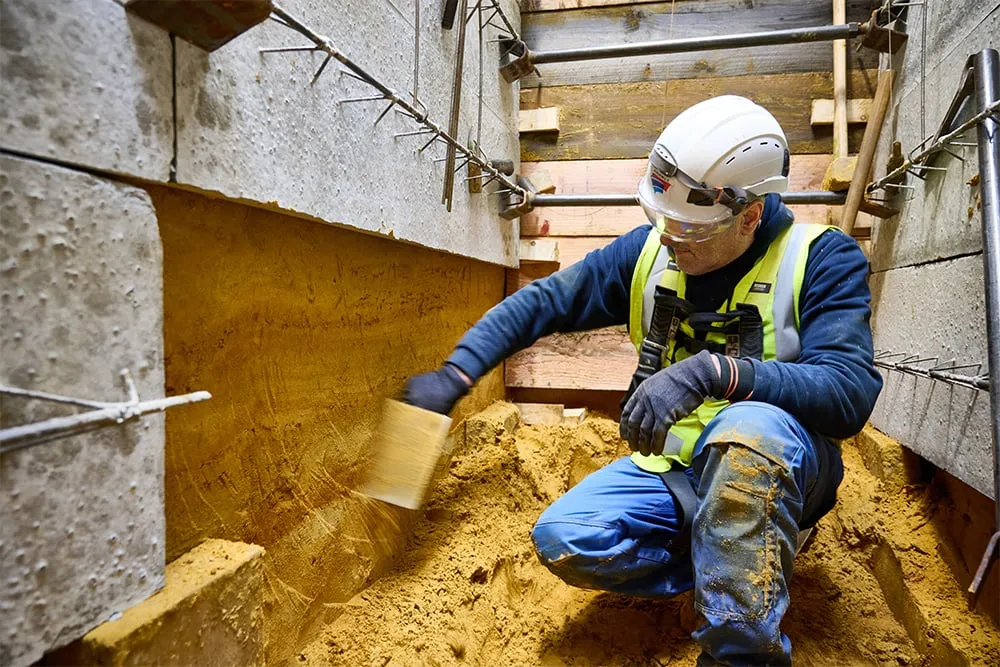
Franki Foundations is once again putting shored trenches, a fully manual technique, in the spotlight. The deep foundation specialist is receiving more and more requests for work in confined locations where construction machinery cannot be used. This is currently the case on the GEN project in Watermaal-Bosvoorde, where emergency exits must be installed in an existing covered railway cutting.
Etienne Delheusy, project manager at Franki Foundations: “In Watermaal-Bosvoorde, we are working as a subcontractor for Socogetra, a general contractor in the BESIX Group, near the point at Terhulpen where the tracks pass beneath the motorway. Initially, some of the emergency exits were to be built using soil mixing or secant piles. However, the allowable load on the roof made it impossible to use machinery. The client therefore opted for construction using shored trenches.”
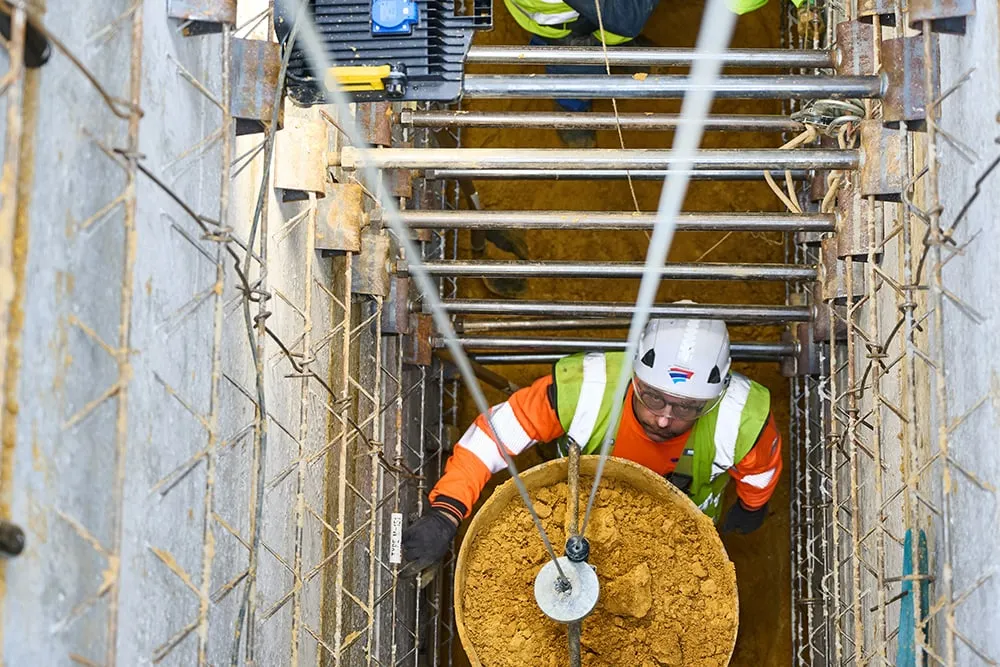
Imagine this: at the bottom of the trench, workers use shovels to fill a 70-litre bucket with soil. One worker hoists the bucket using a winch, then empties it into a wheelbarrow to remove the excavated earth. In the trench, the workers use a trowel to create square recesses for the precast floor slabs, which are lowered into the trench using the winch. Supports are installed between the slabs, and the work continues at greater depths.
17 metres deep
In Watermaal-Bosvoorde, the maximum depth reached is 17 m, with a trench width of 1.10 m, representing approximately 1,300 m³ of excavated soil. The contractor then only has to excavate the material between the trenches and the walls of the roof to create an opening. Etienne Delheusy: “Shored trenching is used on sites where it is impossible to work by any other means, often in railway and underground environments. We are also busy at Hasselt station, for example. In Brussels, some sites easily involve 1,000 m³ of shored trenching. Underpinning and underground structures are also among our specialities. We cover all bases.”
Question about this story? Ask your question
Who worked on it
GEN-project in Watermaal-Bosvoorde
- subcontractorFranki Foundations
- algemene aannemerSocogetra
Keep following this
Get an email when a new story is published. No account needed.
- ProjectGEN-project
- ThemeUsing and protecting the subsurface
- SubjectSewerage & underground infrastructure
- CompanyFranki Foundations
- CompanySocogetra







