









Sewerage & underground infrastructure
Custom-built KWS separator for sewer renovation in Mechelen
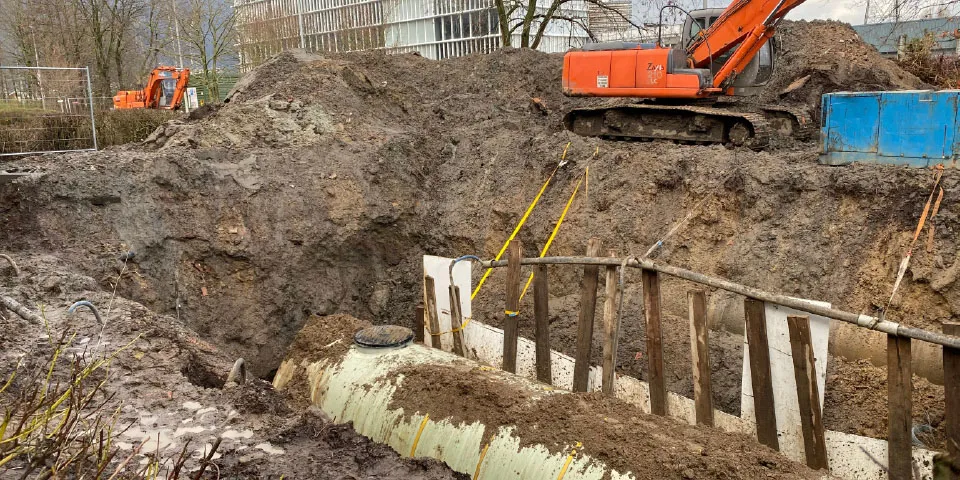
Mihali Wegenbouw is currently carrying out a sewer renovation project for Fluvius on the ring road around Mechelen, near Mechelen-Noord. A notable feature of the project is a 13 m-long hydrocarbon separator (KWS separator) made of glass fibre-reinforced plastic. ACO, a specialist in drainage technology, was commissioned to produce and supply this unique separator. “A fine example of precision custom engineering,” says ing. Rony Verbuyst, project manager at ACO.
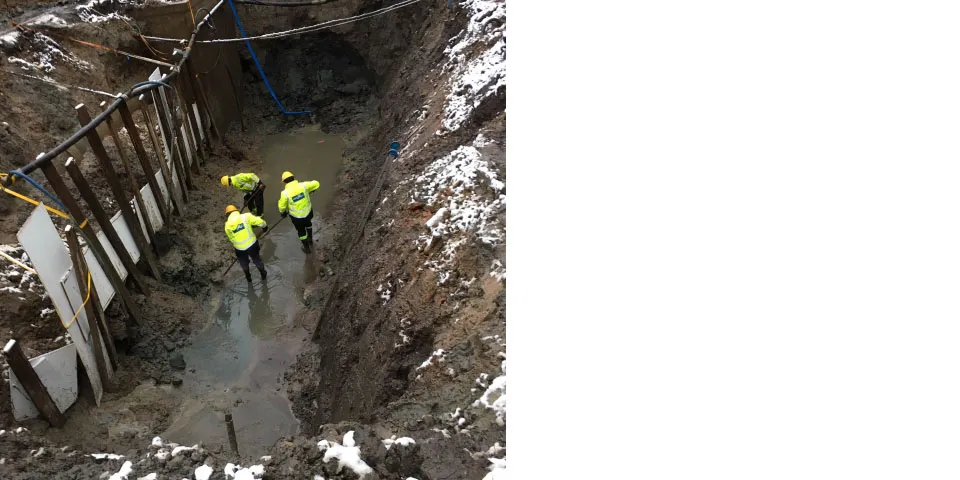
The 13 m-long separator was installed at a depth of 6 m.
The KWS separator was installed as part of the site’s renovation, which required the separation of rainwater and wastewater. Only the works required to renovate the sewer system were included. “There was no need to provide storage or infiltration capacity in the rainwater drainage system,” says Ine Schockaert, project engineer at the engineering consultancy involved, Evolta. “The only requirement for the KWS separator was that it could handle the required flow rate, based on the maximum pumping capacity of the adjacent pump sump. The challenge in this situation was that the rainwater pipes to be connected, with a diameter of 1,200 mm, were located quite deep, so the KWS separator also had to be installed at considerable depth. Additional modifications were therefore needed to make this possible.”
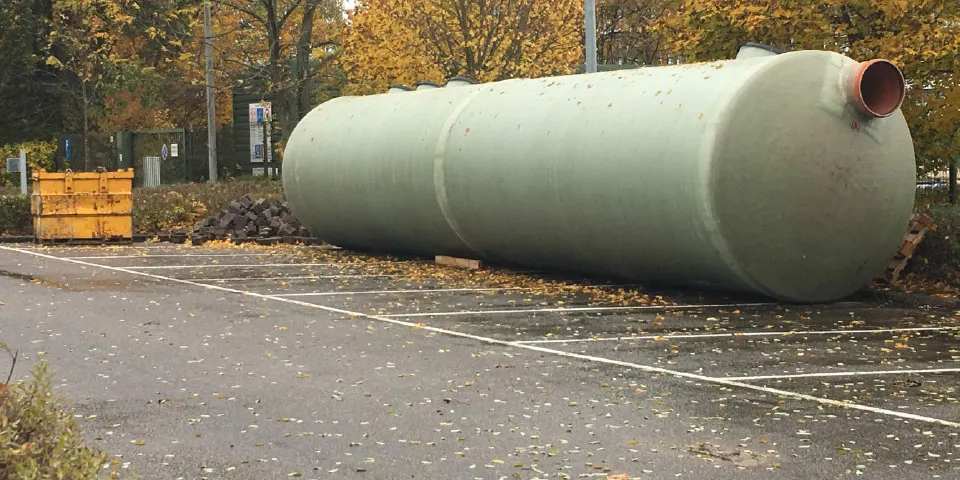
The KWS separator is a unique, custom-made unit manufactured from glass fibre-reinforced plastic.
Oleopator G NS200
ACO was initially asked to provide a KWS separator with a capacity of 125 l/s. “We submitted a proposal for a concrete structure, but the requirement then changed to a separator with a capacity of 165 l/s,” explains Rony Verbuyst. “If we built such a large separator in concrete, it would require a very large excavation and around four separate chambers connected together. Given the limited working space on this project, that was not an option.”
ACO therefore opted for a glass fibre-reinforced plastic (GRP) separator, the Oleopator G NS200. Rony Verbuyst explains: “Having just one chamber in a small footprint offers a major advantage with this design. In addition, the inlet and outlet are located at a depth of approximately 3 m, which is not feasible with standard plastic. Another advantage of this type of separator is its removable filter. It can be cleaned at any time while the separator remains in operation. Like our other separators, this unique unit was supplied with a matching D400-class cover. We can provide covers of this kind for all load classes.”
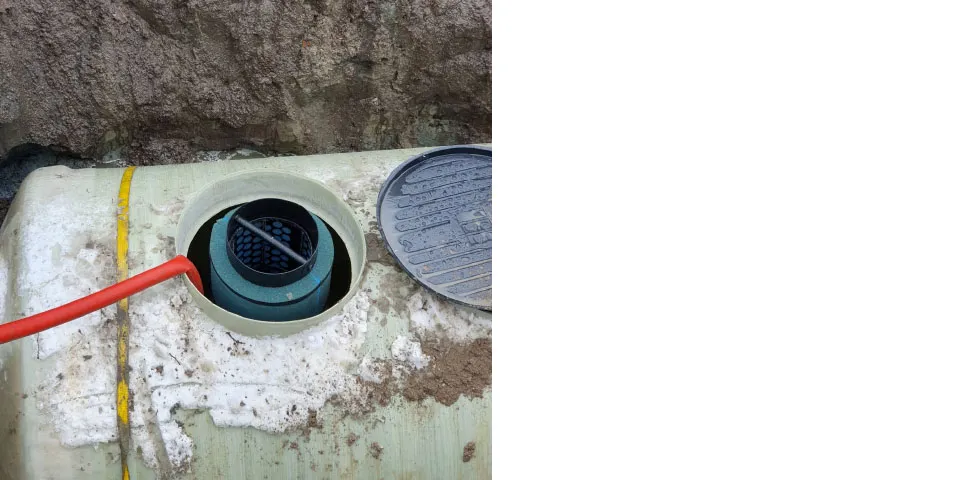
Another advantage of this type of separator is its removable filter.
Little room for manoeuvre
The KWS separator was installed earlier this year. “Getting it into position was quite a complex operation,” says Vincent Van Damme, site manager at Mihali Wegenbouw. “The weight was not so much of a problem, but its considerable length of 13 m was a challenge. Groundwater lowering was also necessary because the water table was too high. The separator was ultimately installed at a depth of 6 m. This was no easy task, particularly with so little room to manoeuvre and the site squeezed between a building on one side and an asphalt road on the other. Credit to our crane operator and foreman for bringing the operation to a successful conclusion, and to ACO for creating such a unique, custom-made separator. It took a lot of logistical planning, but everything went very smoothly in the end. The overall project has now been completed, and we are currently working on the inspection reports.”
Technical drawing of the installed KWS separator.
A bespoke project
ACO is also pleased with the outcome. “Quality and good service are core values at our organisation, and I feel we have demonstrated them in this project. We provide the customer with a detailed drawing showing all the components, the required extensions, covers and so on, giving them a clear picture of what is needed to ensure correct installation. Because the groundwater is so high, we offered to anchor the separator to a cast concrete base slab. This prevents it from floating when emptied. We also clearly mark the anchors on the drawing. We always work closely with the engineering consultancy, contractor and other parties involved on installation, depth and connections. This is a fine example of a bespoke project, which is one of ACO’s key strengths alongside the standard models we offer,” concludes Rony Verbuyst.
Een zakelijke vraag aan ACO? Get in touch
Companies in this story

Keep following this
Get an email when a new story is published. No account needed.
- ThemeFuture-proofing roads and railways
- SubjectSewerage & underground infrastructure
- CompanyACO







