









Sewerage & underground infrastructure
Backup pipeline for a sewer at a water depth of 66 m
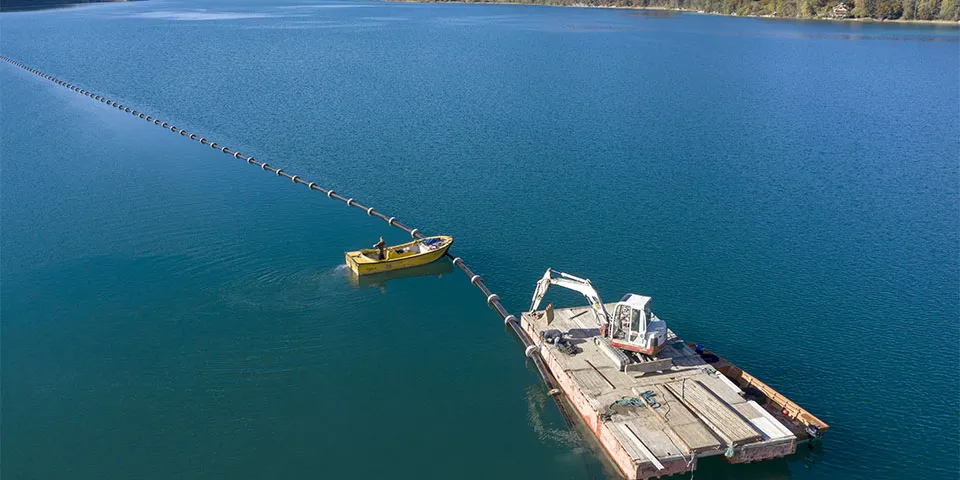
Since the early 1970s, pressure pipelines for wastewater have been installed in various lakes in Austria. This is also the case at Lake Fuschl in Salzburg, where a PE sewer pipeline has been in service on the lake bed since 1975. As its calculated service life of 50 years is soon due to expire, a parallel 4,200 m-long sewer pressure pipeline needs to be installed. This will serve as a backup pipeline that can be brought into service immediately if problems arise with the old pipeline. AGRU Kunststofftechnik is supplying the components required for the pressure pipeline, made from high-tech, stress-crack-resistant PE 100-RC.
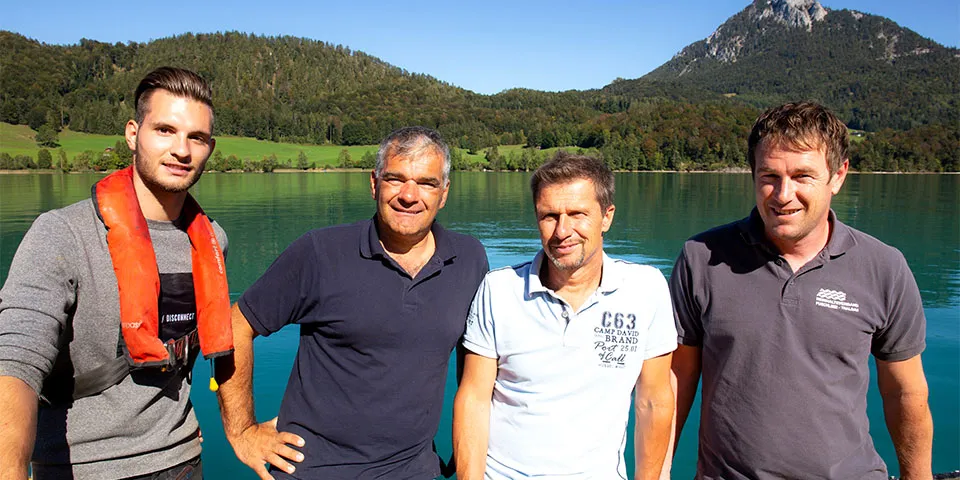
Ing. Erich Peer (second from left) and his son Manuel (far left) were responsible for the installation. Ir. Martin Roither (third from left) planned the pressure pipeline. Christian Winkler (right) is managing director of the water treatment association.
Pressure pipelines offer the advantages of rapid installation and leaving lakeshores, which are often protected natural areas, undisturbed during pipeline installation. They can also be laid in straight lines, reducing the length of pipe required. As a result, they have lower investment costs than a pipeline laid on land. However, because a pipeline laid in deep water is difficult to access if it is damaged, a replacement pipeline must always be available. For this reason, the Fuschlsee-Thalgau water treatment association is investing in a new parallel pressure pipeline made from PE 100-RC. The pipeline will run the full length of the crystal-clear mountain lake, whose water is so pure it is drinkable, carrying wastewater from the municipality of Fuschl am See. It will transport between 600 and 900 cubic metres of wastewater per day from one side of the lake to the other, where it will be conveyed via a collector to the wastewater treatment plant.
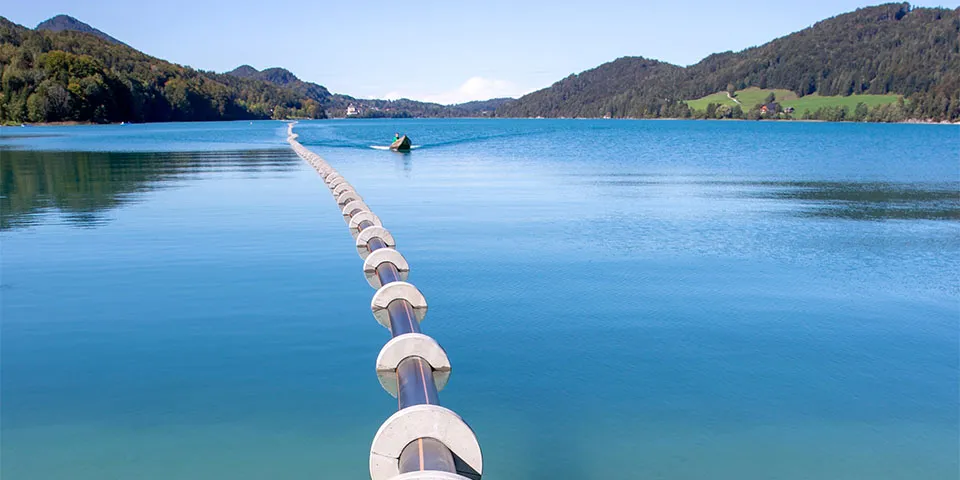
The spacing between the weights was calculated so that exactly half of the empty pipe would be submerged.
AGRU Kunststofftechnik had previously supplied 4,248 linear metres of polyethylene pipe with an OD of 280 mm and SDR 17 (16 mm wall thickness, maximum pressure of 10 bar), as well as fittings and a CNC-controlled butt-fusion welding machine. The black PE 100-RC pipes, with brown axial stripes clearly identifying their application (wastewater), are highly resistant to point loading and stress cracking. The system therefore provides extra safety over decades of service on the stony lake bed at a depth of 66 m, where the water temperature remains at just 4°C all year round due to the lake’s stratification. The material also offers very good resistance to the chemicals found in domestic wastewater, such as alkalis and surfactants.
PEER WASSERBAU GmbH. & Co. KG. is a recognised specialist in hydraulic engineering, structural engineering and civil engineering, with extensive experience in the professional installation of pressure pipelines in lakes. To complete the more than 4 km-long pressure pipeline, engineer Erich Peer and his team must weld together 18-metre-long pipes and then lower them into the pipeline route, all within the short period of about two months. The AGRULINE pipes are welded using the AGRU ST CNC 2.0 butt-fusion welding machine. Its latest control technology keeps all parameters, including pressure, temperature and time, under control. The machine records the parameters for every individual weld, as well as the welder’s name. Only an experienced, certified welder may produce the joints. As the individual pipe sections are joined using only the pipe material, the result is a monolithic, continuously corrosion-resistant pipeline system.
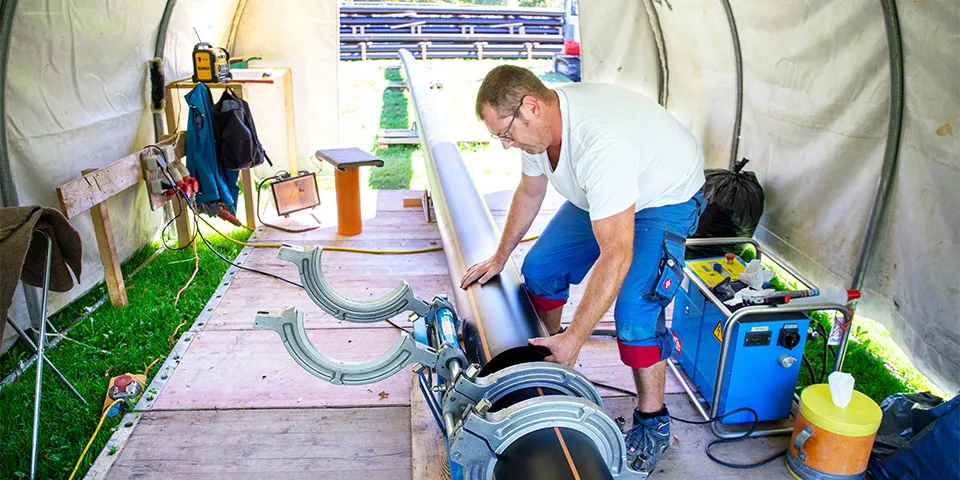
AGRU Kunststofftechnik supplied the pipes, fittings and welding machines for the new pressure pipeline in Lake Fuschl.
Weight is also an important consideration for pressure pipelines in lakes. Concrete weights must permanently prevent the pipeline system from floating, a risk further increased by the possible formation of fermentation gases in the pipeline. The weights also stabilise the pipeline, which lies submerged on the lake bed, ensuring it remains in the same position for decades. PEER uses prefabricated concrete elements made up of two halves, which are fitted around the plastic pipe like rings. The halves of each ring are then permanently joined with stainless steel bolts. A foam rubber insert is clamped between the pipe and the concrete to protect the pipe and provide extra security against slipping. These concrete collars, attached every 3 metres, compensate for around 50% of the buoyancy. Once the pipe is filled with water, the concrete weights will make it sink to the bottom.
Around 200 linear metres of ready-to-use pipeline are pushed into the lake from the shore each day. The wind could push the kilometre-long floating pipelines off course, so PEER anchors them each day and keeps them taut. After around two months of work in all kinds of weather, it is time to lower the 4.2 km-long pressure pipeline to the lake bed. Several general conditions must be taken into account before this process can begin. The lake bed along the pipeline route must be mapped in detail, and the exact positioning must also be established using GPS coordinates. The sinking process can then begin. To do this, lake water is carefully introduced into the pressure pipeline at one end, while compressed air is supplied at the other. The rate at which the pipeline sinks is critical, as it must not exceed a certain bending angle. After all, the future sewer will cross the entire length of the lake, including its deepest point at 66 m. The sinking process therefore takes several hours. Once the pipeline has been successfully sunk, the entire pressure pipeline is pressure-tested.
The Steinbacher + Steinbacher ZT GMBH office in Thalgau has many years of experience in urban water engineering and has successfully completed several projects with the Fuschlsee-Thalgau water treatment association. For this reason, Ir. Martin Roither of the Steinbacher office was commissioned to develop the overall concept. This included a feasibility study, planning, tendering and site supervision for the upstream retention basin, the pumping station and Lake Pipeline II through Lake Fuschl.
Christian Winkler is managing director of the Reinhalteverband Fuschlsee-Thalgau: “The water in Lake Fuschl is of drinking-water quality, and it must stay that way. The new pressure pipeline serves as a backup and gives us added security, as it can be brought into service within minutes in an emergency. In consultation with Mr Martin Roither (planning and site supervision), we therefore also opted for a plastic pipeline made from AGRU’s PE 100-RC, as studies have shown that a PE pipeline of this quality can last up to 80 years. We are satisfied with AGRU’s planning and delivery, as well as with the quality of the pipeline. I would also like to thank PEER for the professional and careful installation.”
Question about this story? Ask your question
Who worked on it
Meerdrukleiding Fuschlsee in Fuschl am See
- engineerSteinbacher + Steinbacher ZT GMBH
Keep following this
Get an email when a new story is published. No account needed.
- ProjectMeerdrukleiding Fuschlsee
- ThemeRenewing pipelines and sewers
- SubjectSewerage & underground infrastructure
- CompanySteinbacher + Steinbacher ZT GMBH







