









Sewerage & underground infrastructure
A textbook example of horizontal directional drilling
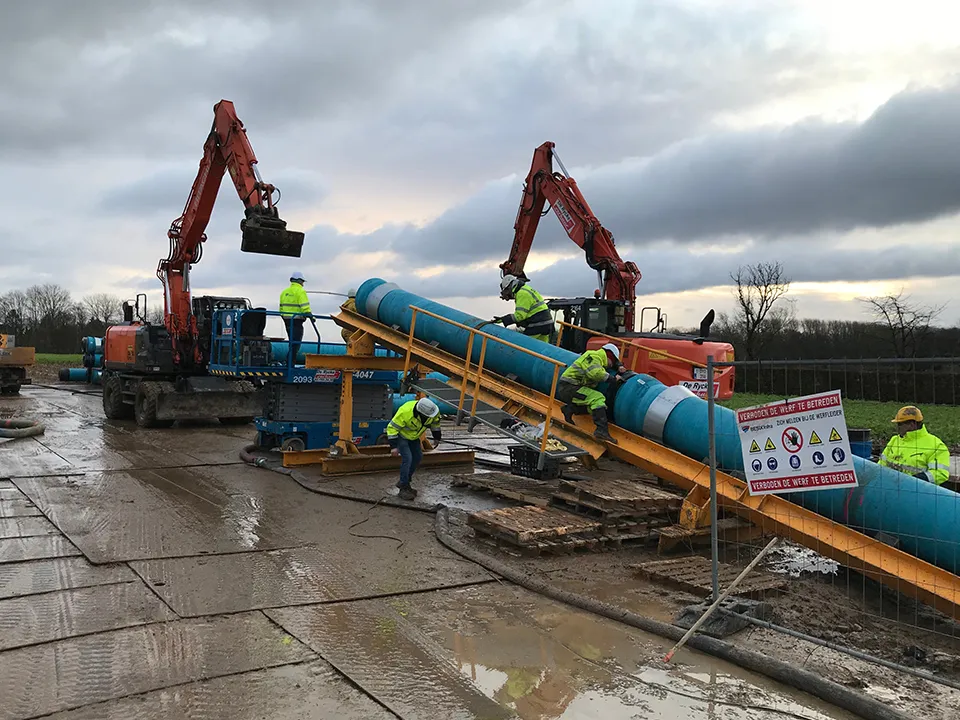
De Watergroep and water-link signed a long-term agreement for the supply of drinking water to Flemish Brabant at the end of 2016.
Commissioned by water-link, an approximately 7 km cast-iron drinking water pipeline was laid between the pumping station under construction on Pidpa’s site in Mechelen-Zuid and De Watergroep’s supply infrastructure in Zemst. Saint-Gobain PAM Belgium successfully delivered, among other things, the 1 km trenchless section.
Thanks to this collaboration between Pidpa, water-link and De Watergroep, drinking water is now supplied from water-link’s Productiecentrum Zuid in Rumst to De Watergroep’s distribution point in Zemst. This is via a new cast-iron pipeline with a total length of approximately 7 km, almost 6 km of which was laid in an open trench. The remainder of the route was completed using horizontal directional drilling. “It is a cast-iron pipeline with a diameter of 600 mm,” says Bart Stulens, Area Sales Manager at Saint-Gobain PAM Belgium. “Two sections, each 500 m long, including one beneath the E19, were successfully installed using horizontal directional drilling.”
Connection on a ramp
In horizontal directional drilling, a steel rod follows a predetermined route before emerging above ground at the correct point. Bentonite is then added and the hole is reamed by rotating the rod, gradually increasing its diameter until it reaches the required size. Bart Stulens explains: “At a certain point, the hole is large enough to receive the pipe. Saint-Gobain PAM prefers to use a mechanical coupling on a ramp, as it did on this project. This makes cast iron the ideal material, as it allows angular deflection and tight bends, unlike welded steel. With both welded steel and welded plastic, the entire pipe must be laid out, and there is usually not enough room to do so during horizontal directional drilling.”
Sustainable cast iron
For Saint-Gobain PAM Belgium, ductile cast iron is the clear first choice of material. “A cast-iron pipe is extremely robust and retains its mechanical properties underground. What is more, a cast-iron pipe is fully ‘cradle to cradle’. At the end of its service life, the pipe is crushed so that the cement lining on the inside falls away. The pipe itself is melted down to make a completely new cast-iron pipe. Cast iron is therefore the most sustainable material for both open-trench installation and horizontal directional drilling. And sustainability is a necessity in the sector today,” concludes Bart Stulens.
Een zakelijke vraag aan Saint-Gobain PAM Belgium? Get in touch
Who worked on it
Drinkwaterleiding Mechelen-Zuid Zemst in Zemst
- gietijzeren drinkwaterleidingSaint-Gobain PAM Belgium
Keep following this
Get an email when a new story is published. No account needed.
- ProjectDrinkwaterleiding Mechelen-Zuid Zemst
- ThemeRenewing pipelines and sewers
- SubjectSewerage & underground infrastructure
- CompanySaint-Gobain PAM Belgium







