









Provincial VLARIO contact days keep their finger on the pulse
Text Niels RouvroisImage Niels Rouvrois / Pixabay
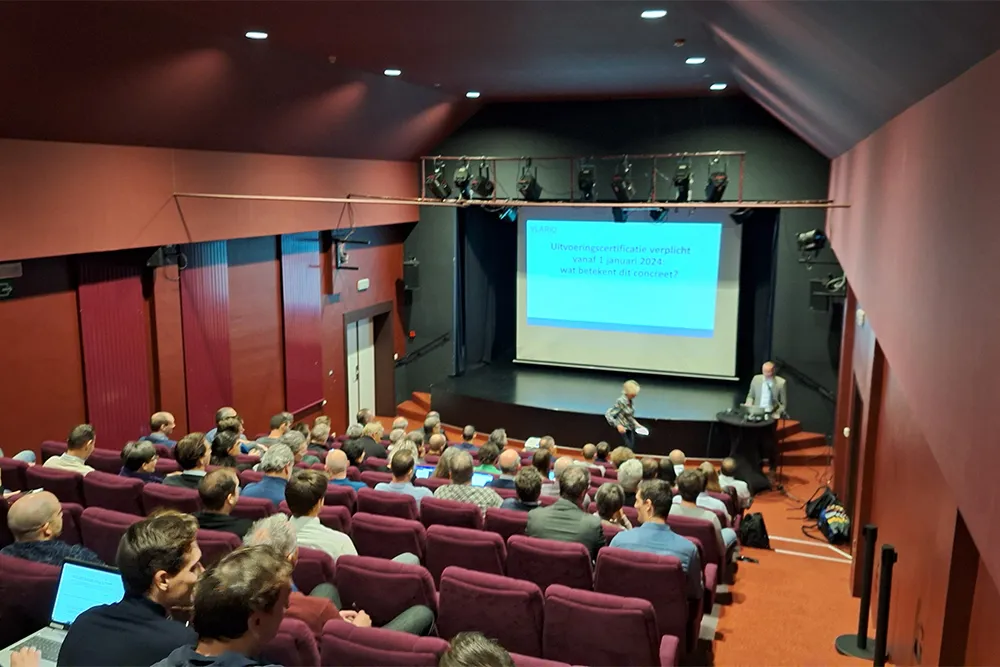
As is traditional, the VLARIO contact days took place this autumn. At these provincial events, VLARIO seeks to reach everyone involved in the province, including municipal authorities, other public bodies, consultancies and contractors, to inform them about the latest developments in the sewerage and wastewater treatment sector. The engaging programme was drawn up in collaboration with the municipal authorities working group. On 22 November, our editor-in-chief went along to the event in his home province of Limburg.
Interested stakeholders from the sector gathered at De Plak community centre in Diepenbeek in the afternoon. The opening remarks were delivered by Diepenbeek mayor Rik Kriekels: “We stand behind VLARIO’s new mission,” the mayor made clear. “Together, we must ensure that a liveable and resilient rainwater and wastewater system is actually delivered in every town and municipality in Flanders. Let’s work together towards a future in which our municipalities can thrive.”
VLARIO director Wendy Francken then took the floor. She highlighted the importance, and above all the value, of the provincial contact days, outlined the busy programme for the day and returned to the amended subsidy decision for the construction of municipal sewers. The subsidy decision was amended on 7 July 2023. The changes simplify the administrative procedure for sewer managers and set a clear timetable so that subsidised projects can be delivered more quickly. Given that lead times are still far too long, this is something we can only welcome.
Multi-year plan
The multi-year plan for municipal authorities was also put under the spotlight at the contact day in Diepenbeek. 2024 will be an election year, including at local level. In 2025, the new authorities will therefore draw up their six-year municipal multi-year plans: the driving force behind investment in public space. An environmental analysis is a mandatory part of the multi-year plan. It enables local authorities to map their surroundings, broader societal trends, and the needs and requirements of all stakeholders. The Association of Flemish Cities and Municipalities (VVSG) offers guidance sheets to help them get started.
Xavier Buijs, policy officer for spatial planning at VVSG, explained what this entails. “The new local authorities will soon be drawing up multi-year plans. If your ideas are included in those plans, you can be much more confident that they will actually be put into practice. What’s more, this is the final planning period before 2027, the deadline under the European Water Framework Directive. The multi-year plan itself will be drawn up in 2025, but work on the environmental analysis can start now. There are no Flemish rules prescribing how this analysis should be prepared, so the authorities have considerable freedom. What should it include? It should map the various societal trends, as well as residents’ needs and the municipality’s overall priorities. At VVSG, we support this process by listing points for consideration across 27 policy areas. Our advice is to read through the guidance sheet and use it for inspiration when preparing the environmental analysis.”
Infiltration is the way forward
Larger rainwater tanks and more water being infiltrated into the ground are among the many measures Flemish Environment Minister Zuhal Demir wants to introduce to better protect Flanders against drought and ensure people have enough water at home. In Diepenbeek, the Working Group of Consultancies, an initiative by VLARIO, ORI and OVIO, took a closer look at creative solutions for infiltrating rainwater in line with the new GSV Hemelwater. “Pay more attention to water and aim to infiltrate as much rainwater as possible at the surface,” was the clear message.
The aim, then, is to provide as many green spaces as possible in public areas, so that as much rainwater as possible can infiltrate. The key is to consider how this can be done as naturally as possible, with close attention to fauna, flora and soil design. “Climate change is threatening the liveability of our urban environments. Reducing heat stress is therefore an important priority.”
Networking
Alongside the multi-year plan and the new GSV Hemelwater, many other topics were discussed. These included enforcement of the GSV: what options are available, and how can you get started? The importance of asset management was, once again, highlighted, as were the implementation certification requirements that come into force on 1 January 2024 and the challenges involved in carrying out dewatering. As is traditional, the day concluded with refreshments and a convivial, productive networking session.
Question about this story? Ask your question
Keep following this
Get an email when a new story is published. No account needed.
- ThemeRenewing pipelines and sewers
- SubjectGeneral







