









Nieuwpoort storm surge barrier protects city and hinterland
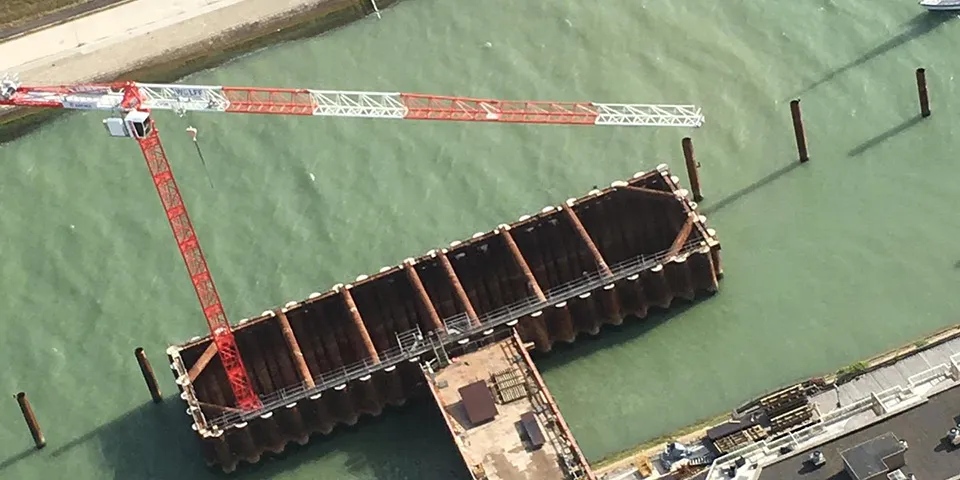
There is no doubt that the future storm surge barrier in Nieuwpoort is one of the most important flood defence structures in Belgium. The storm surge barrier will provide the necessary protection for the port, the city of Nieuwpoort and its hinterland.
Herbosch-Kiere has played an important role in hydraulic engineering projects for more than a hundred years. Kristof De Scheerder: “Herbosch-Kiere is part of the Eiffage Benelux Group, which in turn belongs to Eiffage France, one of the largest construction contractors in Europe. Our main activities include the construction of quay walls, bridges, jetties and locks. We have helped deliver several notable projects, including the harbour breakwater in Oostende, the Kieldrechtsluis at the port of Antwerp, the new weir lock in Harelbeke and the Scheldekaaien in Antwerp.”
Movable storm surge barrier
For the project in Nieuwpoort, the temporary joint venture Herbosch-Kiere/Jan De Nul was established. On behalf of the MDK agency (Maritime and Coastal Services) of the Flemish Government, it is building a movable storm surge barrier at the mouth of the IJzer. Movable barriers in waterways, river estuaries and sea inlets are closed in the event of extreme high water. The barrier in Nieuwpoort is a movable steel structure that, in its ‘parked’ position, sits recessed in a concrete sill on the bed of the IJzer. Kristof De Scheerder: “When a storm surge is forecast, the barrier can be rotated through 90°. It rotates around two cast-steel shafts anchored at either abutment. For maintenance, it can be rotated a further 90°, making 180° in total. This ensures that it remains fully operational at all times.”
1,000-year storm
Storm surges are one of the main natural hazards in the North Sea region. Coastal ports are currently most at risk of flooding during severe storms. Nieuwpoort and its hinterland are also unprepared for the high water levels that accompany severe storms. To protect the coast and hinterland from severe storm surges, the Flemish Government approved the Masterplan Kustveiligheid in 2011. In the same year, the MDK agency began implementing measures along our coast. Its approach is based on the principle ‘soft where possible, hard where necessary’. Through beach nourishment, the agency aims to create a coast that is both safe and attractive, while preserving its natural character.
In some locations, protection from a wider and higher beach is insufficient or not possible. Additional measures are taken there, such as building a storm wall, a wave-dissipating structure, a wider dike or, as in Nieuwpoort, a storm surge barrier. The storm surge barrier is already needed to provide protection against storm surges with a 1-in-10-year probability of occurrence. However, it will also protect against a 1,000-year storm surge. This is a very severe storm that, statistically, can occur once every 1,000 years. The calculations allow for a sea-level rise of 80 cm by 2100.
Construction pit
One of the main challenges so far has been completing the construction pit as a whole. Kristof De Scheerder: “To build the abutment into which the cast-steel shafts are anchored, we first had to construct a dry construction pit. It is being built 10 m from the riverbank and consists of a combi-wall, made up of tubular piles combined with sheet piles. We also had to take the tides into account at all times. The construction pit moved with the tide, and the loads differed between high and low tide. We therefore used equalisation gates in the intermediate panels, keeping the water level inside and outside the construction pit the same.”
Innovative dredging tool
An innovative dredging tool was developed specifically for this project to remove the soil plugs from the foundation piles and the combi-wall piles. “The piles had to be cleared out to a depth of 26 m. The foundation piles have a diameter of 1.27 m, while the combi-wall piles have a diameter of 1.42 m. We had a dredging pump with 2 cutter heads modified so that it would also fit the smallest diameter,” Kristof De Scheerder explains.
After a summer break, work resumed in early September. Kristof De Scheerder: “We have started building the 18 m-high walls of the abutment on the left bank. This work will take about seven months. Once it is complete, part of the construction pit can be removed and work can begin on the construction pit on the right bank. This will be an exact copy of the other one. The 2 construction pits could not be built at the same time, as we had to guarantee a constant navigable width of 35 metres. This is why the phasing is so important.”
Een zakelijke vraag aan Herbosch-Kiere? Get in touch
Wie aan Stormvloedkering Nieuwpoort werkte
- temporary partnership
 Herbosch-KiereMentioned in Construction of second cofferdam for Nieuwpoort storm surge barrier enters final phase
- temporary partnershipJan De Nul GroupMentioned in Construction of second cofferdam for Nieuwpoort storm surge barrier enters final phase
Keep following this
Get an email when a new story is published. No account needed.
- ProjectNieuwpoort storm surge barrier
- ThemeStrengthening waterways and coastlines
- SubjectGeneral
- CompanyHerbosch-Kiere







