









Exceptional transport by water: huge concrete sill for storm surge barrier travelling from Kallo to Nieuwpoort
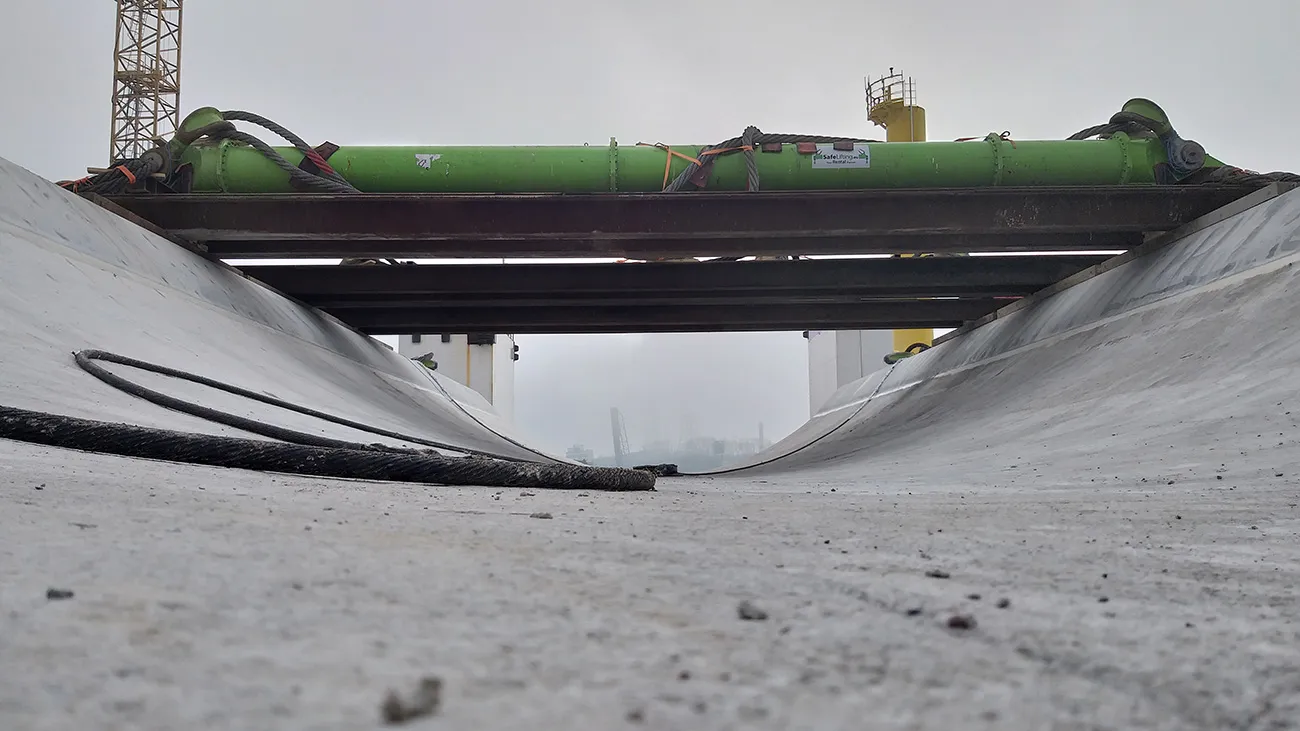
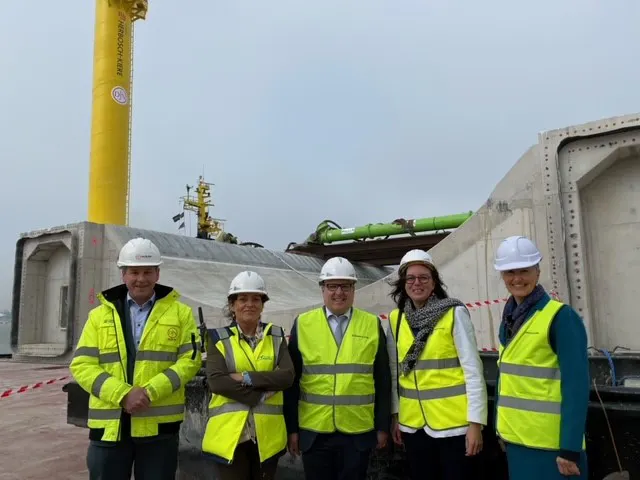
An unusual cargo is set to leave Kallo, in the Port of Antwerp, shortly. It is a pontoon carrying a huge concrete sill. Final destination: the harbour entrance channel at Nieuwpoort. The sill is a key component of the storm surge barrier currently being built there by the Agency for Maritime and Coastal Services (MDK). The barrier will protect Nieuwpoort against very severe storm surges. Minister for Mobility and Public Works Lydia Peeters came to see the final work being carried out on the huge sill.
The concrete sill, which has been under construction in Kallo over the past few months, measures 23.5 metres wide, 42.1 metres long and five metres high. It will soon be installed in the harbour entrance channel at Nieuwpoort, between the two abutments of the storm surge barrier. The steel barrier will later sit in the sill when it is in its normal, open position.
“The construction of the storm surge barrier is unique for our country,” says Minister Lydia Peeters. “Seeing the sill here, transporting it alone is a remarkable feat. A great many different parties are working together to get the sill safely to its final destination. Everyone involved in this project is rightly proud to play a part in the whole process.”
“The storm surge barrier is essential to protect Nieuwpoort and its hinterland against flooding,” says Minister Lydia Peeters. “The coastal ports are currently most at risk of flooding when severe storm surges occur. Nieuwpoort is also not yet prepared for the high water levels that can accompany severe storms. To protect Nieuwpoort, the Flemish Government is investing €58 million in the construction of the storm surge barrier at the mouth of the IJzer. The structure is one of the measures in the Coastal Safety Master Plan, which is designed to protect our entire coastline against severe storm surges through to 2050.”
Dirk Van Rompaey, Director of Civil Works, Jan De Nul Group: “Our Belgian coast is vulnerable to rising sea levels. The storm surge barrier that Jan De Nul is building in Nieuwpoort is part of a series of government measures to protect 67 km of coastline. It is a unique hydraulic engineering structure that brings together all the know-how and expertise of civil and maritime engineering. A perfect fit for Jan De Nul. Lowering the concrete sill into place for this barrier is an important milestone in the project. It is a remarkable feat, delivered by Jan De Nul in collaboration with Herbosch-Kiere.”
Benny De Sutter, CEO of Herbosch-Kiere: “As the work took place on our site in Kallo, we had the privilege of following it closely and seeing the sill take shape every day. It was a special experience for our people here in the office. Work on this impressive, enormous structure went extremely smoothly, and we are proud of our employees, who have worked with great flexibility and professionalism over the past period. We are fully prepared for the eventful journey to the sill’s final destination in Nieuwpoort.”
Transport by water
Getting the sill from Kallo to Nieuwpoort certainly qualifies as an exceptional transport operation. The sill has been built on a submersible pontoon. Two tugboats will first tow the pontoon along the Scheldt and then out to sea as far as the port of Ostend. The journey takes around twelve hours.
Several links in the nautical chain are working closely together to transport the sill along the Western Scheldt and out to sea. The Common Nautical Authority (GNA) authorises the river route, while the Maritime Rescue and Coordination Centre (MRCC) issues the permit for the sea passage. A pilot will be on board for both the Scheldt section and the sea passage to Ostend.
Permits for this exceptional transport have been issued, setting out specific safety requirements.
On arrival in Ostend, all the sea-fastening equipment that prevents the sill from shifting or tipping over during transport is removed. The sill is then attached to a crane on a second pontoon, the Matador III. The concrete sill weighs more than 4,500 tonnes, too much for the Matador III to lift. Anyone who remembers Archimedes’ principle will know that an object is easier to lift underwater. The pontoon will therefore be submerged, bringing the sill completely underwater. The load to be lifted is then ‘only’ 1,210 tonnes. This operation takes 16 to 20 hours. A number of checks must then be carried out. Only then is the sill, suspended from the crane on the Matador III, ready for the final leg to Nieuwpoort, a journey of around six hours.
When the sill reaches the harbour entrance channel at Nieuwpoort, it will be lowered between the two abutments. This takes around 1 day. Finally, the sill must be secured in place. The harbour entrance channel will be fully closed for around ten days to allow this work to be carried out. Divers will be on hand throughout the process in Nieuwpoort to check that the installation is proceeding correctly.
Progress of the works
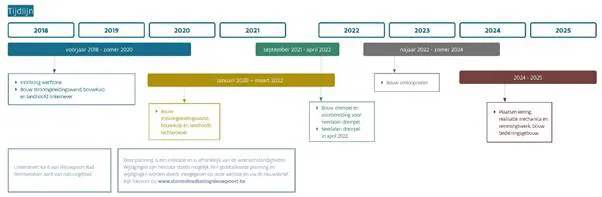
Installing the concrete sill is an important milestone in the construction of the storm surge barrier. The MDK agency began work in spring 2018. In the harbour entrance channel at Nieuwpoort, both concrete abutments and the flow deflection walls have now been built, and the sinking trench for the sill has been completed.
Construction of the bypass culverts will begin this autumn. These are side channels that will be built into each of the abutments. They will ensure that flow speeds at spring tides do not exceed three knots. This will be followed by installation of the steel barrier, completion of the mechanical systems and fendering, and construction of the control building on the right-bank abutment.
The entire project is due to be completed in 2025.
Background information on the storm surge barrier
When a storm surge is forecast, the storm surge barrier will close off the harbour entrance channel, preventing water from flowing into the port and its hinterland. The barrier is already needed to provide protection against storm surges with a one-in-ten-year probability of occurring. It will also protect against a 1-in-1,000-year storm surge. The design allows for a sea-level rise of 80 centimetres by 2100.
The sill in figures
Weight: 4,570 tonnes
Dimensions: 23 metres wide, 42.1 metres long, 5 metres high
1,732 m³ of concrete
572,450 kg of reinforcing steel
Would you like to know how the storm surge barrier will work? Visit www.stormvloedkeringnieuwpoort.be for more information.
Een zakelijke vraag aan Herbosch-Kiere? Get in touch
Wie aan Stormvloedkering Nieuwpoort werkte
- temporary partnership
 Herbosch-KiereMentioned in Construction of second cofferdam for Nieuwpoort storm surge barrier enters final phase
- temporary partnershipJan De Nul GroupMentioned in Construction of second cofferdam for Nieuwpoort storm surge barrier enters final phase
Keep following this
Get an email when a new story is published. No account needed.
- ProjectNieuwpoort storm surge barrier
- ThemeStrengthening waterways and coastlines
- SubjectGeneral
- CompanyHerbosch-Kiere







