









Construction of second cofferdam for Nieuwpoort storm surge barrier enters final phase
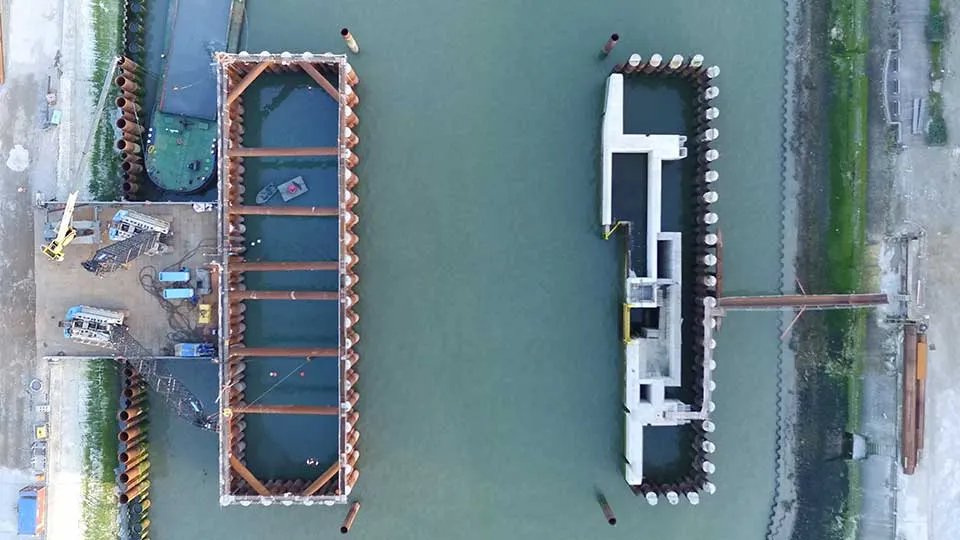
The future storm surge barrier in Nieuwpoort is undoubtedly one of Belgium’s most important flood defence structures.
The storm surge barrier will provide essential protection for the harbour, the city of Nieuwpoort and its hinterland. A temporary joint venture, Jan De Nul Group and Herbosch-Kiere are taking on this impressive project. Following the construction of the cofferdam on the left bank in an earlier phase, the cofferdam on the right bank has now also reached its final phase. “The design and plans, the retaining structures, the foundations and the concrete works are all being carried out using our own resources and expertise,” they say proudly.
In 2011, the Flemish Government approved the Coastal Safety Master Plan to protect the coast and its hinterland from severe storm surges. Storm surges are one of the most significant natural hazards in the North Sea region. Coastal harbours are currently at greatest risk of flooding during severe storms. Nieuwpoort and its hinterland are also unprepared for the high water levels associated with severe storms. To protect Nieuwpoort and the surrounding area, the Master Plan identifies the need to build a storm surge barrier at the mouth of the IJzer. Following extensive studies and an architectural design, a horizontal sector gate with a navigation opening 38 m wide was selected.
Temporary joint venture
For the Nieuwpoort project, the TM Herbosch-Kiere/Jan De Nul was set up. On behalf of the Flemish Government’s MDK agency (Maritime Services and Coast), it is building a movable storm surge barrier at the mouth of the IJzer. Movable barriers in waterways, river mouths and estuaries close in the event of extreme high water. The barrier in Nieuwpoort is a movable steel structure that, in its ‘parked’ position, sits recessed into a concrete sill on the bed of the IJzer. When a storm surge is forecast, the barrier can be rotated through 90°. It rotates around two cast steel shafts anchored in the two abutments. For maintenance, it can rotate a further 90°, to 180° in total. This ensures that it remains fully operational.
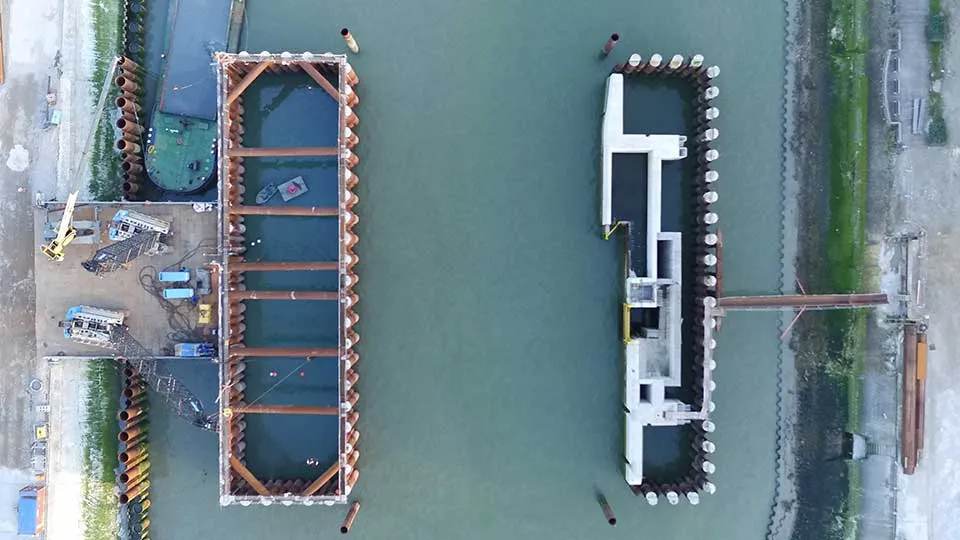
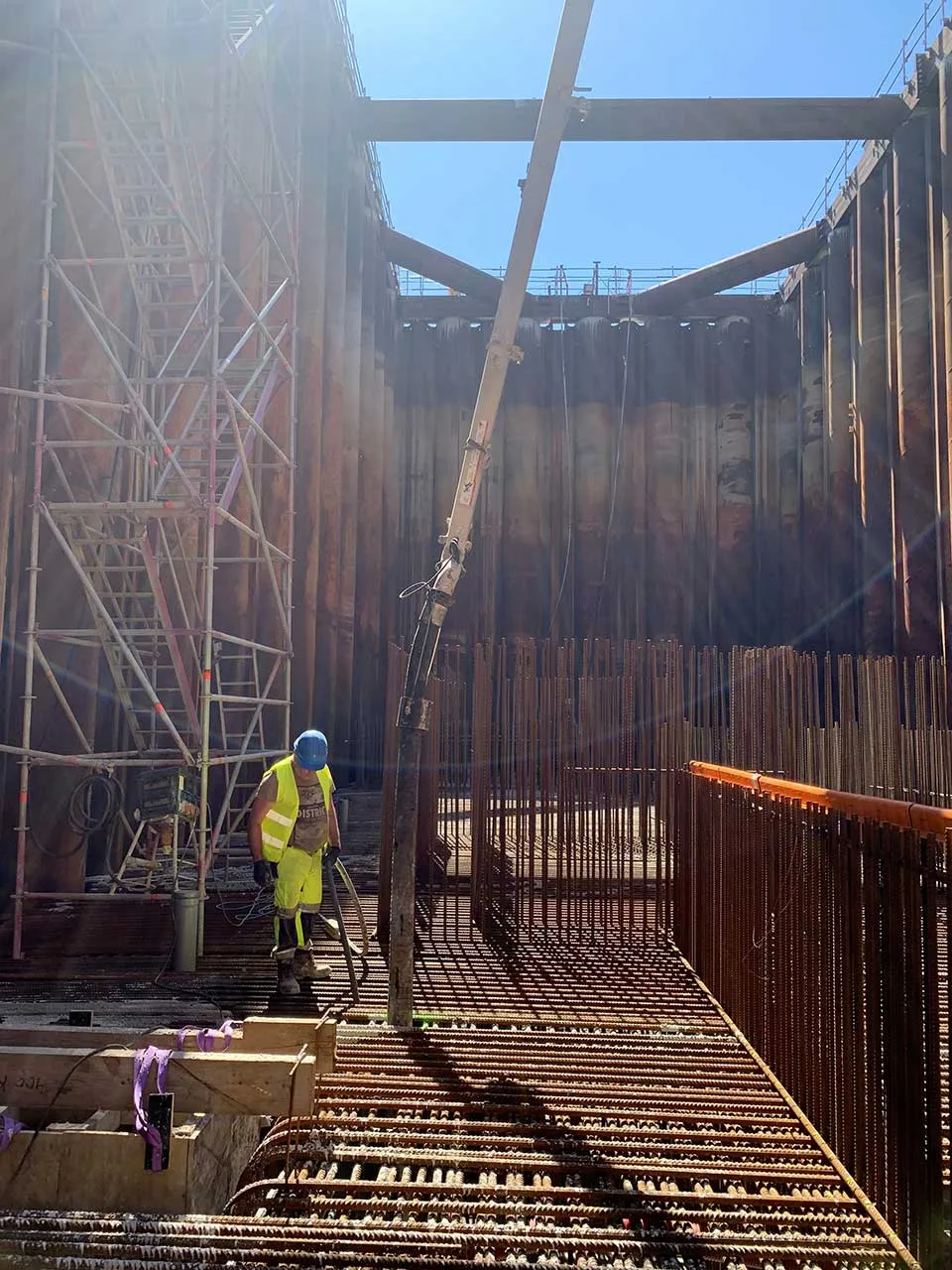
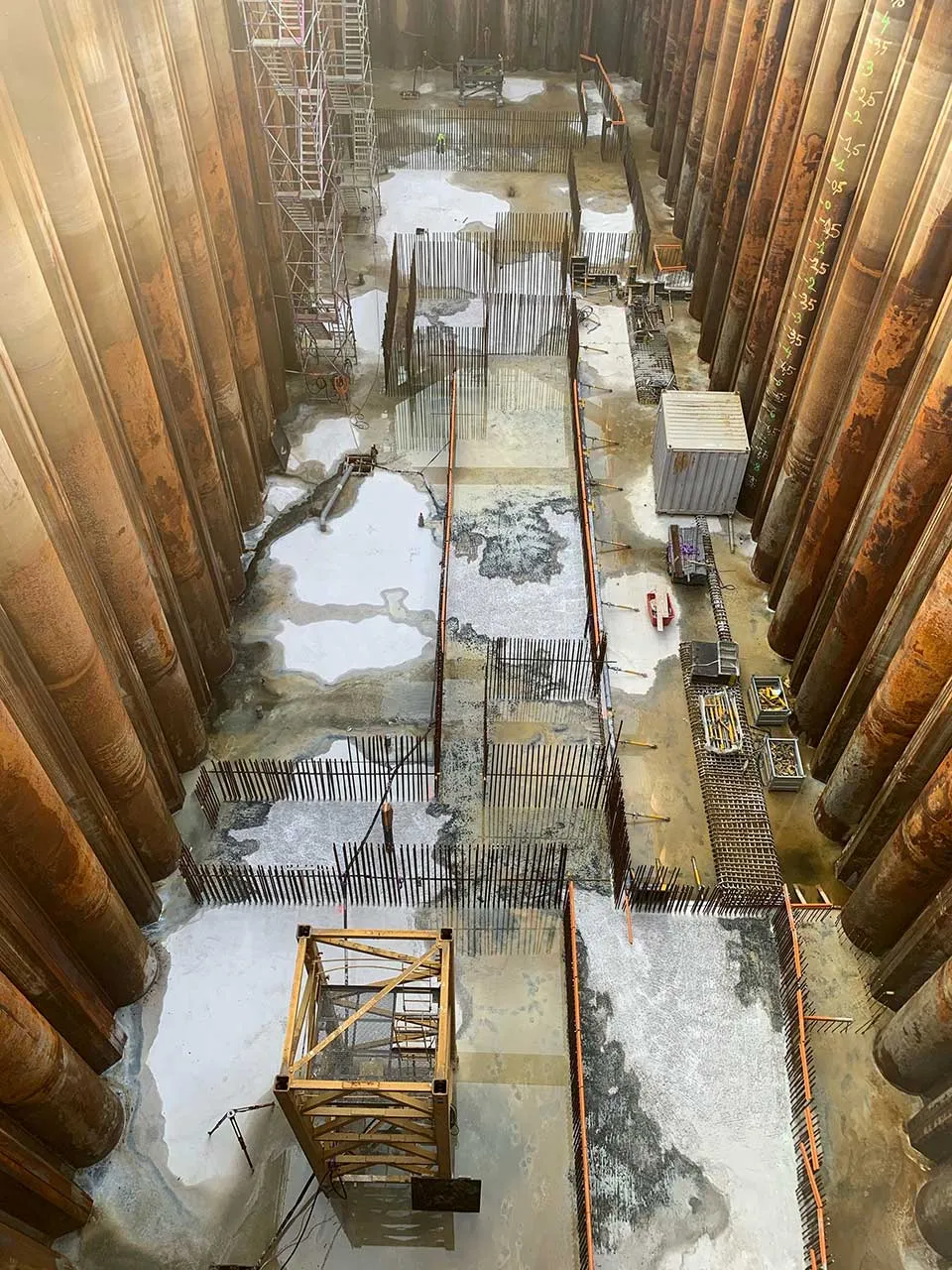
The cofferdam on the right bank is now ready for construction of the abutment. 53 steel tubular piles and an equal number of sheet piles allow workers to carry out the work in the dry. A further 42 tubular piles have been driven inside the cofferdam to provide the abutment’s foundations. The underwater concrete has been poured, the cofferdam dewatered and the reinforcement for the base slab installed during the Easter holidays. As far as possible, all materials were delivered outside the ferry’s operating hours. “The cofferdam on the right bank is essentially a mirror image of the one on the left bank,” says Arnold Feys, project manager at Jan De Nul Group. “The knowledge and experience gained from the works on the left bank have enabled us to optimise the construction method.”
Sill
If all goes according to plan, tower cranes will be erected in June to begin formwork for the abutment on the right bank. “The abutment on the left bank is already complete, apart from the roof slab,” explains Koen Ameye, head site manager at Herbosch-Kiere. “Once the abutment on the right bank is also complete, we will build the sill, which connects the two abutments. The sill is a concrete structure that we will lower below the bed level of the IJzer. According to the schedule, it will be built in spring 2022 on a sinking pontoon at Herbosch-Kiere’s site. After the sill has been transported by pontoon to Oostende, a crane will take over and move it to its final position in Nieuwpoort.”
Weather-dependent
At a later stage, in 2023 and 2024, the electromechanical, hydraulic and steel components will be integrated. It is now more than three years since the overall project began. Arnold Feys says: “Overall, we are certainly pleased with the project’s progress. We could have been further along, but there are always unforeseen circumstances beyond our control. We are, for example, very dependent on the weather. The site is highly exposed to the wind, and strong swells and high waves prevent us from carrying out piling or removing silt. We also encountered unforeseen ground conditions when excavating the cofferdam. These are all things beyond our control, but ultimately they have not caused any major problems. We have also been able to make organisational adjustments. We have, however, asked to continue working through the summer construction holiday. The date for installing the sill, in May 2022, is critical, as preparatory works in the navigation channel will cause significant disruption to shipping.”
Challenges
For Jan De Nul and Herbosch-Kiere, two experienced players in the field, this remarkable contract is right up their street. “But that doesn’t mean we haven’t faced challenges,” says Koen Ameye. “A number of unusual techniques are being used, such as underwater flame-cutting of pipes. The piling work was also far from routine because of the location and the difficult weather conditions. There is also a great deal of specialist diving work involved.” Arnold Feys agrees and stresses the project’s unique nature. “This storm surge barrier is an absolute first for Belgium.
There are only a few barriers of this kind in Europe. The size of the abutments and the considerable depth also make it highly specialised, as do the electromechanical systems and the installation of the large steel gate at a later stage. In terms of scale and cost, we have completed larger contracts, but technically this is certainly a remarkable project.”
The movable steel barrier rotates around a horizontal axis. In its parked position, it sits recessed into a concrete sill on the bed of the IJzer and rotates between two cast steel shafts anchored in concrete abutments. These two abutments are connected to the banks of the IJzer. When a storm surge is forecast, or for a test closure, the barrier is rotated through 90° into the closed position. For maintenance, it can be rotated into the 180° maintenance position. In all three positions, parked, closed and maintenance, the storm surge barrier can be locked and unlocked by remote control.
Extensive experience
The storm surge barrier will be fitted with an operating mechanism on each side, allowing it to rotate in one continuous movement from the parked position to the closed or maintenance position. The mechanisms have sufficient capacity to rotate the barrier from the parked to the closed position at any water level, even if only one of the two mechanisms is operating. “Both Herbosch-Kiere and Jan De Nul have extensive experience in waterway and piling works. We complement each other very well and, importantly, in addition to our experience, we have the equipment and workforce to deliver the project,” says Koen Ameye. Arnold Feys adds: “A major strength is that we have all the expertise in-house, from civil engineering to the most complex mechanical and hydraulic systems. We can call on our own specialists for every part of the work. We are delivering this project using our own expertise, which is also a major added value for the client.”
Een zakelijke vraag aan Herbosch-Kiere? Get in touch
Wie aan Stormvloedkering Nieuwpoort werkte
- temporary partnershipJan De Nul GroupIn this story

Keep following this
Get an email when a new story is published. No account needed.
- ProjectNieuwpoort storm surge barrier
- ThemeStrengthening waterways and coastlines
- SubjectGeneral
- CompanyHerbosch-Kiere
- CompanyJan De Nul Group







