









New Mechelen-Zemst drinking water link improves security of supply
To improve security of supply, De Watergroep, water-link and Pidpa joined forces in 2019 to build a new drinking water link between Mechelen and Zemst.
Thanks to this collaboration, drinking water is now supplied from water-link’s Zuid Production Centre in Rumst, via Pidpa’s network, to De Watergroep’s distribution point in Zemst. The new nodular cast iron pipeline is approximately 6.8 km long. The link was commissioned at the end of September and cost a total of 11 million euros.
At the request of the Flemish Government, several Flemish water companies are entering into partnerships. In late 2016, De Watergroep and water-link signed a long-term agreement to supply drinking water to Flemish Brabant. The aim of the collaboration is to supply drinking water from water-link’s Zuid Production Centre in Rumst to De Watergroep’s distribution point in Zemst. To make this possible, water-link commissioned the construction of a drinking water pipeline between the booster station on Pidpa’s site at the water tower in Mechelen-Zuid and De Watergroep’s supply infrastructure in Zemst.
Booster station and meter room
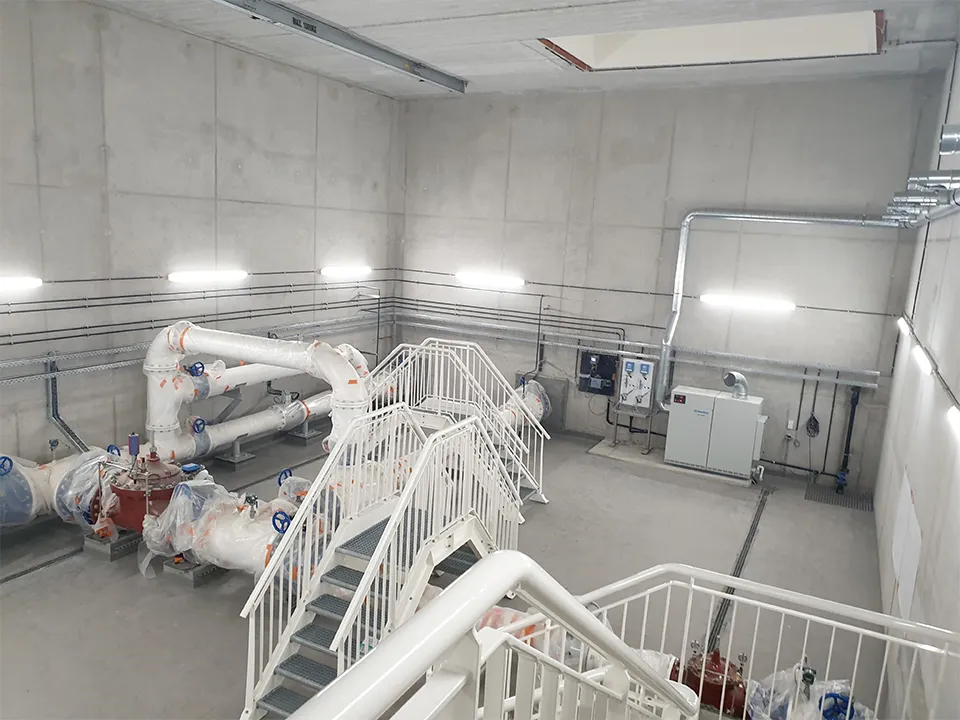
While water-link was responsible for laying the pipeline, De Watergroep built a new meter room in Zemst and Pidpa constructed a booster station to feed the supply pipeline to Zemst. “An additional booster station was absolutely essential,” says Lieven De Maeyer, design engineer at Pidpa. “Water-link supplies water to the water towers in Mechelen-Noord and Mechelen-Zuid via an existing link with a diameter of 600 mm. The water is supplied at a pressure corresponding to the height of the water tower’s tank, which is around 5 bar. Because the supply area is at a higher elevation, De Watergroep requires a higher pressure of around 7.5 bar, so the water had to be pumped a second time. The booster station provides an important link between water-link and De Watergroep via Pidpa, and is crucial to guaranteeing security of supply. Another benefit of this new drinking water link is that tap water for around 30,000 customers in the region concerned will now be slightly softer.”
De Watergroep coordinated construction of the new meter station in Zemst. “Until recently, part of north-west Flemish Brabant was supplied from the reservoir in Meerbeek, which is itself fed by smaller water production centres,” says Gertjan Meulemans, project leader at De Watergroep. “But when water consumption is high, the Meerbeek reservoir comes under pressure. Supply from water-link and/or Pidpa is therefore very useful for relieving the water production centres that feed it, by pushing water against the pressure from Meerbeek. With that in mind, we built a completely new meter room in Zemst. A meter room is essentially a junction where different flows meet, in this case, supply from Pidpa and water-link on the one hand, and inflow from the Meerbeek reservoir on the other. The quality of the incoming water is also monitored in the meter room, which measures approximately 10 m by 20 m.”
Pipeline construction
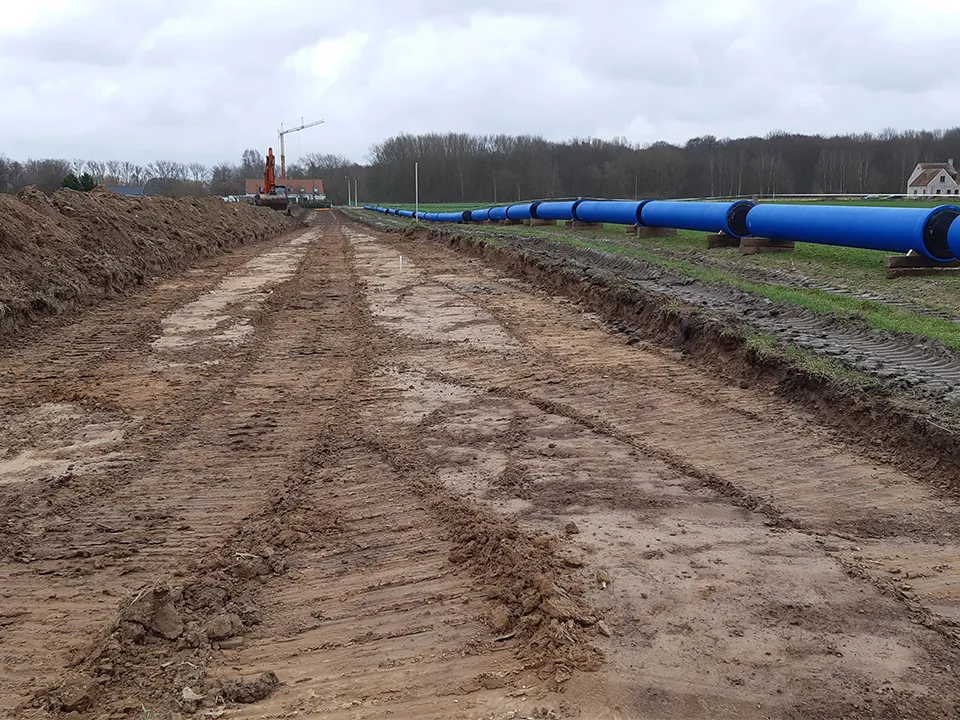
Water-link, in turn, set about laying the pipeline itself. The nodular cast iron pipeline is approximately 6.8 km long, with almost 6 km laid in an open trench. The remainder of the route was completed using two horizontal directional drills. “The new pipeline runs from Pidpa’s booster station in Mechelen-Zuid to De Watergroep’s meter room in Zemst,” says Luc Simons, project engineer at water-link. “The pipeline is designed to transport around 4.5 million m3 of drinking water a year. Water-link took full responsibility for laying the pipeline. We chose to construct the entire pipeline in nodular cast iron, including the sections installed using horizontal directional drilling. This material is commonly used for pipelines laid in open trenches on the Flemish market, but not for horizontal directional drilling. As we mainly work in the city of Antwerp and its surrounding area, where it is not always possible to lay out long lengths of pipe, we have opted several times to use nodular cast iron for horizontal directional drilling. With this material, there is no need to lay out the entire pipeline first.”
Key considerations
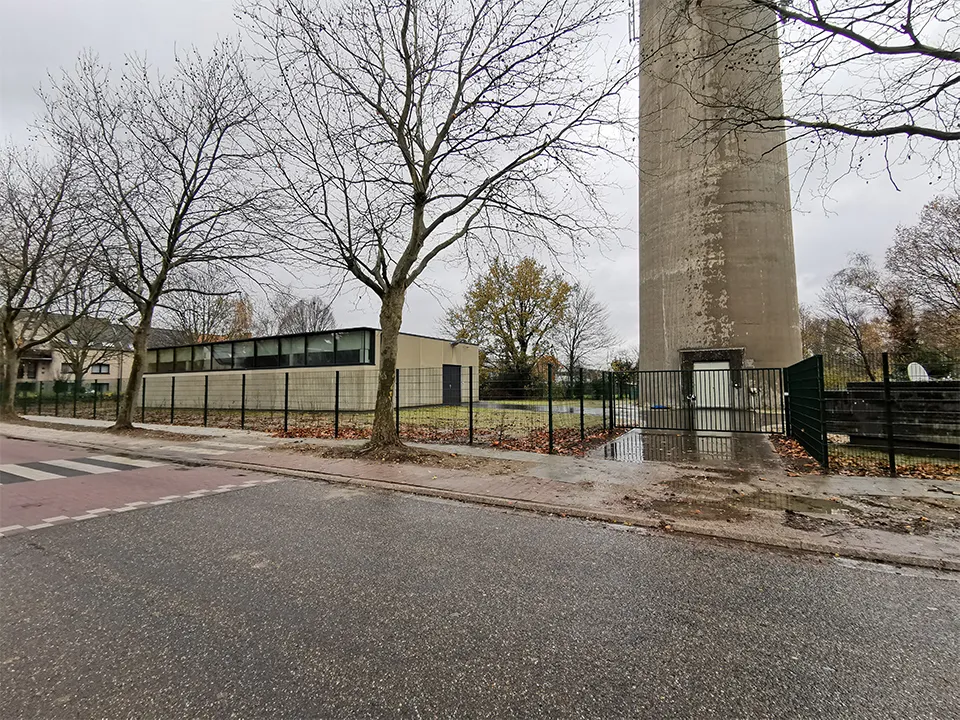
De Watergroep, Pidpa and water-link each had their own considerations in delivering the project. Lieven De Maeyer of Pidpa says: “Like many water towers, the one in Mechelen-Zuid is in a residential area. We therefore commissioned an acoustic study for our booster station, which stands right next to the tower, and took measures to limit noise. The station is an enclosed structure with acoustic doors and glazing. The pumps are mounted on extra-heavy plinths to reduce the transmission of their vibration. Mechelen-Zuid water tower is a landmark in Mechelen, and it was important that our booster station fitted in aesthetically. That is why we also opted for architectural concrete.”
For water-link, the biggest challenge was obtaining permits. Luc Simons says: “We had to cross around 3 km of private land, which is a major undertaking every time. But in the end, we were able to agree the right arrangements and everything worked out. We also reached agreement through constructive discussions with Zemst municipality and the city of Mechelen. Another challenge was crossing beneath the E19. It was not our first time doing this, of course, but a pressurised pipeline adds complexity. Our extensive experience and expertise proved invaluable. We also carried out a second horizontal directional drill because the route crossed a habitat area. To avoid running into problems during open-trench construction, we opted for horizontal directional drilling here too.”
The coronavirus crisis also put the overall schedule to the test. Gertjan Meulemans of De Watergroep says: “Coordinating the schedules of the three separate projects was certainly no easy task. Our contractors were able to continue working, so the impact on our work was limited. As a junction for several pipelines, the new meter room will play an important role in the future. Water quality must be monitored and safeguarded at all times, and we keep a very close eye on it. It is important to De Watergroep that our customers know we will continue to make this effort. Security of supply is the main driver behind this project. Being able to take a few smaller water production centres out of service in the future is an additional benefit.”
Unique collaboration
This project is an exemplary case of unique collaboration between three water companies in Flanders. It was also a partnership that all the parties involved welcomed. Successfully completing a project of this scale in a difficult year such as 2020 requires close collaboration, clear communication and mutual respect. “It was a great pleasure to deliver this project together. We have taken an important step towards greater security of supply for all our customers,” they say in unison.
Blue Deal to tackle drought and water scarcity
In recent years, Flanders has increasingly faced the effects of drought. Recent analysis of satellite images shows that Belgium is among the European countries hardest hit by extreme drought. Of all OECD regions, Flanders ranks third from bottom for water availability. The Flemish Government therefore decided, at the proposal of Flemish Minister for the Environment Zuhal Demir, to launch a Blue Deal, bringing together more than 70 concrete actions to prepare Flanders for the droughts of the future. The government has already earmarked an initial tranche of 75 million euros.
Through the Blue Deal, the Flemish Government is stepping up its fight against drought and water scarcity. The joint project by De Watergroep, water-link and Pidpa is fully in line with the ambition to develop climate-resilient, integrated water supply. “Building a new drinking water link meets the call for more structural cooperation to improve security of supply,” says Flemish Minister for the Environment Zuhal Demir.
Question about this story? Ask your question
Keep following this
Get an email when a new story is published. No account needed.
- ThemeRenewing pipelines and sewers
- SubjectGeneral







