









Make your plot climate-resilient with the Green-Blue Level
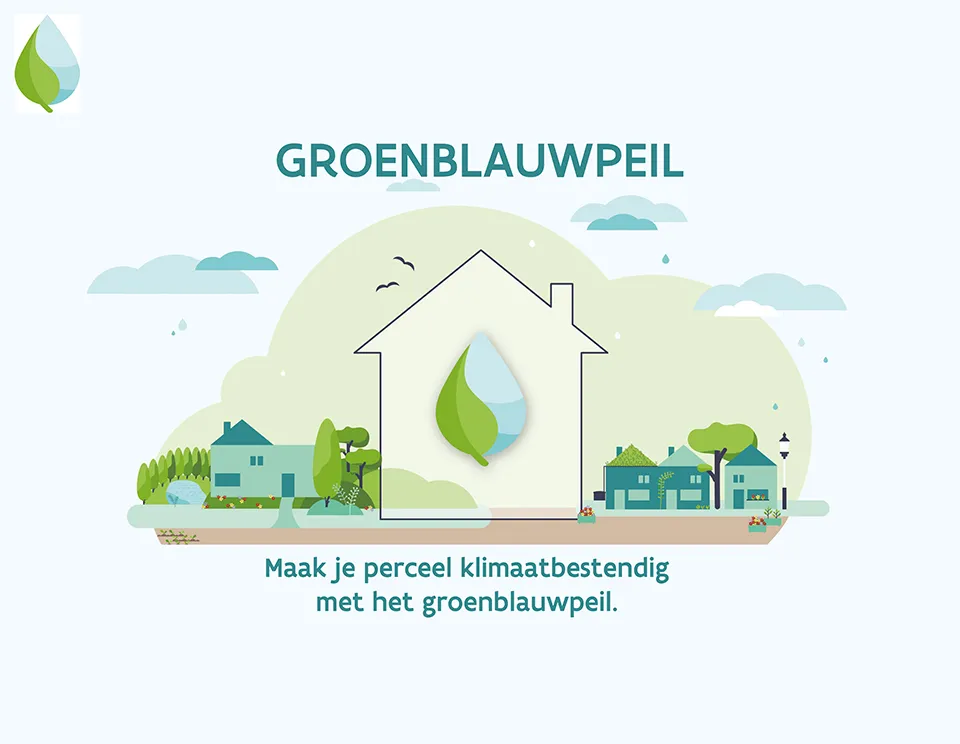
With practical tips, this online tool can also help make a plot more climate-resilient.
We all experience the effects of climate change on our lives and immediate surroundings. A few times a year, for example, intense rain showers can cause flooding on your plot. Equally, your rainwater tank may not be replenished in time, or persistent summer temperatures may cause the vegetables in your kitchen garden and your lawn to wither. It is too wet and too dry at the same time.
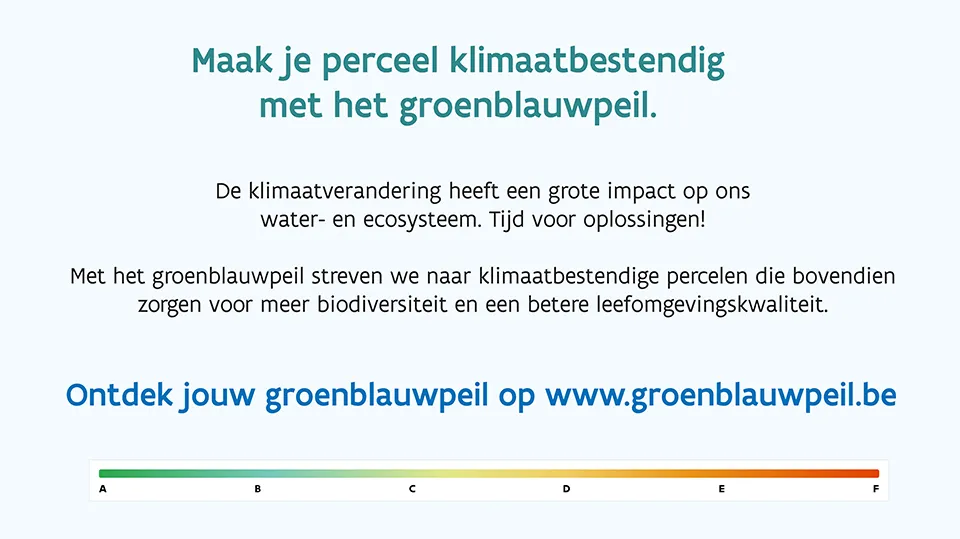
Citizens, businesses and government want to tackle these climate challenges. But many people in Flanders do not know where to start: “What can I do as a citizen in and around my home? What impact will changes have?” To answer these questions, Vlario, the Flemish Confederation of Construction and the Department of Environment have developed a tool to help make a plot more climate-resilient: the Green-Blue Level.
“We are increasingly facing heavy rain showers and longer periods of drought. The consequences are becoming ever clearer: the scorching summers and water shortages of recent years have given way to heavy rain, with all the consequences that entails. We will all have to do our bit to adapt to the new reality. The Green-Blue Level gives people in Flanders a handy tool to adapt their own home or plot and protect it against the effects of climate change,” says Flemish Minister for the Environment Zuhal Demir.
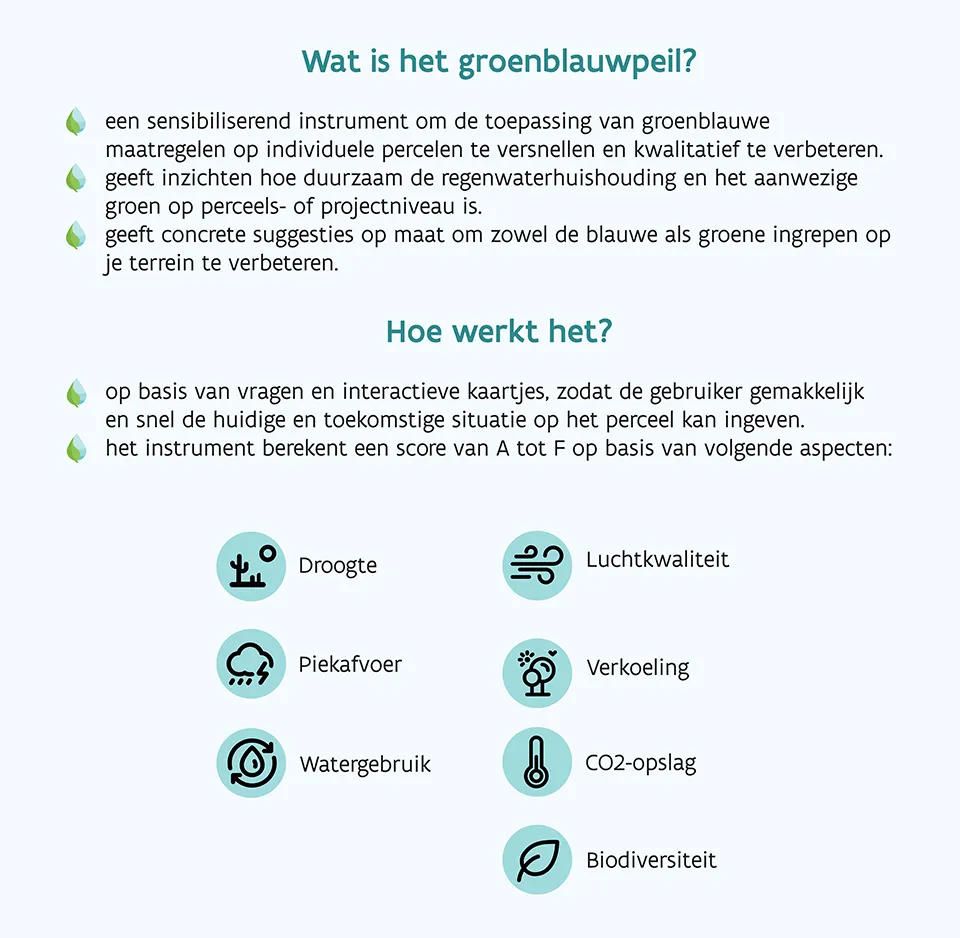
“The Green-Blue Level allows citizens, architects, developers, businesses and municipalities to see how an existing plot or new design scores on ‘blue’ aspects, such as rainwater collection, use and infiltration, and ‘green’ aspects such as biodiversity, CO2 storage, air quality and cooling,” says Wendy Francken, director of Vlario.
By determining your Green-Blue Level, you can find out how climate-resilient your home and garden are, and how they could be greener and bluer. Once you have entered information about your plot, including the area and type of roof, whether you have a rainwater tank and its capacity, and what greenery you have in your garden, you will receive a score from A to F, along with suggestions for improving it.
“Addressing the effects of climate change is becoming increasingly important when building and renovating homes, as well as when landscaping gardens. With the Green-Blue Level, we have developed an interactive awareness-raising tool that takes account of the specific characteristics of your home and plot, and which citizens, architects and contractors can use straight away,” says Marc Dillen, director-general of the Flemish Confederation of Construction.
What do these scores mean in practical terms across Flanders?
- If every plot in Flanders scored “C” for the blue component, we would solve most water problems in built-up areas caused by water running off paved plots too quickly. Put simply, this would be a “solution to today’s water problems”.
- If every plot scored “A”, we would tackle the problems of “tomorrow”. Specifically, we would address the effects of climate change up to the 2050 time horizon.
- Trees are the best way to improve a green score. If we want to score better on climate adaptation by 2050, we need to plant those trees now. If you no longer have room to plant a tree, you can improve your score by adding vertical greenery and/or a green roof.
“The Green-Blue Level brings green and blue features together in one easy-to-use tool. The measures it suggests help make our surroundings more climate-resilient, boost biodiversity and improve the quality of our living environment,” says Robin De Smedt, policy adviser at the Department of Environment.
Question about this story? Ask your question
Keep following this
Get an email when a new story is published. No account needed.
- ThemeRenewing pipelines and sewers
- SubjectGeneral







