









Green-blue score: “A high score can increase the value of your home”
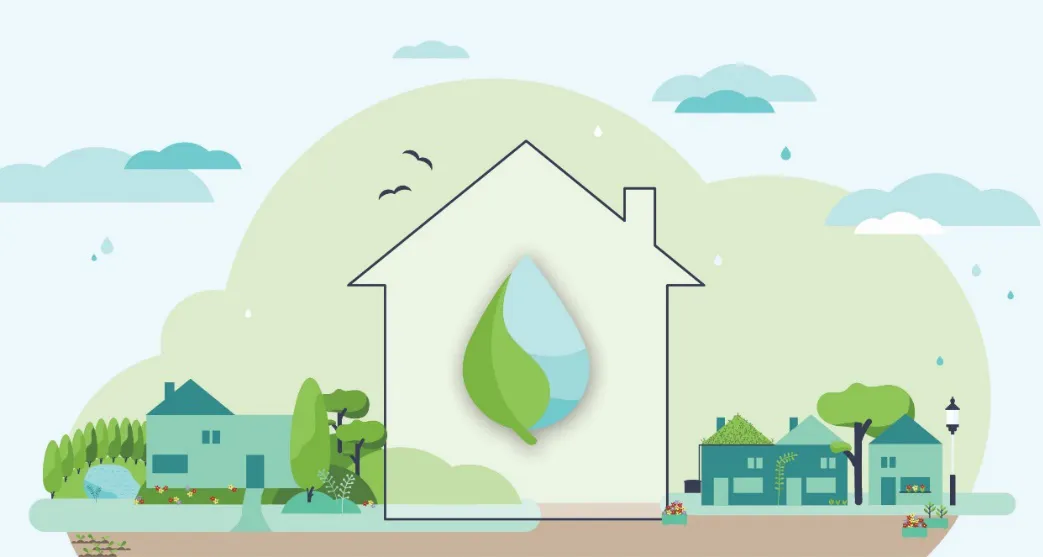
On 21 September, the green-blue score was unveiled to the public. More than 40,000 people in Flanders have since visited www.groenblauwpeil.be. The green-blue score has been calculated for more than 25,000 homes and gardens.
Over the past month, more than 25,000 people in Flanders have calculated their green-blue score.
What is the green-blue score?
Adapting to the effects of climate change is becoming increasingly important when building and renovating homes, as well as when laying out gardens. The water management knowledge centre VLARIO, the Flemish Confederation of Construction and the Flemish Department of Environment have developed an interactive awareness-raising tool, with support from the Blue Deal. The tool takes account of the specific characteristics of your home and plot. Citizens, architects and contractors can start using it straight away.
“People in Flanders are born with a brick in their stomach, and gardens cover 9% of Flanders. It goes without saying that we can make significant gains for the climate if we adapt our homes and gardens to the new reality we face. A month ago, the green-blue score gave people in Flanders a handy tool to adapt their home or plot and protect it against the effects of climate change. I’m pleased that so many people are finding their way to this new tool and looking for ways to help make Flanders more climate-resilient,” says Flemish Minister for the Environment Zuhal Demir (N-VA).
The tool is based on a green score and a blue score. The blue score shows how well you capture, retain and make useful use of rainwater on your plot, while the green score assesses factors including biodiversity and air quality in your garden. Plants and trees help purify the air and provide cooling.
Like the energy performance certificate (EPC), which uses a score from A to F to show how energy-efficient your home is, the green-blue score uses the same letters to show how well or poorly your plot performs. A means climate-resilient: specifically, it means your plot can cope with the effects of climate change up to 2050. An F means there is still a lot to be done.
To find out how well your home and garden score, visit www.groenblauwpeil.be. Since the score is based on the specific characteristics of each plot and building, it takes around 15 minutes to complete the assessment. Start by entering your address. You will also be asked about the area of your roof, its type, whether you have a rainwater tank, the size of your patio and/or driveway, and the types of greenery in your garden.
How are plots in Flanders performing on the green-blue score?
More than 40,000 people have now used the tool. More than 25,000 plots have been fully assessed. The results show that around one-third of plots achieve a C score. That is a good start, but there is naturally room for improvement. This makes the recommendations provided crucial.
Almost 60% of plots score C or higher for green, compared with just 40% for blue. This lower blue score is not surprising, since buildings constructed to the current building regulations, introduced in 2014, receive a C for the blue component. These regulations include a requirement for a rainwater tank and an infiltration facility. Most homes in Flanders were built before these regulations came into force and have not undergone major renovations since. Installing a rainwater tank and an infiltration facility are therefore the most common recommendations from the green-blue score. People who already have a rainwater tank are advised to use the rainwater not only in the garden, but also for the washing machine and flushing toilets.
For the green score, planting trees is the most common recommendation. Trees protect us against heat stress and purify the air. However, trees take time to grow, so the green score will only improve over time. Large, mature trees are therefore invaluable, and this is reflected in the green-blue score. Combining different plant species, choosing plants that benefit butterflies, bees and other insects, and allowing part of the garden to grow wild are recommendations that have a more immediate impact on the green score.
“Anyone planning a major renovation and energy-saving measures would be wise to make their home climate-resilient at the same time. A high green-blue score can increase the value of your home. Make sure you capture and use as much rainwater as possible. A green roof is another option. Scientific research has shown that solar panels perform better when combined with a green roof,” says Marc Dillen, director-general of the VCB.
“Also consider the materials you want to use for your driveway, patio and garden path. There are already many water-permeable materials on the market that offer an attractive alternative. In any case, limit the amount of hard surfacing on your plot. This has a positive effect on both your blue and green scores.” adds Wendy Francken, director of VLARIO.
“The fact that so many people are calculating their green-blue score of their own accord also points to growing awareness that the effects of climate change are rapidly catching up with us. Making our homes, gardens and public spaces climate-resilient at an accelerated pace is therefore a top priority for Flanders’ climate adaptation policy,” says Robin De Smedt, policy officer at the Department of Environment.
Question about this story? Ask your question
Keep following this
Get an email when a new story is published. No account needed.
- ThemeRenewing pipelines and sewers
- SubjectGeneral







