Geogrids under scrutiny in the Oosterweel project
Monitoring to support new techniques
Geosynthetics are proving to be an economical and efficient way of building up embankments. Unfortunately, uncertainty remains around the design parameters, so the solution is still rarely used in Belgium. An exception is the Oosterweel works on Linkeroever. Even so, client Lantis wants to leave nothing to chance. It therefore asked Buildwise to use monitoring to compare deformations in the geosynthetics with the design calculations, both in the short and long term.
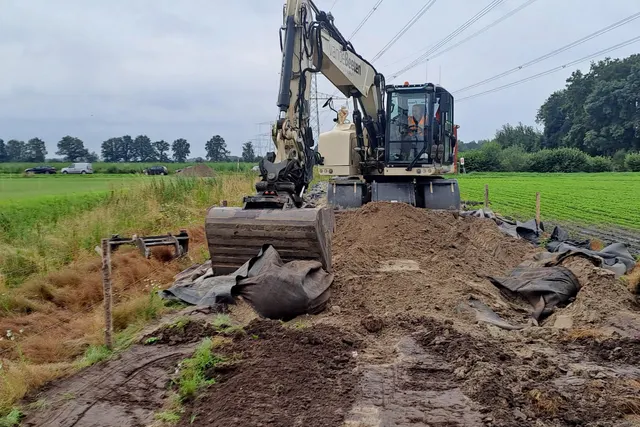
Work has been in full swing on Linkeroever for some time. This district of Antwerp plays a key role in the construction of the renowned Oosterweel connection. As a partner in the Rinkoniên consortium, Stadsbader will build several new bridges, tunnels and roads here over the coming years. First, however, a large number of embankments need to be built, several of them reinforced with geogrids.
“This is a logical choice, as these types of earth structures can be 30 to 50% cheaper than other, conventional concrete solutions,” says Nicolas Denies, deputy head of the laboratory at Buildwise. “Their environmental footprint is also much lower, as no concrete or steel is required and there is no need for large cranes or machinery. However, the technique is still rarely used in Belgium because there is no clear framework for designing these earth structures. We have to rely on standards or guidelines from abroad, which are not always neutral and/or consistent, leading to difficult discussions between clients, design consultants and contractors. In addition, there is little knowledge worldwide about how this type of reinforcement performs over the long term under real service conditions. All this is holding back the wider adoption of the technique, even though examples abroad show that it could well become standard practice.”
Benefits for the entire construction sector
Lantis considered the benefits compelling enough to specify the reinforcement technique for certain embankments in the tender documents. Stadsbader went a step further and submitted a proposal to use geosynthetics on other sites in the project as well. “We have great confidence in the potential and advantages of geogrids as reinforcement,” explains Nathan Lauwers, works planner for reinforced soil at Stadsbader. “However, we too often come up against a brick wall because there is no regulatory framework. Since the client itself was keen to explore the technique on this project, we saw an opportunity to use it on a large scale. Another incentive was that Lantis had commissioned Buildwise to study the long-term performance of the geogrids. A monitoring campaign of this kind is invaluable to us in optimising future designs of these structures.”
Nicolas Denies continues: “Buildwise also found this to be a very interesting commission, especially because the entire construction sector will benefit from it. We are allowed to use the results in the federal research project on this subject that we have been carrying out with FOD Economie and NBN since 2018.”
A challenging application
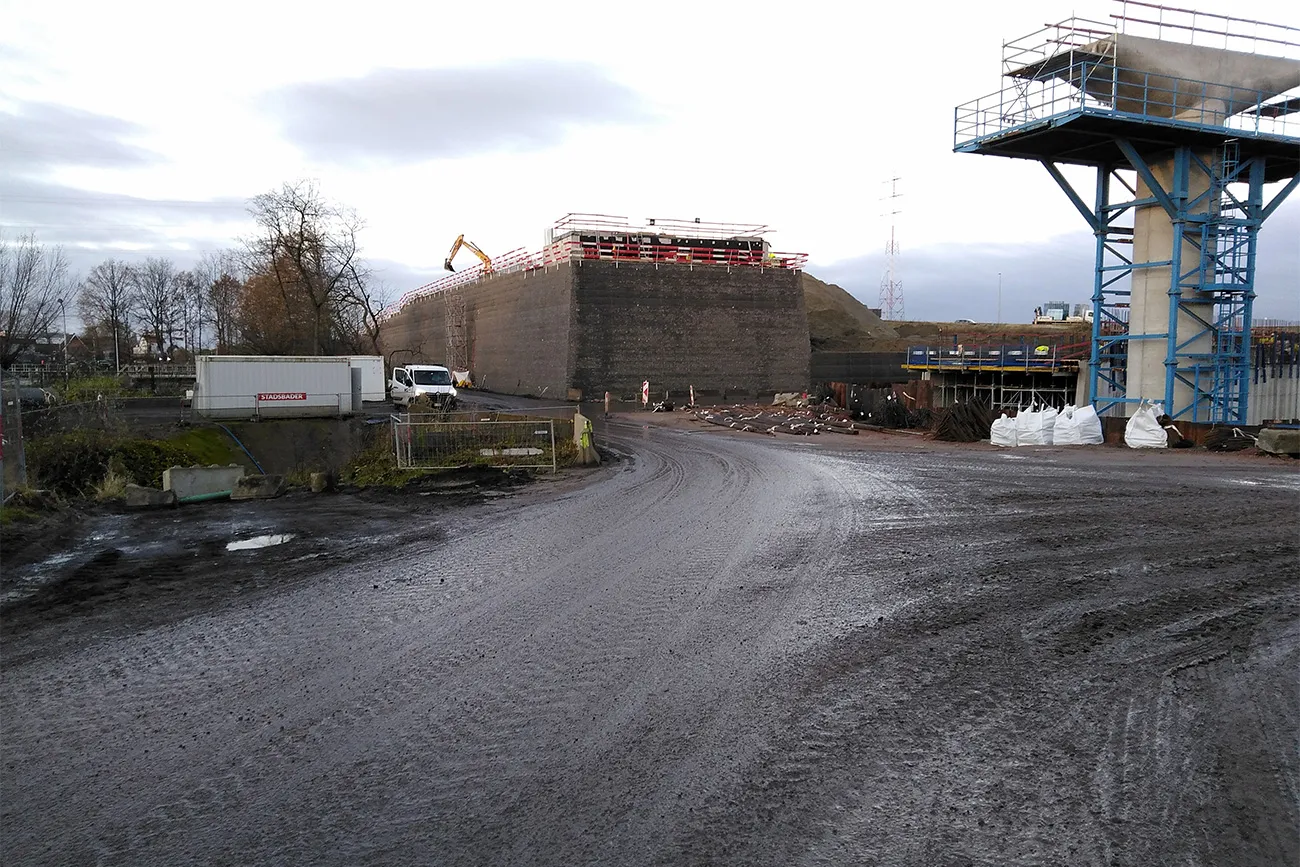
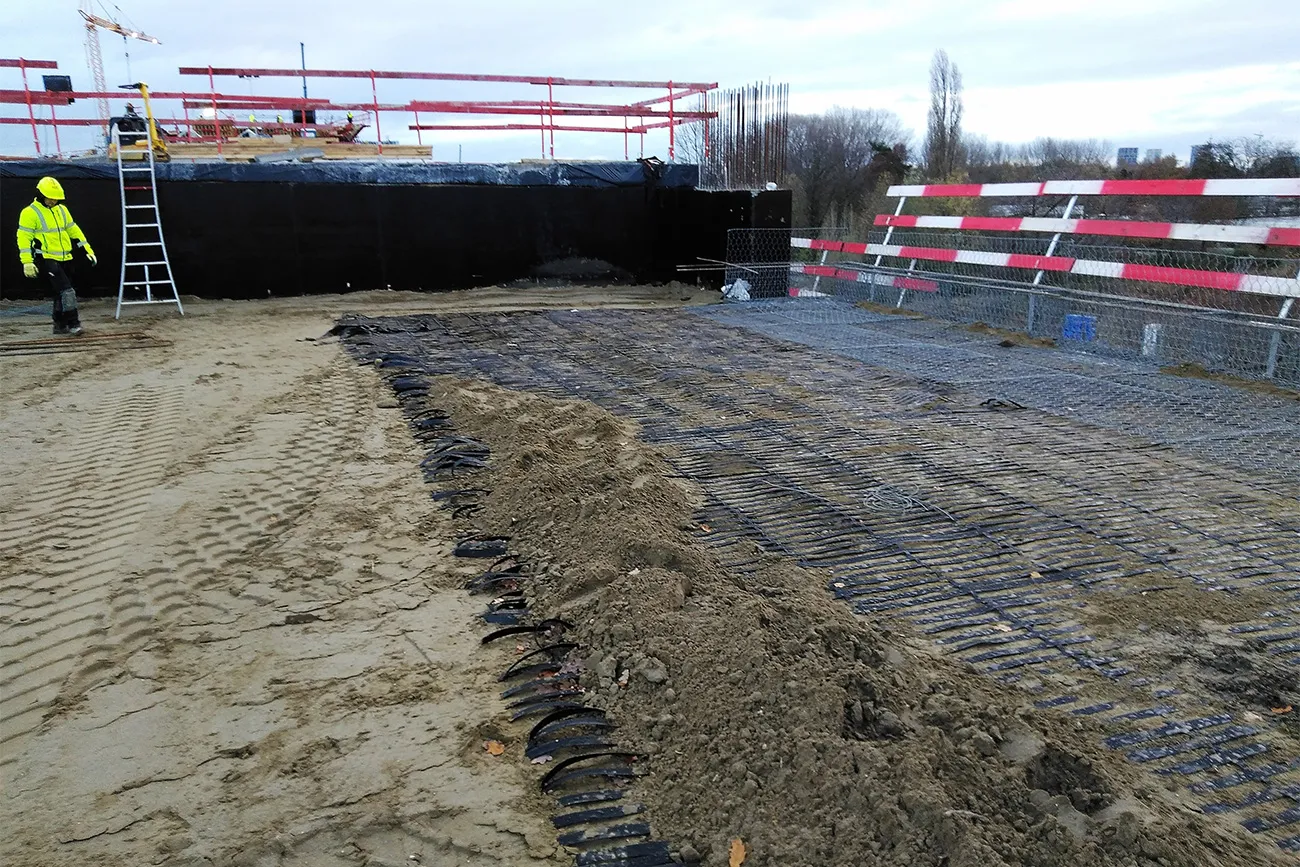
It was only logical to select the most striking site for the monitoring campaign: retaining wall G03 Linkeroever, Zone Zwijndrecht (between the E17 and the Aquafin wastewater treatment plant). Nathan Lauwers explains: “An approach ramp and an abutment are being built there for the viaduct that will carry traffic on the E17 towards Antwerp to the new Scheldt Tunnel or the E34. The retaining wall therefore has a dual function, which in itself makes it particularly interesting. It is also an embankment 16 m high, the tallest in this project. It consists of 29 layers, reinforced with 18 geogrids. We opted for a solution from the Italian company Maccaferri, comprising steel-wire baskets containing polyester geogrids wrapped in polyethylene.”
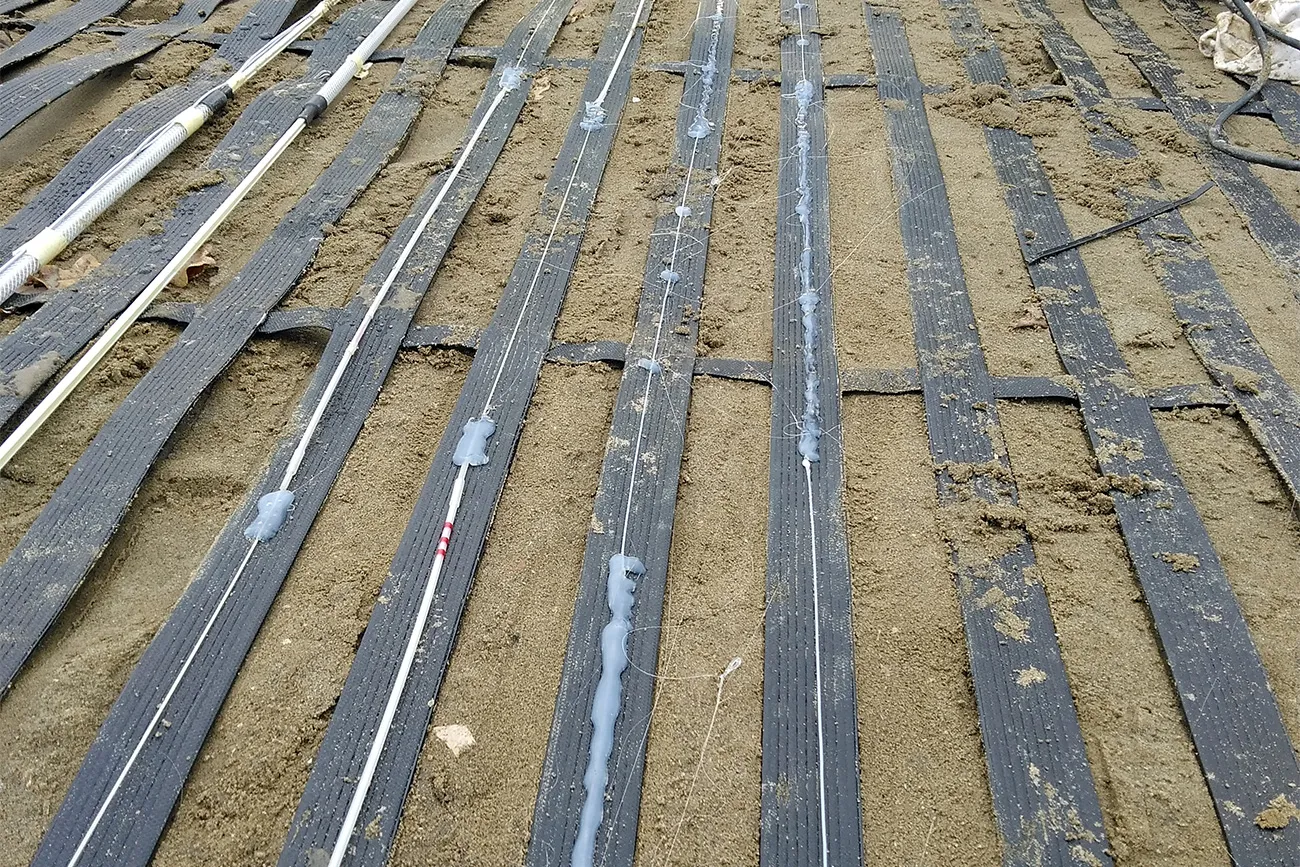
For cost-efficiency reasons, it was decided to monitor five geogrids. This is done using fibre-optic cables attached to the geogrid. Nicolas Denies says: “This was not always easy, as we had to install these extremely fine, fragile cables on site, sometimes in challenging weather conditions. In this case, we also want to test the technical limits of these sensors, so we have provided enough backups. We installed several examples of several types of optical fibre in each layer. This allows us to benchmark these products and test their quality.” The practical knowledge gained, such as the most suitable sensor type and attachment method, will also feed into the VLAIO-subsidised COOCK project ‘Monitoring van structuren en systemen met optische vezel’ and could eventually lead to the development of robust, ready-to-use products.
Intermittent monitoring campaign
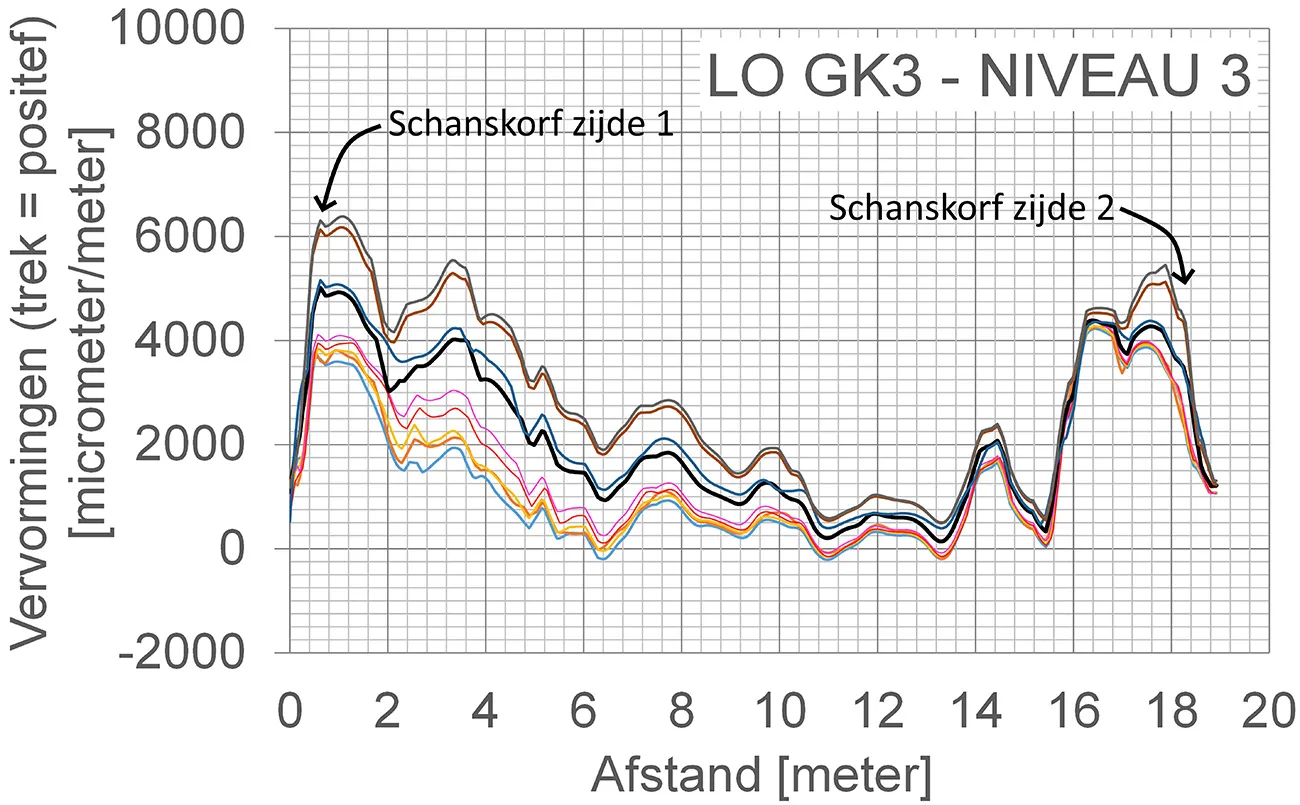
The main aim of the monitoring campaign is to measure strain/deformation in the geogrid from the moment each layer is placed. “In theory, the sensors can be read in real time, but Lantis opted for an intermittent approach,” says Nicolas Denies. “While the reinforced soil embankment was being built, from June to December 2021, the sensors were read on average twice a month. We then switched to a frequency of once a month. Since settlement is theoretically largely stabilised after six months, from then on we will visit the site about twice a year.
The aim is to keep a close eye on the structure and obtain an accurate picture of strain/deformation over the longer term too.”
Comparative study
Lantis and Stadsbader also want to monitor settlement accurately. “We always carry out topographical surveys on projects like this,” says Nathan Lauwers. “These are conducted periodically by a surveyor, who measures wall movements using reflectors fitted to the outside of the embankment. In addition, the geotechnical department of the Flemish government has installed two settlement tubes within the embankment. These are horizontal inclinometer tubes through which an inclinometer is periodically passed. The aim is to map the settlement of the tubes, and therefore of the embankment. In short, the performance of the reinforced soil embankment is being monitored in three ways.”
Data open the door to optimisation
The initial results are positive and reassuring. The recorded strain/deformation matches the design calculations by design consultant Arcadis. Nicolas Denies says: “The data will give both the contractor and the design consultant new insights, for example into how the structures can be optimised. It may be possible to use geogrids with lower stiffness or tensile strength on the other sites.” Nathan Lauwers adds: “We can also study creep, the phenomenon whereby deformation gradually increases over the years. Creep characteristics are typically determined in the laboratory using accelerated tests. This project will allow us to compare these laboratory results with actual deviations.”
Could other alternatives be used?
The parties involved have even greater ambitions. They also want to investigate whether cohesive soils can be used. Nathan Lauwers explains: “Today, we build reinforced soil embankments using gravel or sand. However, it would be cheaper, faster and more sustainable to use the soil available at each site, either wholly or in part.”
Nicolas Denies says: “Another line of enquiry concerns circularity. Could we use recycled aggregates from industry or dredged material, possibly stabilised with cement or lime? There is still so much we do not know about reinforced soil embankments. Yet this is a promising technique that is attracting strong interest worldwide. The design of geotechnical structures is being given a prominent place in the revision of the Eurocodes. Unfortunately, the outcome of that work is still several years away. That is why this monitoring project is so important. It enables us to show the sector, in black and white, what geogrids can do, right now. By giving contractors more knowledge of this new technique, they will be less dependent on suppliers and better equipped to convince the client.”
More information: www.buildwise.be
Question about this story? Ask your question
Keep following this
Get an email when a new story is published. No account needed.
- ThemeMaterials with a lower environmental impact
- SubjectGeotextiles