









New sluice gates on the Zuunbeek improve water management
Text Arno Verheij Beeld SPIE
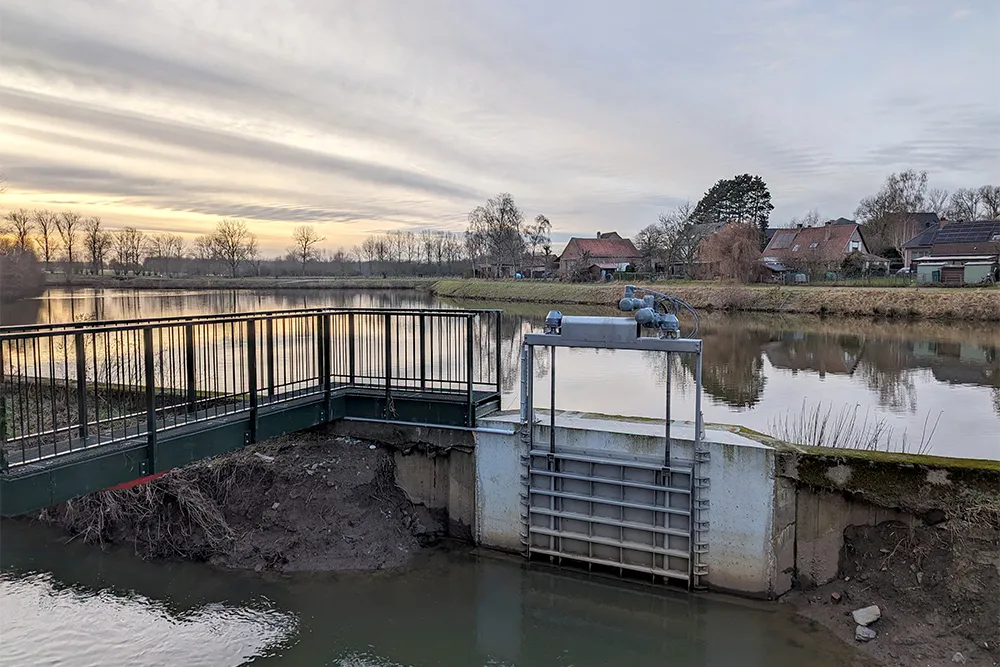
On behalf of De Vlaamse Milieumaatschappij (VMM), SPIE Infrastructure is installing two new sluice gates to separate the Zuunbeek in the Pajottenland from the adjacent retention basins. The gates will allow better control of water levels in the basins during dry periods. This is no luxury, given current climate change.
Near Sint-Pieters-Leeuw are two retention basins managed by De Vlaamse Milieumaatschappij. They help prevent flooding in the surrounding areas. During high water, water from the Zuunbeek is temporarily stored in the basins, relieving the stream. Mechanical non-return valves allowed water to flow back into the stream once water levels had fallen again.
Better control of water levels
SPIE Infrastructure is replacing the old non-return valves with new sluice gates to improve control over the filling and emptying of the retention basins, both manually and automatically. “The sluice gates are motorised, allowing them to operate fully automatically during both high and low water levels,” says project engineer Tibo Geenen. “The old system worked well during high water, but low water has become a problem. The increasingly warm, dry summers pose a risk that the retention basin will dry out completely. Alternatively, the water may warm up too quickly, leading to fish deaths and a loss of biodiversity. The aim of the project is to maintain an optimal water level.”
Renovation project
The two automatic sluice gates are for the large Volsembroek retention basin, with a capacity of 81.000 m³, and Slesbroek, a small retention basin with a capacity of 46.000 m³. “This is a renovation project, expanding on an existing project. Large sluice gates have also been installed in the Zuunbeek itself, and can close off the entire stream to protect the area downstream from high water. During the works, we therefore need to take care not to damage the existing installations.”
Blue Deal
The urgency became clear a few weeks ago, when the water level in the Zuunbeek rose to a threatening height and both retention basins were completely full. Fortunately, there was another option available: the Volsembroek nature reserve. “That is why projects like this are so important,” stresses Tibo. “It is also why the project is partly funded by the EU as part of the Blue Deal.”
“In our day-to-day work at De Vlaamse Milieumaatschappij, we are confronted with climate change more than anyone. One consequence is that we have to reassess, adjust and, where necessary, modify the operation of some of the electromechanical installations needed for effective high- and low-water management. It is good to be able to rely on our close collaboration with a company such as SPIE.” Frank Delamalle, project lead and electromechanical engineer at VMM.
Become a SPIEcialist
Would you also like to work on these challenging SPIE projects? Visit www.join.spie.be and search for “Infrastructure”.
Question about this story? Ask your question
Keep following this
Get an email when a new story is published. No account needed.
- SubjectHydraulic engineering







