









Construction sector backs climate-resilient communities
Improving sewerage coverage, creating water storage capacity, capturing and infiltrating rainwater, greening and depaving urban centres, and nature-based engineering measures in the landscape to tackle flooding and mudflows … The construction sector in Flanders is already playing an active part in numerous approaches to creating a high-quality environment for our region. The Flemish Government will continue to make this a high priority in the years ahead.
The construction sector has the necessary expertise to step up the implementation of these plans. It is also important to actively involve and encourage individuals, businesses and farmers to retain and store rainwater, among other things. A rewards scheme, as a key element of an awareness campaign, could further accelerate the transition to a water-resilient Flanders.
The Flemish Confederation of Construction is already developing an assessment framework to measure the (positive) impact that potential measures in a construction project have on biodiversity in the immediate surroundings. The same approach could be taken to systematically integrate well-considered water management, storage and infiltration. VLARIO, the consultation platform for the sewerage and wastewater treatment sector in Flanders, is calling for an infiltration bonus for businesses and individuals who take steps to increase rainwater infiltration into the soil. A uniform framework and consolidated benchmark for measures relating to biodiversity and water management could have a significant awareness-raising effect if achievable targets were linked to financial incentives, among other things. The result would be a high-quality living environment that prepares residents for the effects of climate change.
“Transforming paved surfaces through smarter design is crucial to the construction shift. In existing built-up areas, a wide range of far-reaching measures is needed to enable local rainwater reuse and natural infiltration, alongside the urgent need for a reinforced separate sewerage system. Depaving car parks and squares can play an important role, but above all it is vital to ensure that drainage is carefully designed to direct water to the lowest point in the area, where the necessary infiltration and storage basins are or will be provided,” says Marc Dillen, Director-General of the Flemish Confederation of Construction.
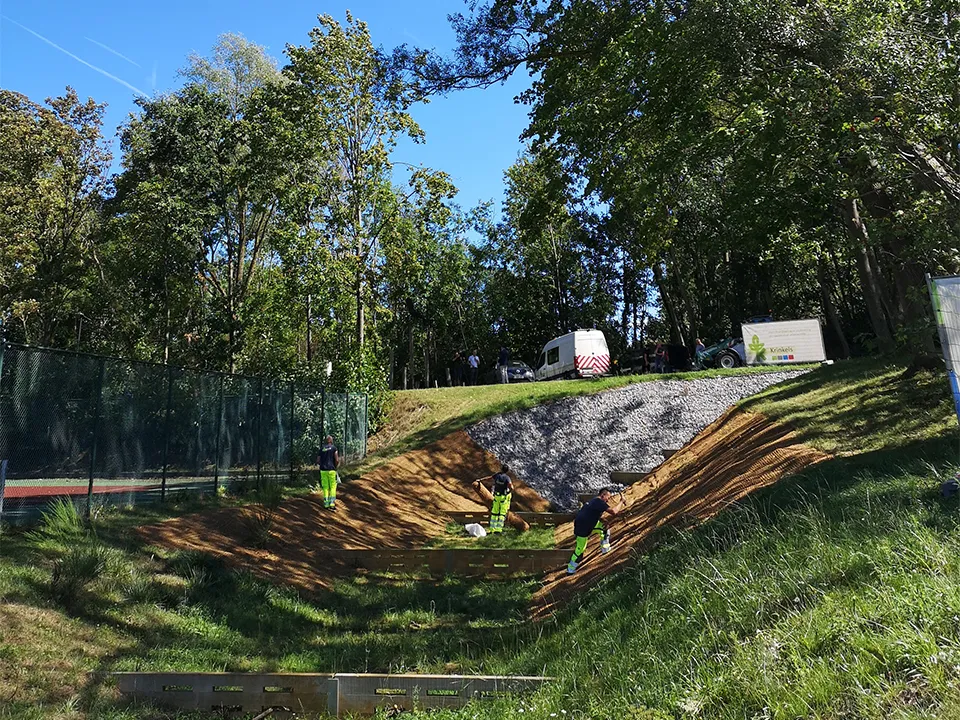
Heavy runoff of rainwater without infiltration into the soil is a significant challenge not only in built-up areas but also in depaved areas such as farmland, which accounts for almost 60 % of Flanders. Far-reaching measures are therefore also needed in rural areas. Landscaping contractors in the construction sector are bringing about crucial changes to the landscape through nature-based environmental construction (NTMB). Examples include the construction of infiltration basins and brushwood dams in agricultural areas to tackle flooding and mudflows.
Ensuring a return on investment
“As the Flemish Confederation of Construction, we consistently stress the importance of robust and coherent measures within the Flemish Government’s spatial planning policy. Owners, households and businesses can only be encouraged to implement the necessary blue-green measures if they can be confident that their investments will not subsequently be lost. The same applies to their energy investments, among other things, which contribute to climate targets. That is why, when the rules change, compensation at market value is essential to provide legal certainty. We cannot overstate the importance of the previous Flemish Government’s decision to provide, under the Instrument Decree, for compensation based on the market value of a property. Retaining approval of this fair compensation unchanged during the current legislative term is therefore crucial to maintaining support among households and businesses,” concludes Marc Dillen of VCB.
Addressing the historic backlog calls for ambitious targets
The Blue Deal being launched by the Flemish Government is an excellent instrument for introducing stronger measures in the short term to encourage both (agricultural) businesses and households to take action. These could include installing green roofs and façades, systematically installing rainwater tanks, depaving and greening car parks at sports and cultural centres, out-of-town retail stores and hospitals, depaving private driveways and front gardens, and significantly increasing rainwater reuse in buildings.
The Government must not only maintain a high level of investment through the Blue Deal to make the transition to a water-resilient region. It must also address the historic backlog in the maintenance of (water) infrastructure. The construction sector has the expertise needed to help meet this enormous challenge. However, the sector needs clarity on the revised investment plans of (local) authorities so that sufficient resources, staff, equipment and other means can be deployed in good time.
Question about this story? Ask your question
Keep following this
Get an email when a new story is published. No account needed.
- SubjectHydraulic engineering







