









Complex automated dewatering during preparatory works at Royerssluis
Text Niels RouvroisImage Smeyers
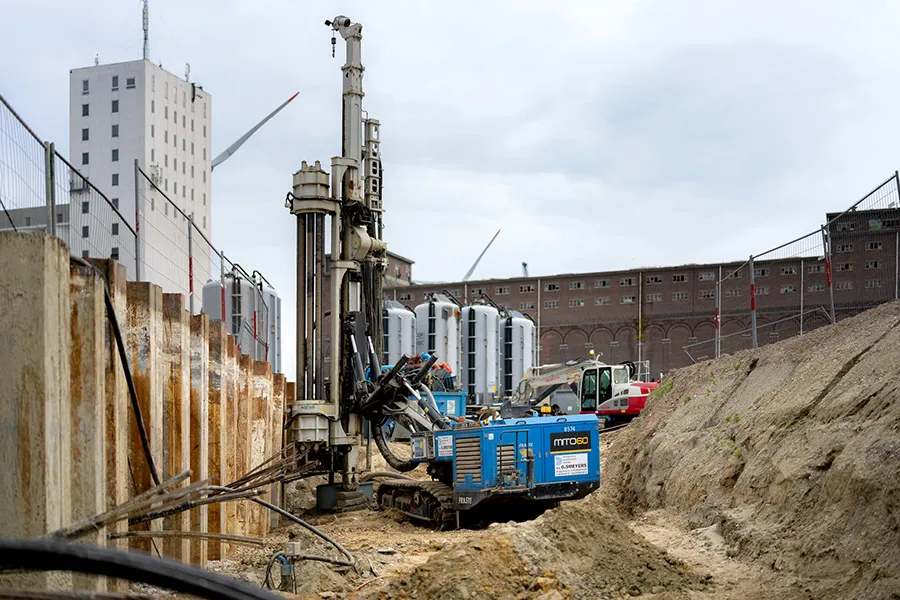
Work on Royerssluis in Antwerp is now in full swing. The contract for the lock was tendered and awarded by Lantis, but the works are being carried out on behalf of Havenbedrijf Antwerpen, with Afdeling Maritieme Toegang (AMT) acting as the lead authority and also responsible for the lock’s design and engineering. For the dewatering works involved in preparing the site for construction, TM Ronkoniën, comprising Artes, Mobilis, Stadsbader and CIT Blaton, called on Smeyers’ expertise. “We opted for a dewatering system in which our equipment is controlled automatically,” says Bert Creve, operational manager at Smeyers.
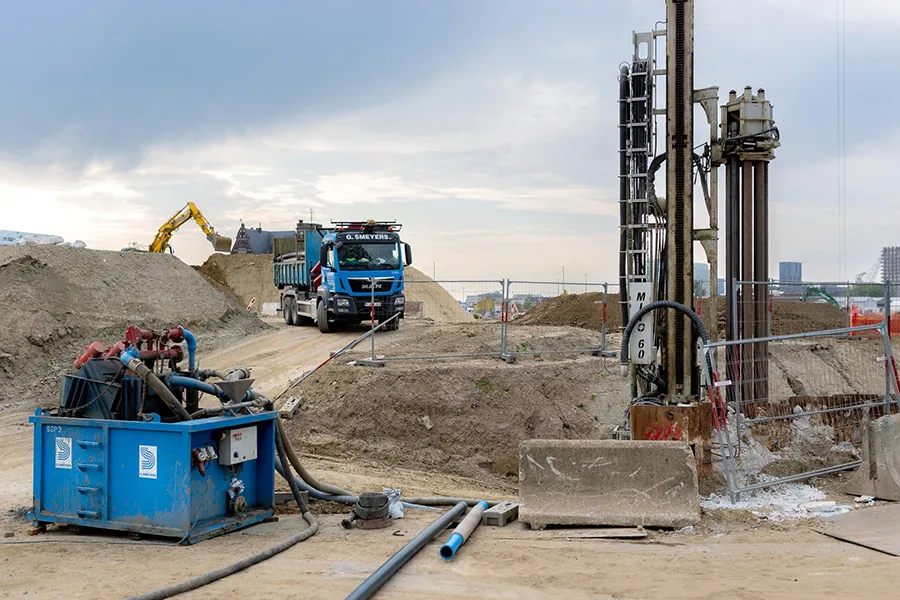
Royerssluis is an important shipping link between the Scheldt and the Albert Canal and is to undergo a major renovation in the coming years. Work began in October 2021, and the renovation is an important step in the modal shift towards more sustainable modes of freight transport. The lock is being expanded into a high-performance inland waterway lock that will handle modern vessels safely and efficiently. It will be made significantly longer, from 180 to 235 metres, and wider, from 22 to 36 metres, enabling it to accommodate larger inland vessels efficiently and increase freight volumes on the Albert Canal.
Preparing the site for construction
In the first phase, work is focused on preparing the site for construction, building 2 cofferdams and silt walls, and realigning the roads. In the second phase, once no infrastructure crosses the existing lock and a sealed construction pit has been created, the pit will be excavated and the existing lock demolished. Construction of the new Royerssluis is due to start in 2024. Smeyers, based in Zandhoven, is currently carrying out the dewatering works as part of site preparation. Bert Creve explains: “The site is right next to the Oosterweelknoop, where the tunnel emerges above ground on the right bank. The future ring road will also run right alongside the site, which makes our work somewhat more complex. We are keeping the construction pit dry down to -15 m TAW. The work is being carried out within a water-retaining wall to limit the impact on the surrounding area.”
“We opted for a dewatering system in which our equipment is controlled automatically,” Bert Creve continues. “The pumped water is directed to two water treatment plants. If either plant experiences a fault or problem, our dewatering system must therefore shut down automatically and restart once the issue has been resolved. A complex project like this involves a lot of work, as we are talking about more than 80 submersible pumps and other equipment that has to be automated.”
Digbag dewatering
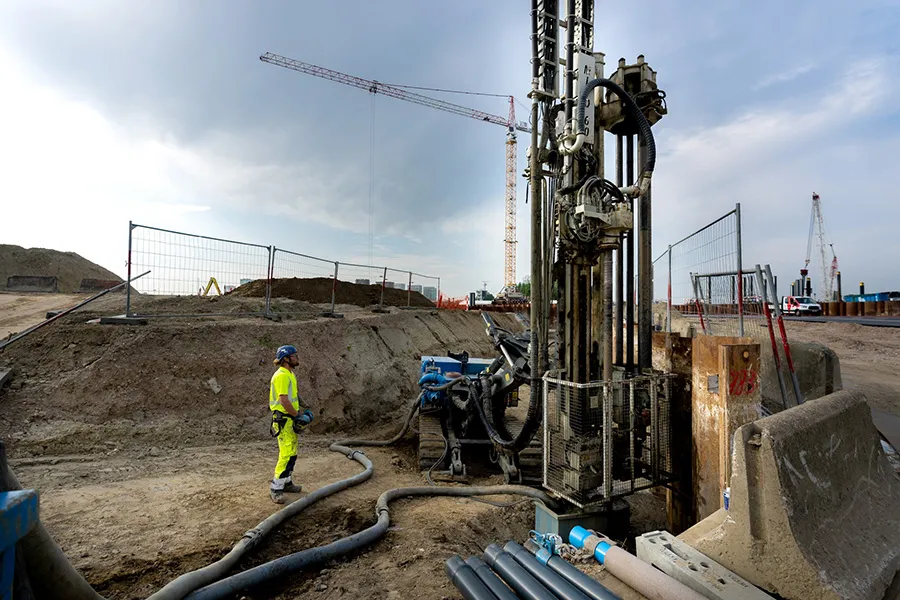
It is a major challenge, but it is also where Smeyers’ strengths lie. Bert Creve says: “Automation, real-time monitoring … Applying modern technology to dewatering is one of our strengths. Clients also know they can turn to us with difficult challenges. We also carried out the full dewatering study, an area on which we place a strong focus. In addition, we used a dewatering technique developed in-house for this project: digbag dewatering. This technique involves burying the familiar big bags, hence the name digbag, saving a great deal of time and making the construction method easier to implement. To enable the silt walls to be built, we used a dewatering approach that passively brought the groundwater levels inside and outside the construction pit into balance, by letting nature take its course. This too is being closely monitored.”
Geothermal energy too
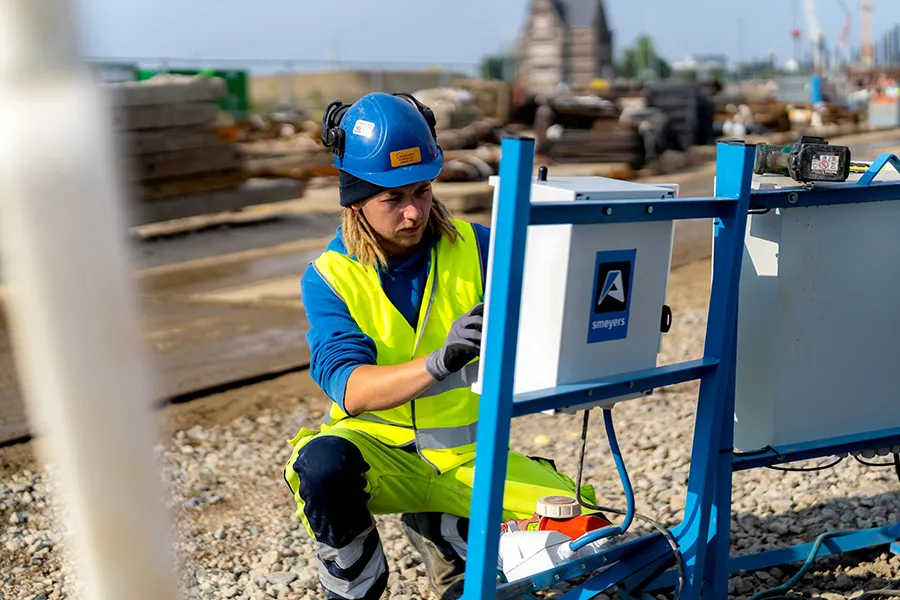
The dewatering works at Royerssluis are therefore rather unusual. “Drilling began immediately after the Christmas break, and the dewatering system is now operational, with work entering its full start-up phase. The first excavation work has begun. Dewatering to the full depth is planned for the autumn. This project’s complexity is right up Smeyers’ street. Customers can also follow everything clearly via our cloud platform. Later in the project, we will also be involved in renovating the old lock keeper’s house, where Smeyers will provide geothermal heating. But that will not happen for a few years yet,” concludes Bert Creve. ■
Een zakelijke vraag aan Smeyers nv? Get in touch
Who worked on Royerssluis
- contractors' consortiumRinkoniênMentioned in Royerssluis works now available to follow via livestream
- clientPort of Antwerp-BrugesMentioned in Nieuwe tijdelijke weg over kofferdam beperkt hinder werken én verbetert verkeersdoorstroming in haven
- clientVlaamse overheidMentioned in Nieuwe tijdelijke weg over kofferdam beperkt hinder werken én verbetert verkeersdoorstroming in haven
- contractors' consortiumTM Rinkoniên RechteroeverMentioned in Nieuwe tijdelijke weg over kofferdam beperkt hinder werken én verbetert verkeersdoorstroming in haven
- clientDepartement Mobiliteit en Openbare Werken van de Vlaamse overheidMentioned in Open Construction Site Day attracts more than 3,500 visitors to Royerssluis in Antwerp
- aannemersconsortium TM Rinkoniên RechteroeverArtes GroupMentioned in Open Construction Site Day attracts more than 3,500 visitors to Royerssluis in Antwerp
- aannemersconsortium TM Rinkoniên RechteroeverCIT BlatonMentioned in Open Construction Site Day attracts more than 3,500 visitors to Royerssluis in Antwerp
- aannemersconsortium TM Rinkoniên RechteroeverBoskalisMentioned in Open Construction Site Day attracts more than 3,500 visitors to Royerssluis in Antwerp
- aannemersconsortium TM Rinkoniên RechteroeverMobilisMentioned in Open Construction Site Day attracts more than 3,500 visitors to Royerssluis in Antwerp
- aannemersconsortium TM Rinkoniên RechteroeverStadsbaderMentioned in Open Construction Site Day attracts more than 3,500 visitors to Royerssluis in Antwerp

Keep following this
Get an email when a new story is published. No account needed.
- ProjectRoyerssluis
- ThemeStrengthening waterways and coastlines
- SubjectHydraulic engineering
- CompanySmeyers nv







