A facelift for the guardian of the Leopold Canal and the Leie diversion canal
Text Arno Verheij Beeld Herbosch-Kiere
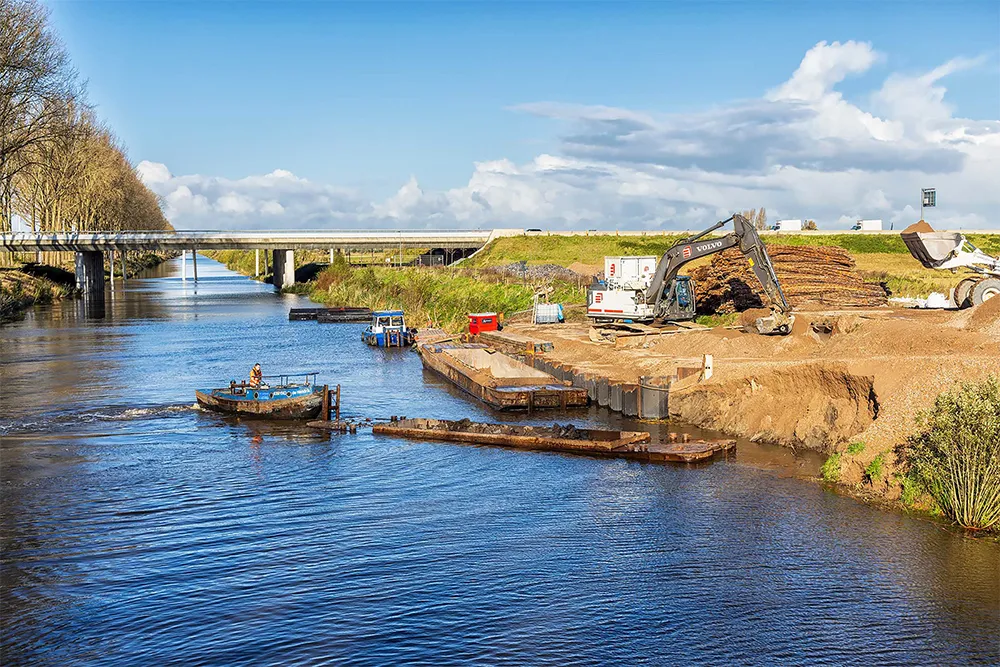
Since August 2023, water engineering contractor Heirbosch-Kiere has been working to repair the central embankment between the Leopold Canal and the Schipdonk Canal, better known as the ‘Blinker’ and the ‘Stinker’. The central embankment was seriously weakened after a breach 5 years ago. The works are intended to ensure the embankment’s safety in the future. A challenge, not only logistically, but also because of the presence of vulnerable breeding birds and bats.
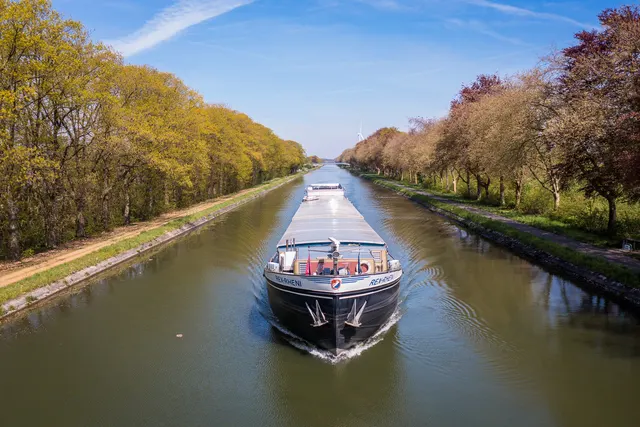
The Leopold Canal and the Leie diversion canal share a route between Maldegem (Strobrugge) and the outfall structures at Zeebrugge. The canals are separated by the central embankment. Project manager Geert Baert: “In our capacity as maintenance contractor, we were called out in December 2018 after a breach almost 30 metres wide had opened in the central embankment between the Leopold Canal and the Schipdonk Canal. We immediately set about repairing the embankment.” The precise cause of the breach was difficult to establish, as the weakened section had been washed away in its entirety. It was clear, however, that parts of the central embankment were so badly weakened that its safety could not be guaranteed in the future. Both sides of the embankment therefore had to be repaired, strengthened and protected against erosion.
Works in phases
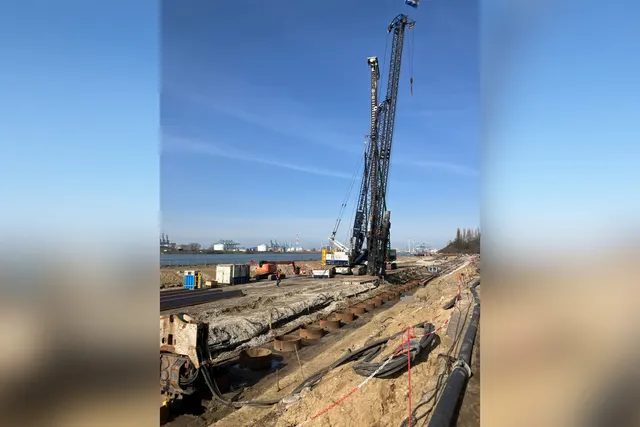
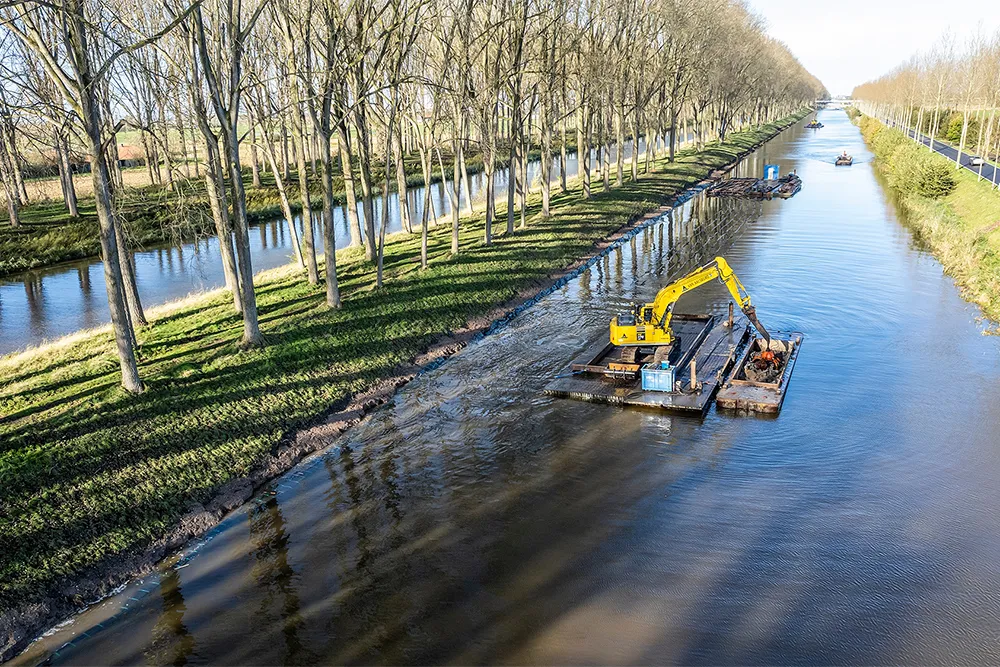
Herbosch-Hiere, based in Kallo, is carrying out the work in collaboration with the Dutch company Van Aalsburg bv. Work began in August 2023 in the municipality of Damme, at Oostkerkebrug. The works will continue as far as the outfall culverts in Heist, covering a length of just under 8 kilometres. Project manager Geert Baert: “We are strengthening the slope of the central embankment on both the Leopold Canal and the Leie diversion canal sides. If everything goes according to plan, we will be working for another 3 years. The works are being carried out in phases. First, we are working along the entire Leopold Canal bank. The first section, a 2.4 km stretch from Oostkerkebrug to Zelzatebrug, has now been completed. That bank will be finished by the end of January 2025, after which we will continue on the Leie diversion canal side, along a further 8-kilometre stretch.”
A logistical challenge
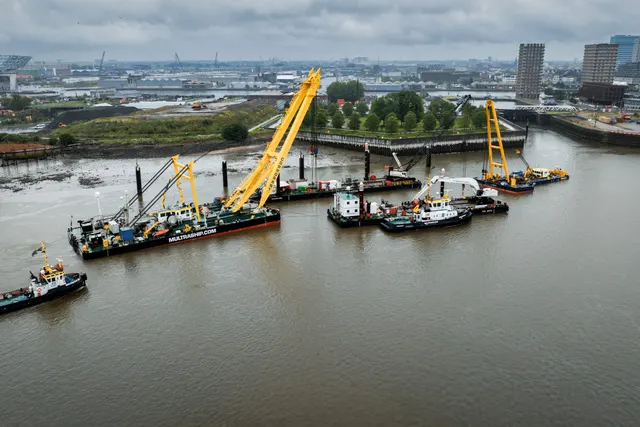
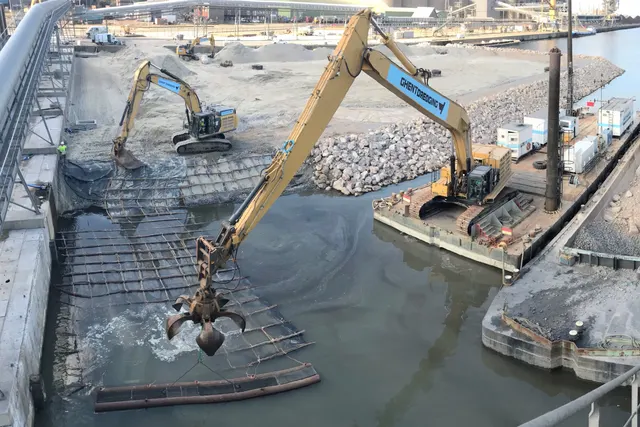
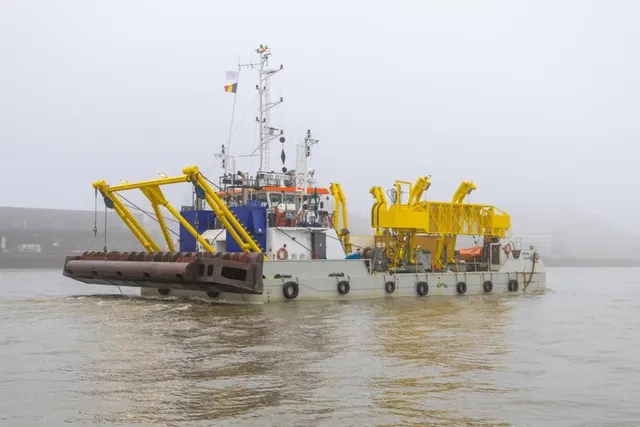
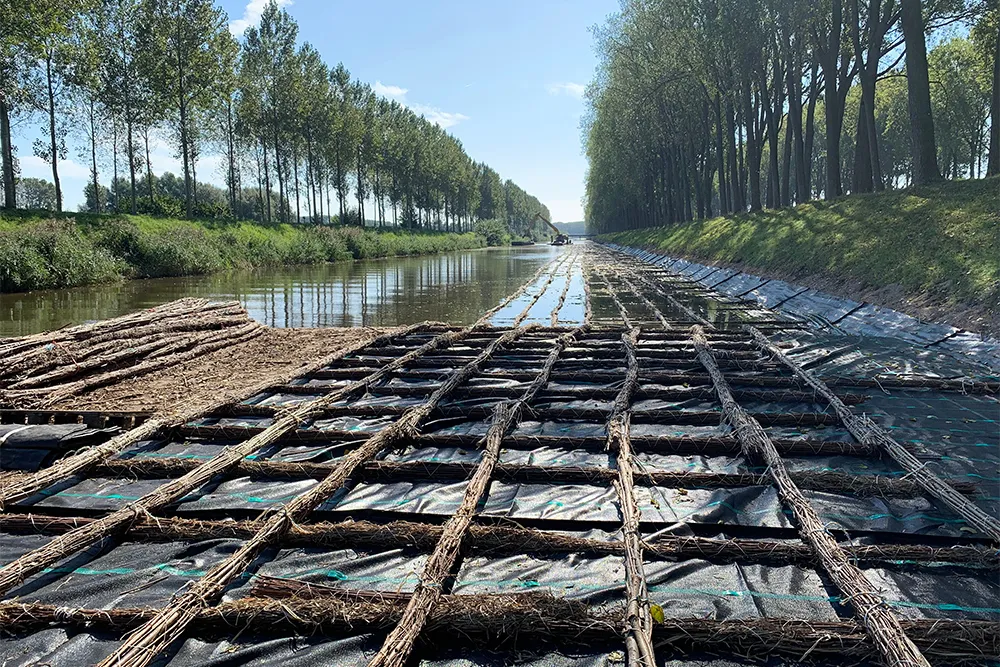
To maintain the stability of the central embankment, all the work is being carried out from the water using 3 floating pontoons. Mattress structures are being laid on the bed and embankment, then covered with broken stone and soil. The geotextile and willow bundles for the mattresses are made on site and installed as a single piece, without seams. The sections above the water are being reseeded. Geert Baert: “Every day, we handle enormous quantities of stone to fill out the existing slope, which we are making less steep. For the first 2.4-kilometre section, we are using 20 thousand tonnes of broken stone and 25 thousand tonnes of crushed stone. For the entire project, we have allowed for 81,200 tonnes of broken stone and 132,390 tonnes of crushed stone. Getting these quantities to the site on time and in the right volumes, all by road, is a major logistical challenge for us.”
Birds and bats
Disruption to cyclists and walkers is being kept to a minimum during the works. A local diversion has been put in place for the busy cycle superhighway along the Leopold Canal. As the work zone lies within a Birds Directive site, work is being carried out from August to February. Geert: “This minimises disturbance to birds during the breeding season. We are also limiting the impact of the works by working from bridge to bridge and on one side at a time. This prevents too much reed from being removed and habitats from becoming fragmented.” To protect bats, no work is carried out between sunrise and sunset, and no artificial lighting is used.
A business enquiry for Herbosch-Kiere? Get in touch
Companies in this story
Keep following this
Get an email when a new story is published. No account needed.
- SubjectHydraulic engineering
- CompanyHerbosch-Kiere