









Sewerage & underground infrastructure
Water drainage for the railway bypass at the new Mechelen station
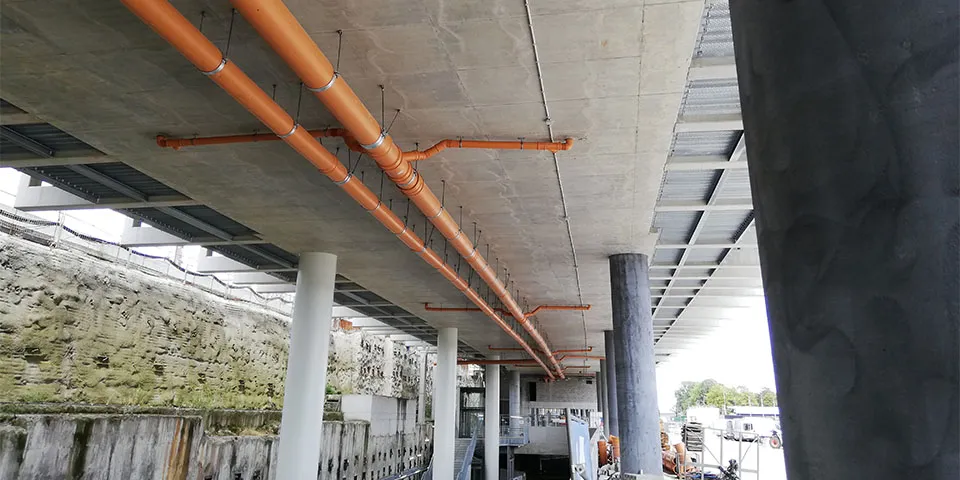
The new Mechelen station is gradually taking shape. Contractor CIT Blaton is building new platforms 11 and 12 on the railway bypass and working on their canopy. The railway bypass is a new 3.2 km railway line comprising two additional tracks and 2 new platforms at the rear of Mechelen station. Deschacht redesigned the drainage plan and supplied the pipes to drain water from the roof, the roof’s emergency overflow and the troughs beneath the tracks.
Work on the station project began in Mechelen in 2012. A cooperation agreement was signed between NMBS, Infrabel, De Lijn, the city of Mechelen and the Flemish Government. Over several years, the project will deliver, among other things, a new pair of tracks alongside the existing Brussels-Antwerp railway line, a new access road between Brusselsesteenweg and Douaneplein, and a road tunnel between Leuvensesteenweg and the station. The existing train and bus station is also being completely rebuilt, with excellent facilities and connections for cyclists and pedestrians.
To meet demand for greater capacity and accommodate the needs of high-speed trains, the number of tracks and platforms is being increased from 10 to 12. Construction of the canopy over the new platforms is currently under way. CIT Blaton senior project manager Frank Denys explains: “The canopy covers an area of 3000 m². The design included horizontal high-pressure pipes to drain water from the emergency overflow and the track troughs. We were supposed to weld them together airtight on site, in areas beneath the track troughs that were difficult to access. That was impossible. So we reviewed the design with Deschacht and decided to replace those high-fill drainage pipes with PP pipes. We also used PP pipes to drain rainwater from the canopy.”
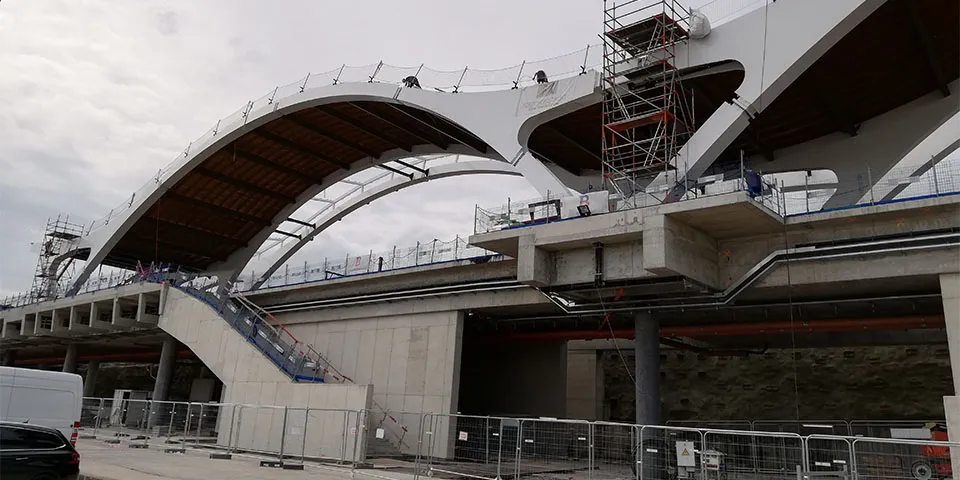
The canopy covers an area of 3000 m².
Pipe and bracket design study
Using PP pipes has two major advantages. “You join the pipes with standard socket connections and install them using the ‘traditional’ method,” explains Frank Denys. “That made installation much easier for us. Deschacht assessed the drainage pipes and carried out a study to determine the right materials, flow rates and bracket strengths. This led us to choose PP pipes with diameters of 315, 400 and, in some locations, even 630 mm. When water flows through them, it weighs a great deal. The brackets therefore also need to be strong enough and anchored securely to keep the pipes firmly in place.”
The added value of the design team
Choosing Deschacht was an obvious choice for CIT Blaton. “We chose Deschacht because we were looking for a practical solution that could be implemented. Their design team studied which materials would be best suited to replace those drainage pipes, carried out all the calculations and developed the whole concept into a complete construction dossier. We always find it easy to work with the people at Deschacht. And, of course, their competitive prices also played a part,” concludes Frank Denys.
Een zakelijke vraag aan Deschacht? Get in touch
Companies in this story

Keep following this
Get an email when a new story is published. No account needed.
- SubjectSewerage & underground infrastructure
- CompanyDeschacht







