









Sewerage & underground infrastructure
Sustainable underground attenuation tanks: an effective solution for local retention, reuse and infiltration
Text and images De Bonte Group
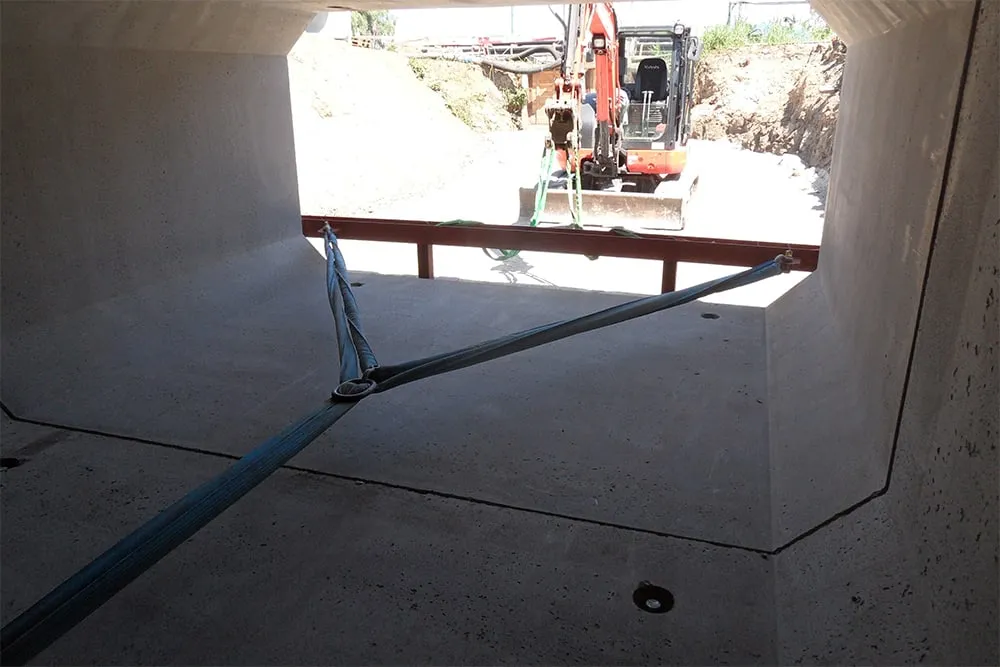
With climate change accelerating and rainfall becoming increasingly intense, it is crucial to adapt our infrastructure proactively. Well-built attenuation tanks play a key role, providing an efficient way to manage peak stormwater flows, prevent flooding, ease pressure on existing sewer systems and avoid discharges into foul sewers. De Bonte Group recognises the challenges involved in installing prefabricated attenuation tanks and has therefore held extensive consultations with installers and operators.
The simplest solution is to install swales. These green, surface-level solutions help retain rainwater naturally on site, thereby preventing flooding and allowing the water to infiltrate into the ground. They are ideal in areas where space is available and help improve biodiversity in our living environment.
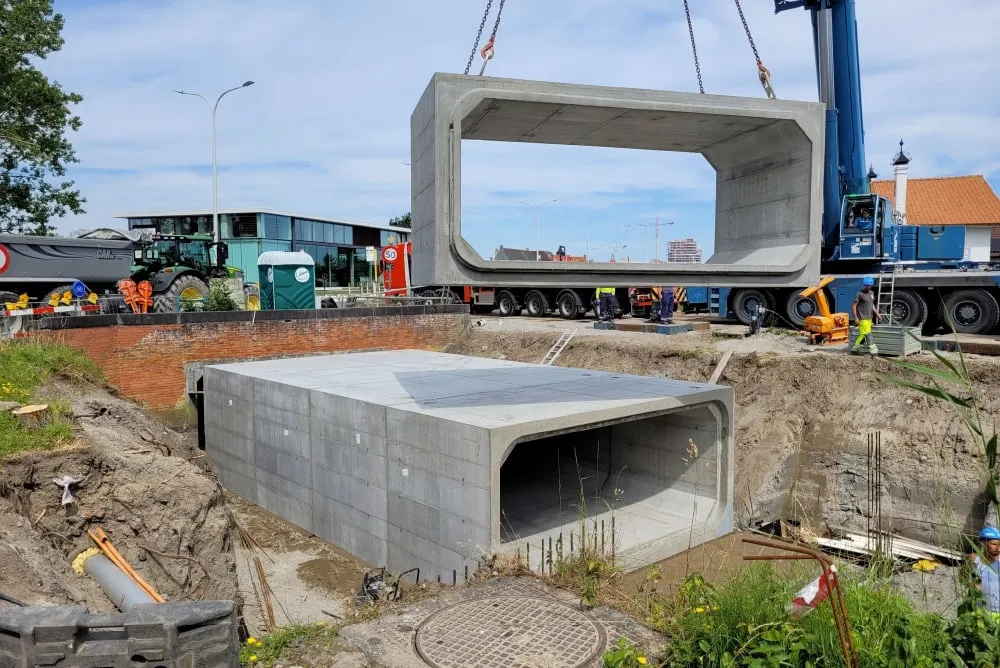
Underground, man-entry concrete attenuation tanks
However, swales are not suitable everywhere. They are often installed or maintained incorrectly, risk turning into rubbish dumps and can therefore be unhygienic for children at play. In densely built-up or urban areas where space is limited, underground, man-entry concrete attenuation tanks offer a valuable alternative. They are easy to inspect, clean or maintain. The stored rainwater is protected from sunlight and remains pH-neutral thanks to contact with the concrete. This makes it easier to reuse rainwater, which remains a higher priority in the Lansink ladder.
In harmony with the dynamics of the ground
The success of an underground attenuation tank depends on its long-term performance and its ability to remain watertight over time. Although an attenuation tank may appear efficient at first in collecting excess rainwater, the biggest challenges often only become apparent over time: sediment build-up and cleanability, combined with the dynamics of the ground in which the tank is installed.
Underground structures cast in situ often lose their long-term watertightness as a result of ground movements, ranging from settlement to changes in water pressure. This leads to water ingress and, consequently, a significant loss of storage capacity.
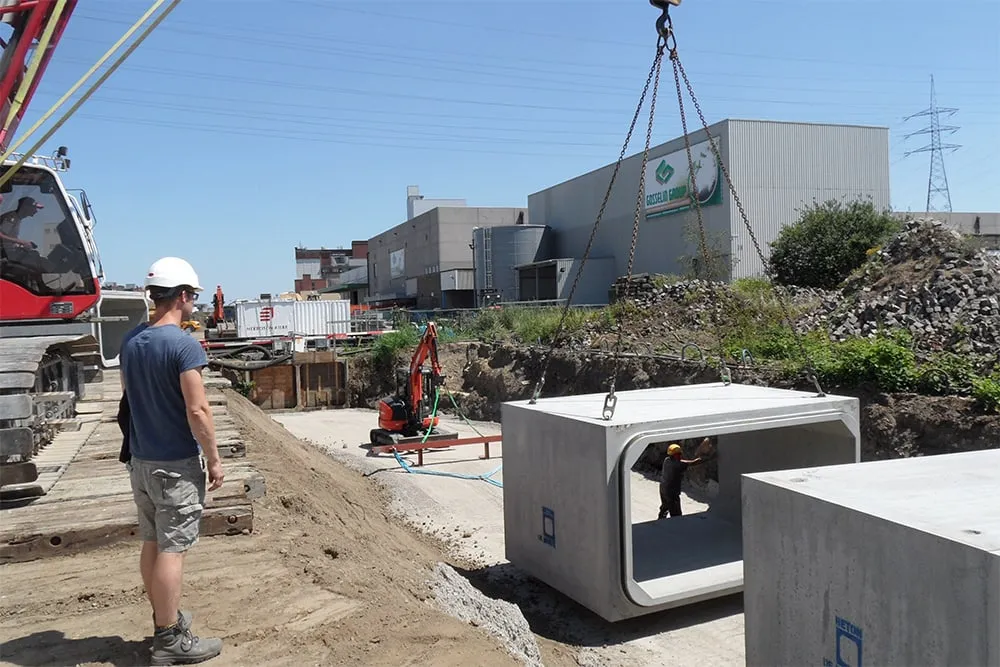
A prefabricated tank with sealed joints
A concrete attenuation tank built from box sections offers an excellent solution. These dimensionally accurate sections are mechanically connected to one another with high-quality seals to form a durable system.
The individual sections of the tank can move as a unit with the natural dynamics of the ground without leaks developing. This is crucial, as ground movements are unavoidable, particularly in areas with clay or peat soils or where groundwater levels fluctuate.
Durable installation
This prefabricated solution can be installed durably by following a few simple points. Here are the most important ones:
- Ensure the foundation is correctly dimensioned and laid on a stable base;
- Avoid uneven pressure on the joint seals by laying an even bedding;
- Backfill and compact evenly in layers on both sides of the sections.
Consultation with installers and operators
De Bonte Group recognises the challenges involved in installing prefabricated attenuation tanks and has therefore held extensive consultations with installers and operators. This has led to new insights and clearer guidelines for the design, installation and monitoring of these systems. These will be reflected in forthcoming amendments to SB250 and NBN EN 1610.
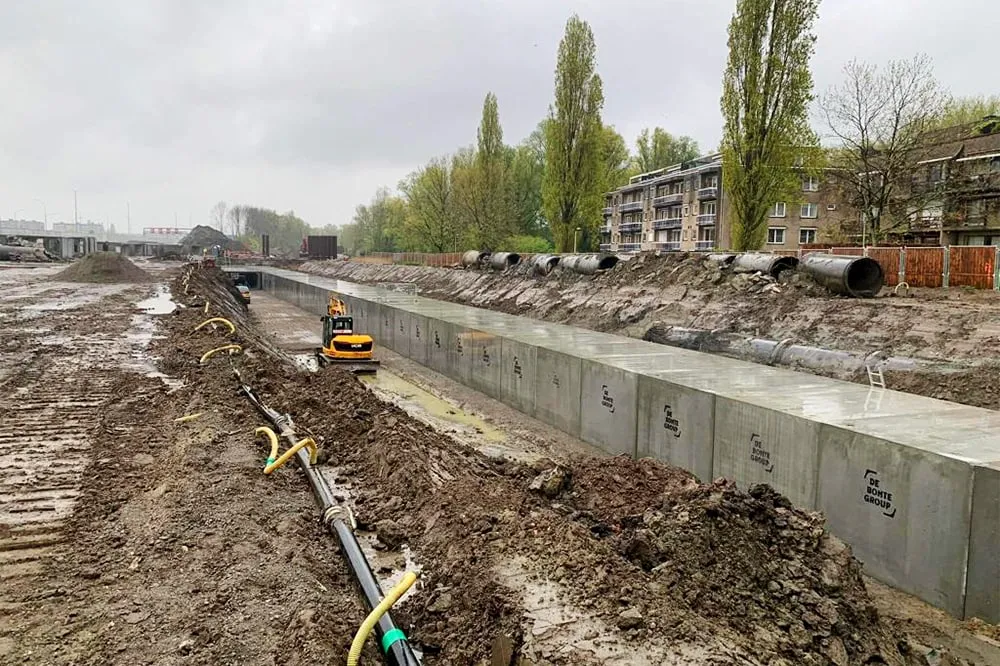
Prioritising prevention during installation
Specific improvements have been made to the design and production process to reduce installation errors:
- An adjusted 3° taper on the spigot and socket provides improved watertightness;
- Minimum spacers are provided, with mechanical couplings available as an option, to ensure the correct joint gap;
- The connection is fitted with a shear stop to ensure a durable seal;
- The option of fitting the joint with a double seal, which can be post-injected if required;
Each box section is supplied with a digital passport containing the complete product and installation specifications, as well as all critical measurements. This guarantees a factory warranty for the watertightness of the box sections.
De Bonte Group can provide guidance on our installation specifications. This will give all project supervisors, including project managers and site supervisors, the right knowledge to help ensure a durable installation.
Durable water storage for decades
In short, a sustainable concept for underground attenuation tanks requires not only high-quality materials and factory quality, but also careful, durable installation. By paying attention to every detail, an attenuation tank can function sustainably for decades and help us make sensible use of rainwater through reuse.
Question about this story? Ask your question
Keep following this
Get an email when a new story is published. No account needed.
- ThemeSpace for water and green infrastructure
- SubjectSewerage & underground infrastructure







