









Sewerage & underground infrastructure
Sewerage sector calls for a more realistic approach to rainwater infiltration and storage
Text Niels Rouvrois Beeld FEBE

The Regional Rainwater Ordinance 2023 (GSVH 2023) sets out Flanders’ ambitions for rainwater reuse, infiltration and storage, with the aim of preventing flooding and promoting sustainable water management. FEBELCO, the product group within FEBE representing manufacturers of precast concrete products for sewerage, rainwater conveyance, storage and infiltration, supports the ordinance’s ambitions. The group says it wants to be a partner in the transition towards as much rainwater infiltration and storage as possible. However, FEBELCO believes the GSVH 2023 contains a provision that is too strict and therefore unrealistic: the ordinance says that all water infiltration must take place above ground.
The new Regional Rainwater Ordinance therefore says that infiltration should preferably take place above ground, unless there is a good reason to do it underground. It states: ‘Infiltration facilities must be constructed above ground, unless the permit applicant provides a reasoned demonstration that underground construction is unavoidable.’
Evert Lemmens, CEO of TUBOBEL Group and chair of FEBELCO, is clear: “We really have no time to lose when it comes to carrying out infrastructure works to manage rainwater. Climate change only makes this more urgent. Sewerage projects already have an average lead time of 8 years. If we have to work under this strict ordinance, whose ambitions we fully support, many projects will be delayed, have to start again from scratch or even be abandoned. Surely that cannot be the intention?”
Not a black-and-white issue
The sector wants to raise awareness among all stakeholders of the advantages and disadvantages of underground and above-ground rainwater infiltration solutions. To this end, it is developing a website that aims to prompt visitors to think through five questions. Evert Lemmens: “On the one hand, the website is a guide that points you in one direction or another depending on the situation. On the other, we want to encourage all stakeholders to take a wiser approach to the GSVH 2023 and our rainwater. We want to make it clear that every project is different and that water infiltration cannot be a black-and-white issue, as it is currently being presented.”
Evert Lemmens: “We consulted many stakeholders on the website content and vision document, from water infrastructure operators and cities and municipalities to cycling and traffic organisations. We heard similar concerns from everyone: they all support the need to manage our rainwater more wisely and understand that above-ground infiltration solutions alone are not very realistic.”
The article sets out a number of arguments for when above-ground or underground infiltration and storage may be preferable. Limited space in Flanders, for example, could make it difficult to implement everything above ground. A ditch or a swale takes up space, potentially at the expense of cycling infrastructure or agricultural land. Expropriations to enable above-ground solutions cause delays. The sector acknowledges that above-ground solutions can benefit biodiversity, but can sometimes also compromise (road) safety. There is no clear-cut ideal solution in terms of cost: it depends on the project. Above-ground solutions can sometimes be quick and inexpensive to install, but they usually require more maintenance than underground infiltration systems, where, in the best-case scenario, only a filter needs to be emptied.
The product group hopes the current Flemish government will amend the GSVH 2023 on this point, so that work can continue on improving rainwater infrastructure.
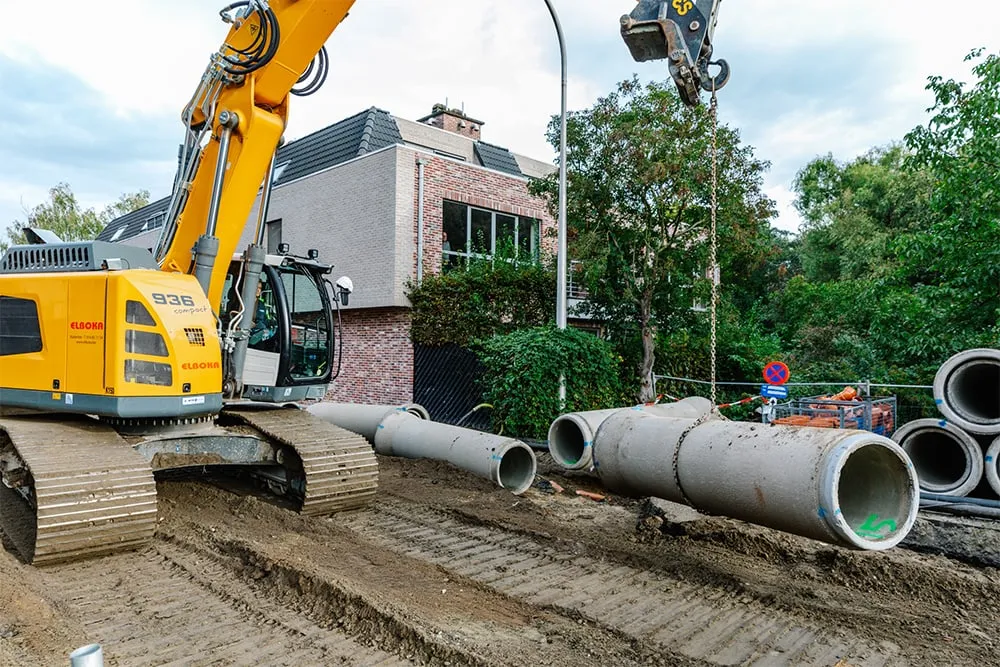
Cement-free geopolymer sewer pipe installed in Duffel
Materials used in the infrastructure sector often have a substantial environmental footprint. TUBOBEL Group and Finnish company Betolar have developed a pipe based on a sustainable alternative to cement: Geoprime®, the first product in TUBOBL’s Climate Concrete range. Geoprime® pipes were installed for the first time at an Aquafin site in Duffel.
In TUBOBEL’s Geoprime® pipe, which was also a laureate at the latest Techni-Mat Awards, the binder is an activated geopolymer. These geopolymers are by-products of steel production. As cement is not used as a raw material and an existing by-product is used instead, Geoprime® has a CO2 footprint from raw material use that is 78% lower than that of conventional concrete (Life Cycle Assessment levels A1 & A2). Geoprime® pipes are intended for rainwater storage and conveyance. Mechanically, they meet the same requirements as ordinary concrete pipes. Research is currently under way to establish whether they are more resistant to biogenic sulphuric acid corrosion caused by H2S.
The first geopolymer pipe was successfully installed in the rainwater sewer of an Aquafin sewerage project in Duffel. Evert Lemmens: “This is a valuable reference project for our Geoprime® pipe, and we will of course continue to promote and develop this product. Environmental awareness will only become more important in the years ahead, and TUBOBEL wants to continue to play an active role in that.”
Question about this story? Ask your question
Keep following this
Get an email when a new story is published. No account needed.
- ThemeSpace for water and green infrastructure
- SubjectSewerage & underground infrastructure







