









Sewerage & underground infrastructure
Is vitrified clay the answer to the Flemish government’s environmental challenges?
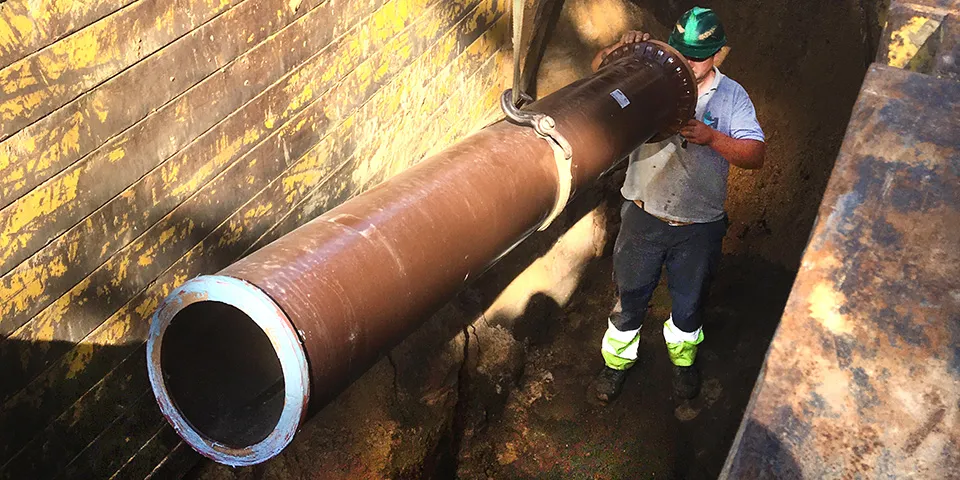
The previous Flemish government set the goal of making all public contracts 100% sustainable by 2020. Now is the time to make a firm commitment to the circular economy and consciously choose solutions with the least environmental impact. Can vitrified clay, a ceramic sewer pipe material manufactured in Flanders and used in the sewerage sector worldwide for many decades, help the current and next governments achieve their objectives?
Steinzeug-Keramo is convinced that the best solutions are inspired and supported by nature. When natural, sustainable applications are available, should they not be preferred to materials that harm the environment, generate unnecessary waste and are difficult to recycle chemically? That is why, when shopping, we now consciously choose plates and straws made from natural materials that are easy to recycle or compost.
The raw materials used to make vitrified clay are clay, water and grog: three materials of natural origin. Since clay is available in unlimited quantities and will therefore be more than plentiful for future generations, these materials offer a sustainable solution. Grog is made from recycled ceramic material. This includes not only the company’s own production waste, but also waste from other ceramic industries, which is mechanically recycled. Valuable crude-oil-based raw materials are put to better use in applications where natural alternatives are not possible, such as pharmaceuticals, safety or insulation.
Recycling is good, avoiding waste is better
Not only are the raw materials natural, but the production of vitrified clay sewer pipes is also a model of sustainability. Clay is transported by water, while biomass plants provide renewable energy and green electricity. It is no coincidence that these sewer pipes have been awarded Cradle to Cradle certification, which puts a closed production cycle at its heart. This system allows sustainable materials to be reused indefinitely without compromising quality or being subject to downcycling, a problem that unfortunately continues to severely limit the long-term sustainability of plastic materials.
It is unclear whether the government will achieve its goal of carrying out only 100% sustainable projects in 2020. But the sector has everything it needs to support the government and make a firm commitment to the circular economy now. Nature-based solutions such as vitrified clay can certainly help address the economic and environmental challenges of a changing society.
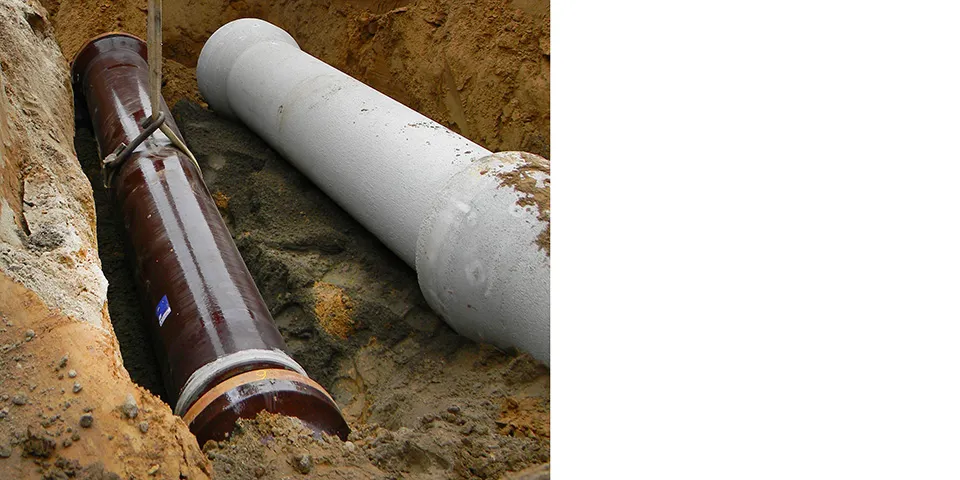
Even in difficult conditions where achieving good compaction is a challenge, the long-term stability of the pipe is guaranteed.
Prevention is better than cure
Because vitrified clay pipes are rigid, they have the upper hand during installation. Even in difficult conditions, such as where pipes cross or the ground is very wet, where achieving good compaction is a challenge, the pipe’s high mechanical strength guarantees long-term stability. As a result, there is no need for requirements that delay construction, such as ovality and longitudinal profile measurements, to achieve a stable pipe and a straight flow profile. Together with the 2.5 m length of Steinzeug-Keramo pipes, this means that installation productivity, and therefore the cost of careful installation, is comparable to that of concrete pipes and plastic pipes, whose length for main sewers is also limited to 3 m to minimise irregularities in the longitudinal profile.
Asset management
Vitrified clay sewer systems have an unrivalled service life and are an ideal fit for considered asset management. Their straight flow profile and hard, smooth inner surface prevent water stagnation and sedimentation, and they can withstand high-pressure jetting. Thanks to their high-performance sealing system, root ingress, infiltration and exfiltration are no longer a concern.
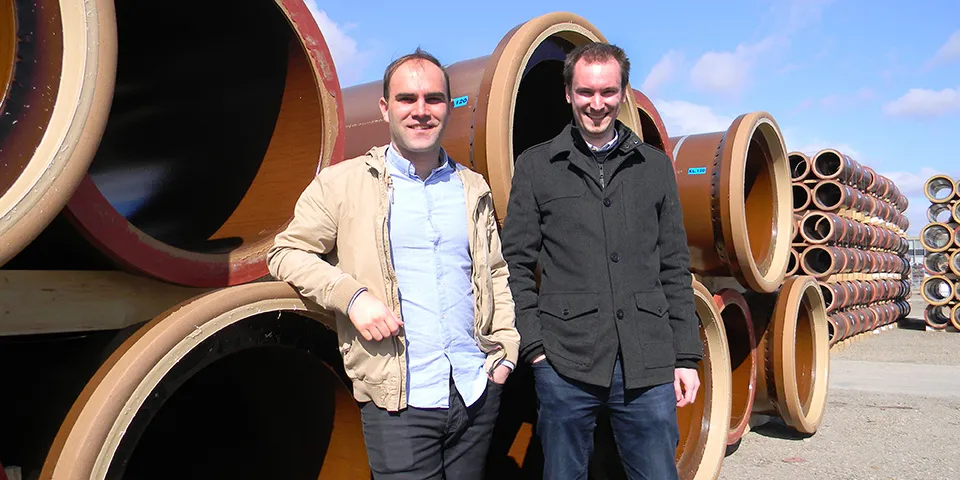
Steinzeug-Keramo has welcomed two new team members: sales support engineer Dieter Schreurs and Jens Barbieur, technical and commercial manager for Antwerp and East Flanders.
Fresh young faces
Steinzeug-Keramo is securing not only a sustainable future for sewer systems, but for the company itself. Two young recruits have recently joined the sales and technical teams. Dieter Schreurs is the new sales support engineer for the Benelux. He holds a master’s degree in chemistry and has a broad, multidisciplinary background gained through his doctoral research. He will provide in-depth technical support, acting as the link between the market, the sales team and Steinzeug-Keramo’s in-house design department.
Jens Barbieur recently became the company’s new technical and commercial contact for Antwerp and East Flanders. He has experience in the road construction sector, working as a site manager and as a designer at a well-known engineering consultancy. These recent appointments are part of the company’s continued expansion across Europe. They also aim to strengthen expert support for projects during design, construction and aftercare, thereby achieving maximum customer satisfaction.
Question about this story? Ask your question
Keep following this
Get an email when a new story is published. No account needed.
- SubjectSewerage & underground infrastructure







