









Sewerage & underground infrastructure
Innovative plastics technology revolutionises aquaculture
Text AgruImage Agru
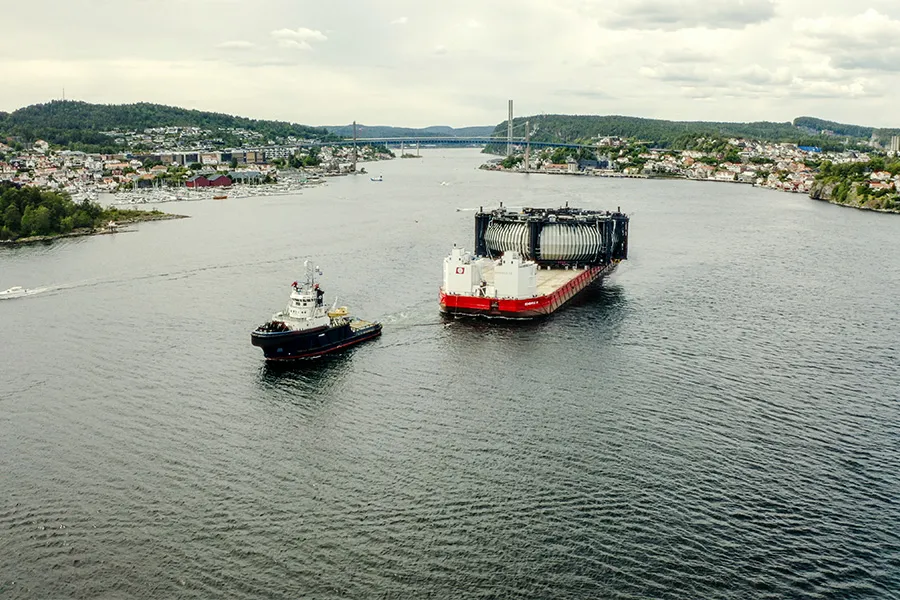
A Norwegian company has successfully delivered a groundbreaking aquaculture project. The Marine Donut, a closed, floating fish farming system made from highly crack-resistant PE 100-RC plastic, has been installed at a salmon farm in Norway. Supplied entirely by AGRU Kunststofftechnik GmbH, this innovative facility marks the beginning of a new era of sustainability in salmon farming.
With an external diameter of 55 m, a height of more than 17 m and a total weight of approximately 600 tonnes, the Marine Donut is the world’s largest thermoplastic structure. The unique design of this floating fish farm has the potential to revolutionise salmon farming methods. The Marine Donut’s outstanding design creates a controlled environment that reduces stress for the fish and enables them to grow more healthily. Thanks to its durability and cost-effectiveness, this solution is intended to replace conventional net pens in the future. The Marine Donut can hold up to 200,000 salmon weighing 2.5 kilograms, which remain in the facility until they reach their harvest weight of 5.5 kg.
Groundbreaking innovations
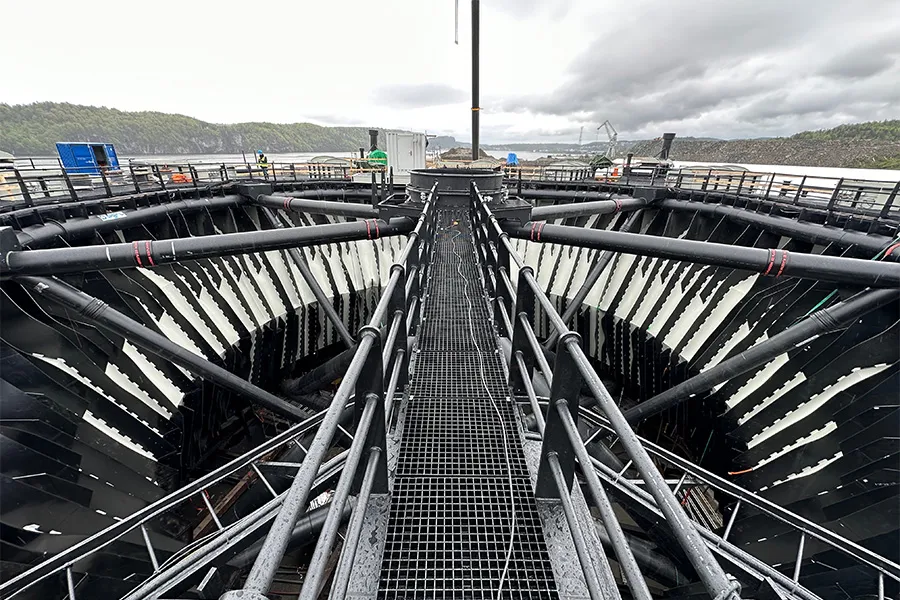
The Marine Donut’s innovation lies in its closed structure. This makes it possible to protect salmon from parasites such as sea lice and keep them healthy. The discharge of filtered deep water prevents sea lice from entering. Food waste and fish excrement are collected as sludge at the facility. This is then pumped ashore for environmentally friendly disposal. This process not only minimises the environmental impact of salmon farming, but also prevents the spread of disease.
Another striking feature of the Marine Donut is its artificial current channel, which simulates a river. A continuous current flows through the facility’s ring-shaped structure. The fish are therefore constantly in motion, which has a positive effect on their quality. In addition, the structure is equipped with ballast tanks, which allow the Donut to be raised, lowered or tilted in the sea. Fish ready for harvest can be guided into a connected hose by tilting the structure, then transported unharmed to the processing vessel for further processing.
Plastics technology from Austria
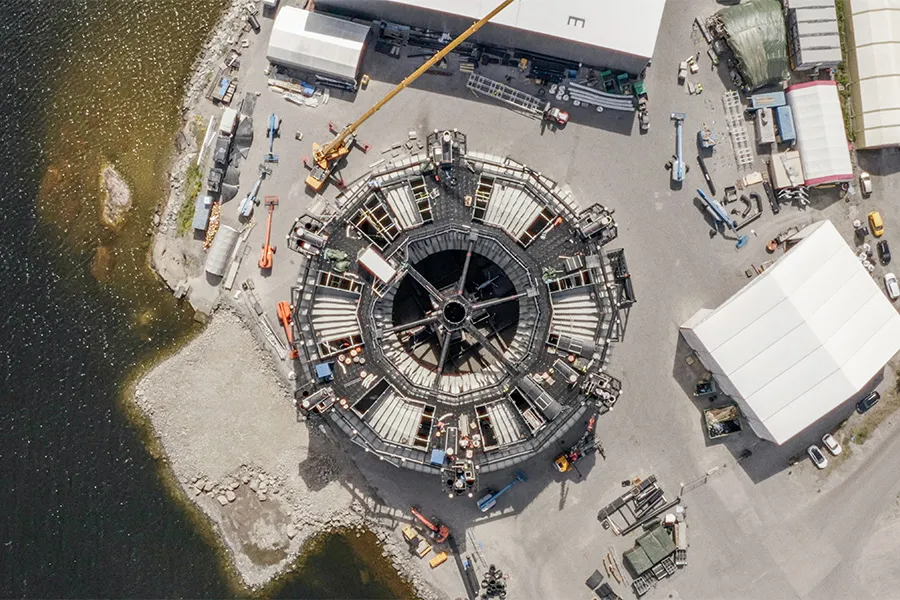
Bad Hall-based AGRU Kunststofftechnik GmbH played a central role in delivering this ambitious project. It manufactured and supplied all PE 100-RC components for the 22,000 m³ Marine Donut. The deliveries included 400 tonnes of agate-grey and black PE 100-RC plastic sheets, as well as 200 tonnes of PE 100-RC piping systems and electrofusion fittings with external diameters of up to 1,200 mm. AGRU also made a significant contribution through its extensive application technology consultancy.
“We are proud to have made a significant contribution to the realisation of this revolutionary aquaculture technology with our expertise and high-quality materials,” explains Albert Lueghamer, Head of Technical Services at AGRU. “Close cooperation with our customer and AGRU’s in-depth knowledge of the challenges posed by plastic products in salt water have contributed significantly to the successful delivery of the project.”
To make the plastic sheets easier to handle during installation, AGRU manufactured them in a special format. On site, the precise curvature of the sheets was achieved by bending them over a circular formwork. Once they had taken the correct shape, the sheets were joined by butt welding. The Marine Donut’s structure also uses special stiffening ribs made from black PE sheets. These are the result of a finite element analysis carried out to assess the strength and deformation of the complex geometry precisely.
Sustainability through plastics
Peter Undeutsch, Head of Sales at AGRU, highlights the forward-looking importance of using plastics in marine applications. “The Marine Donut is a milestone in aquaculture and demonstrates the enormous potential of thermoplastics in this field. We will continue to use our extensive experience and expertise in plastics technology to support the development of the aquaculture industry.” ■
Question about this story? Ask your question
Keep following this
Get an email when a new story is published. No account needed.
- SubjectSewerage & underground infrastructure







