









Sewerage & underground infrastructure
Guaranteeing water infiltration with the right gravel lawn
Text Niels Rouvrois Beeld Acterra
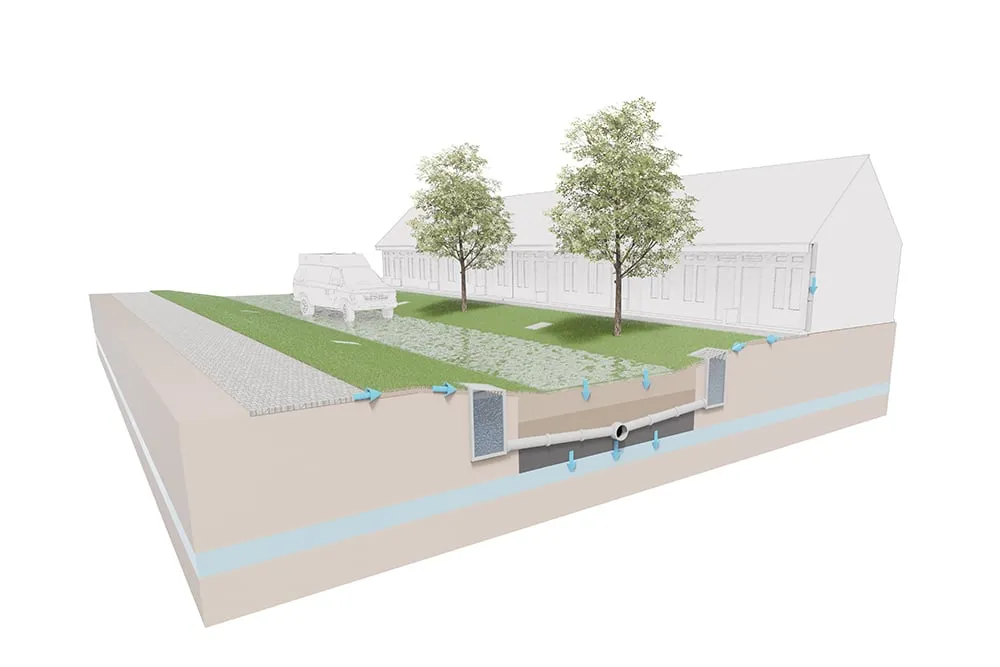
The importance of depaving and incorporating more green space continues to grow. SuDS basins and permeable paving are now more the rule than the exception in both public spaces and private plots. Naturally, this makes it crucial to have soils with good permeability. “Thanks to the trafficable RevivA® Tree Planting Substrate, water can infiltrate effectively after heavy rainfall, within 24 hours,” says Bart Geerts, managing director of Acterra, which produces RevivA® Gravel Clover Lawn and TerraViva® substrates, among other products.
Every measure taken by local authorities and private individuals to make public spaces, homes and gardens more climate-resilient makes a difference. One interesting and widely used solution is the wadi (Water Drainage Infiltration), a gravel- and sand-filled depression or basin that can both store water and allow it to infiltrate. In many cases, creating a wadi means sacrificing an expensive plot of land on a housing development or business park.
Trafficable wadi
Bart Geerts: “A wadi is intended to allow rainwater to infiltrate slowly into the ground, but in many cases it is made extremely deep to provide sufficient storage capacity, with infiltration taking place over a very small area. As a result, the sides are very steep, making maintenance difficult. After a few years, the wadi becomes overgrown, and chainsaws have to be brought in to clear it up. This means that, particularly in public spaces, the wadi becomes an unsafe and untidy feature, and one that is increasingly seen in a negative light.”
Acterra has developed a solution that combines water infiltration with a trafficable road. This allows the available space to be put to better use. By laying the access road around, for example, a business 30 cm lower than the surrounding green space, water can be stored along the entire road. Even when there is water in the wadi, vehicles can still drive over it without subsidence or the risk of getting stuck. A win-win situation.
RevivA® Gravel Clover Lawn
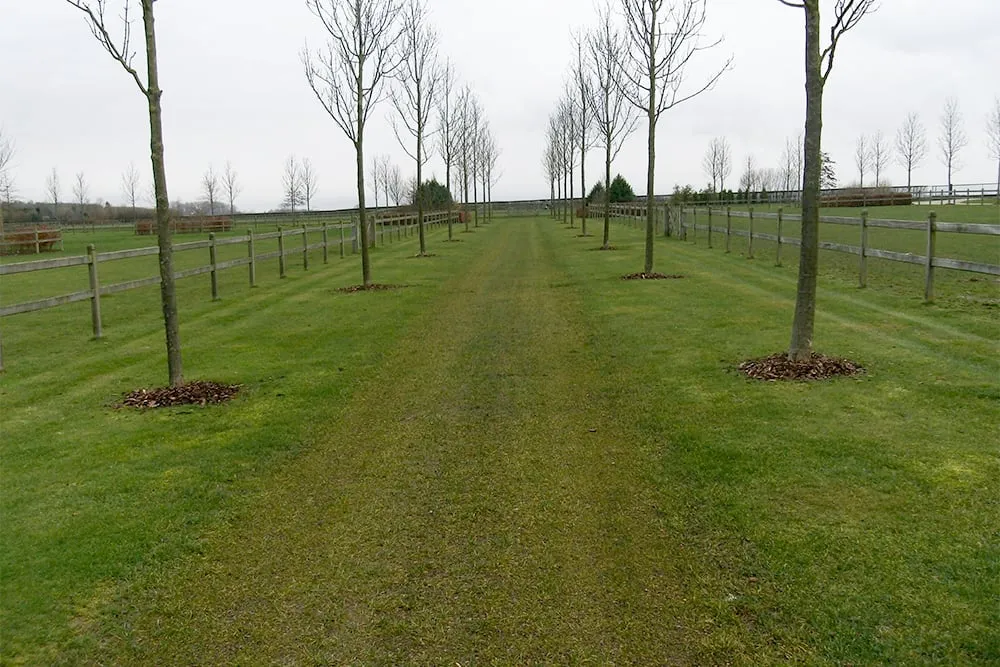
RevivA® Gravel Clover Lawn from Acterra is a substrate used for areas of lawn that are driven over occasionally. Fire access roads, campsites, moving routes … are all suitable applications for a gravel lawn. The gravel lawn is pre-mixed with grass seed and can be laid on RevivA® Tree Planting Substrate. RevivA® Gravel Clover Lawn is a homogeneous mix of trafficable aggregates (lava and fired clay) with growing medium (topsoil, peat, Vlaco green compost, composted horse manure) and grass seed. This substrate can also be laid using an asphalt paver.
Bart Geerts: “RevivA® Gravel Clover Lawn can provide a valuable solution for enabling water to infiltrate effectively within a set period after heavy rainfall. In areas with naturally impermeable soils, such as clay soils, intense rainfall can cause waterlogging. This can harm the surrounding area, potentially leading to flooding and erosion. The use of traditional wadis may be limited where the natural soil structure is not conducive to rapid rainwater infiltration, as is the case across large parts of Belgium. By building a TerraViva® Aqua Mobilis with RevivA® Herb-Rich Gravel Lawn, you can guarantee infiltration, regardless of the underlying soil. It also offers sufficient load-bearing capacity for emergency vehicles, biodiversity-rich vegetation, nitrogen reduction and space savings as additional benefits. For example, a RevivA® wadi in clay soil needs considerably less space to provide the same infiltration capacity, while microclover incorporated into the gravel lawn captures up to 200 kg of nitrogen per hectare per year.”
Question about this story? Ask your question
Keep following this
Get an email when a new story is published. No account needed.
- ThemeSpace for water and green infrastructure
- SubjectSewerage & underground infrastructure







