









Sewerage & underground infrastructure
Bringing together expertise and resources for an ambitious, complex metro project in the heart of Brussels
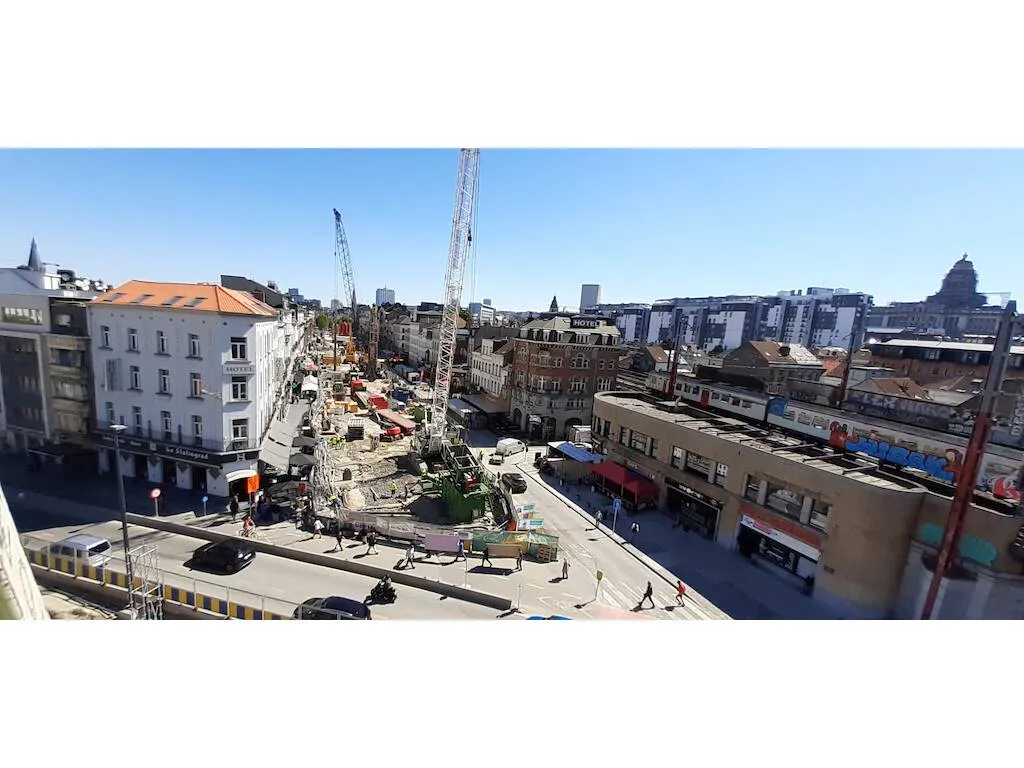
In the heart of Brussels, the temporary joint venture (TM) Toots, a partnership between BESIX, Jan De Nul Group and Franki Construct, is currently building a new metro tunnel. The works form part of the Metro 3 project and include two tunnels, the construction of Toots Thielemans metro station, and the renovation and expansion of Lemonnier tram station. The walls of one tunnel section will be built using grout piles from the basements of the Zuidpaleis, after which the tunnel roof will be constructed in stages from the same basements. For the other tunnel section, the cut & cover technique is being used once again in central Brussels for the first time since the 1990s.
The future Metro Line 3 between Bordet and Albert will enable the MIVB to accommodate growing passenger numbers in a region where the population is increasing year on year. The project will modernise the entire mobility network in the Brussels-Capital Region at a time when the quality of journeys is becoming increasingly crucial for major cities. It also aims to provide user-friendly stations that are accessible to people with reduced mobility, and public spaces that meet citizens’ expectations, with public-realm works shaped through a participatory process. As part of the wider Metro 3 project, TM Toots is currently responsible for constructing Toots Thielemans metro station and the two tunnels. One runs beneath the Zuidpaleis towards Lemonnierlaan, while the other runs beneath Zuidlaan and along Jamarlaan to Baraplein. The works are all taking place between Brussels-South station and the Anneessens district, in the heart of the Belgian capital, and include the civil engineering works and fit-out. Work on the tunnels and Toots Thielemans metro station began in September 2020, with the new metro scheduled to enter service by 2025. Work on Lemonnier tram station will follow, between 2025 and 2028.
Line 3 tunnels
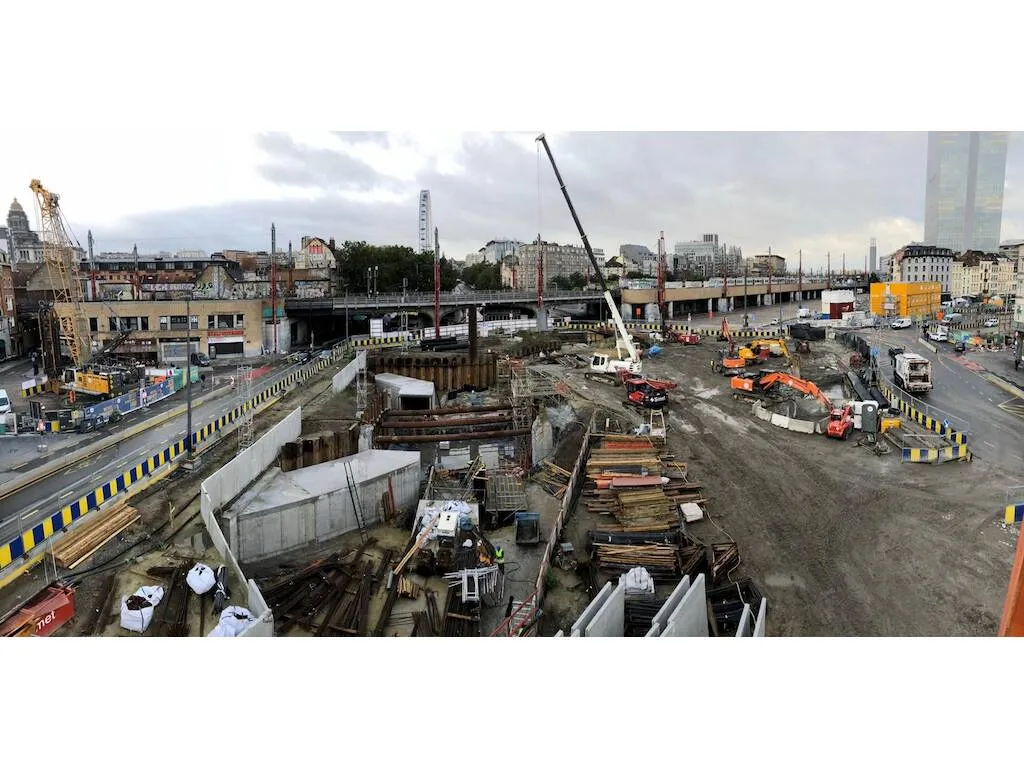
The first on-site phase involved preparatory works to adapt the public realm to the site conditions. “The area was converted to a construction site in stages, including the installation of temporary roads,” explains Gaëtan Lamaille, project manager at BESIX. “Since the preparatory works, the main focus has been on the foundations, followed by, and partly in parallel with, the structural works to divert the sewer. The foundations are also being installed in stages, using a range of techniques. Particular attention is needed at the central junction in the middle of the project, on the Small Ring Road.”
Toots Thielemans
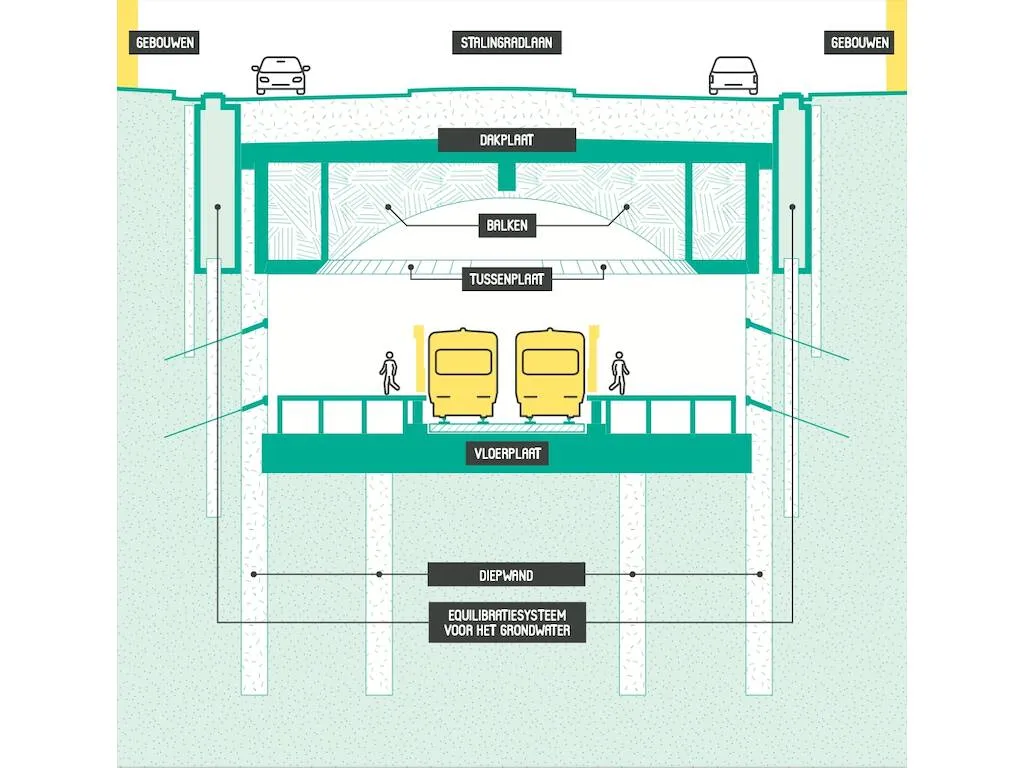
The first tunnel is 300 m long and will connect the new Toots Thielemans station to the existing tunnel section towards Brussels-South, near Bara plein. The foundations here will be installed mainly using the cut & cover technique. Trenches are excavated and concrete side walls cast in them, then a roof slab is built on top. This creates a strong structure that allows the ground beneath the roof slab to be excavated, followed by the construction of the floor and intermediate slabs underground and the installation of the internal structures and equipment, with very limited disruption above ground. François-David Jonard, project director at Jan De Nul Group, explains: “This shows just how complex this site is. It is the first time since the 1990s that the cut & cover technique has been used again in central Brussels. That is quite remarkable, as it is not a routine technique and you have to be willing to use it. Given the surroundings and the conditions, cut & cover was the only option for this project. It is a major advantage that three strong partners can pool their knowledge and experience from other tunnel projects, such as the renovation of the Leopold II tunnel, the construction of the Schuman-Josafat tunnel, the construction of the railway bypass in Mechelen and the construction of the tunnel on the ring road around Aalst.” The complex ground conditions demand precise work, as this tunnel section also requires excavation beneath the existing tram tunnel and through a complicated junction of sewer collectors. “Ground freezing will therefore be used beneath the existing tram tunnel at that point,” says Jan Poppe, site manager at Franki Construct. “The groundwater is frozen, making the ground impermeable to water so that it can be excavated safely from within. There are several such junctions that require particular attention, which makes this contract very specific indeed.”
Lemonnier
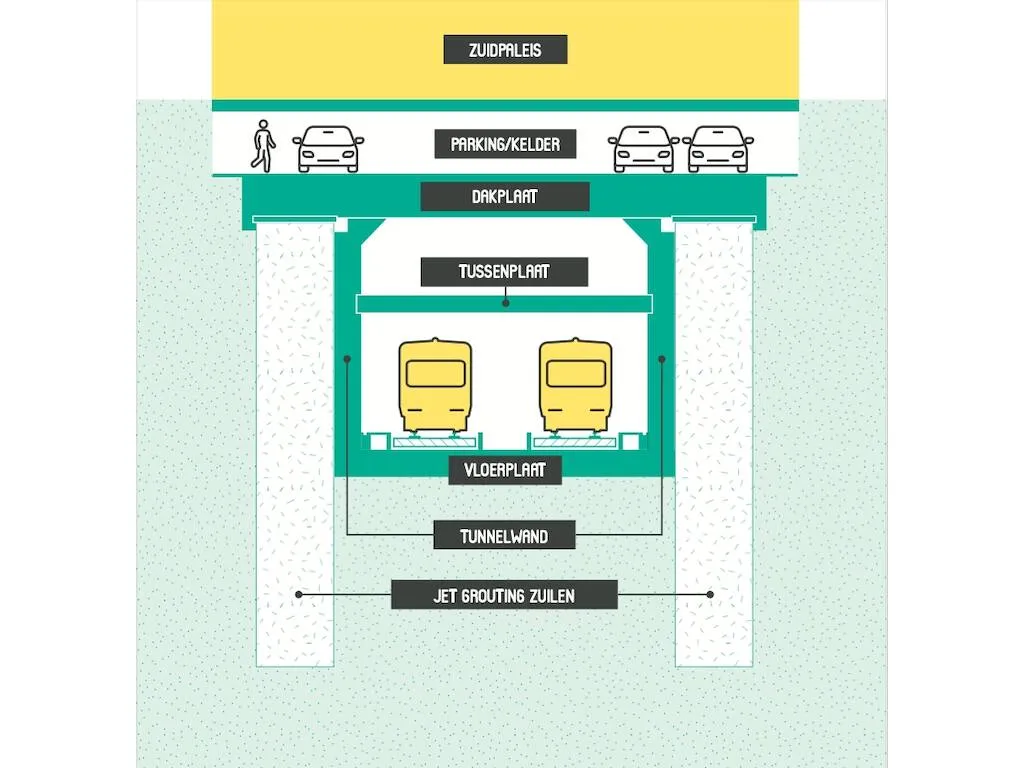
The second tunnel, 210 m long and mostly to be built beneath the existing ‘Zuidpaleis’ building, will connect the metro station to the existing tunnel section towards Anneessens. This tunnel section can only be built by first strengthening the historic building from its basements, then using jet grouting to install grout piles from the basements of the Zuidpaleis. Injecting cement mortar under high pressure and mixing it with the soil creates load-bearing, watertight columns. A roof slab is then laid in stages to support the building, allowing work and excavation to continue underground. Once the reinforced-concrete base slab and side walls have been completed, they will permanently take over the function of the grout piles.
A combination of factors makes this project so challenging for BESIX, Jan De Nul and Franki Construct. Gaëtan Lamaille says: “It is not just the considerable technical complexity and the variety of techniques, but also the scale of the project that presents a challenge. The quantities involved are enormous, for example, in jet grouting, diaphragm walls, earthworks and concrete structures. Then there are the external factors we have to take into account: existing buildings and tram tunnels, traffic, public transport ... It all adds to the challenge and makes this project unique.”
Ambitious and complex
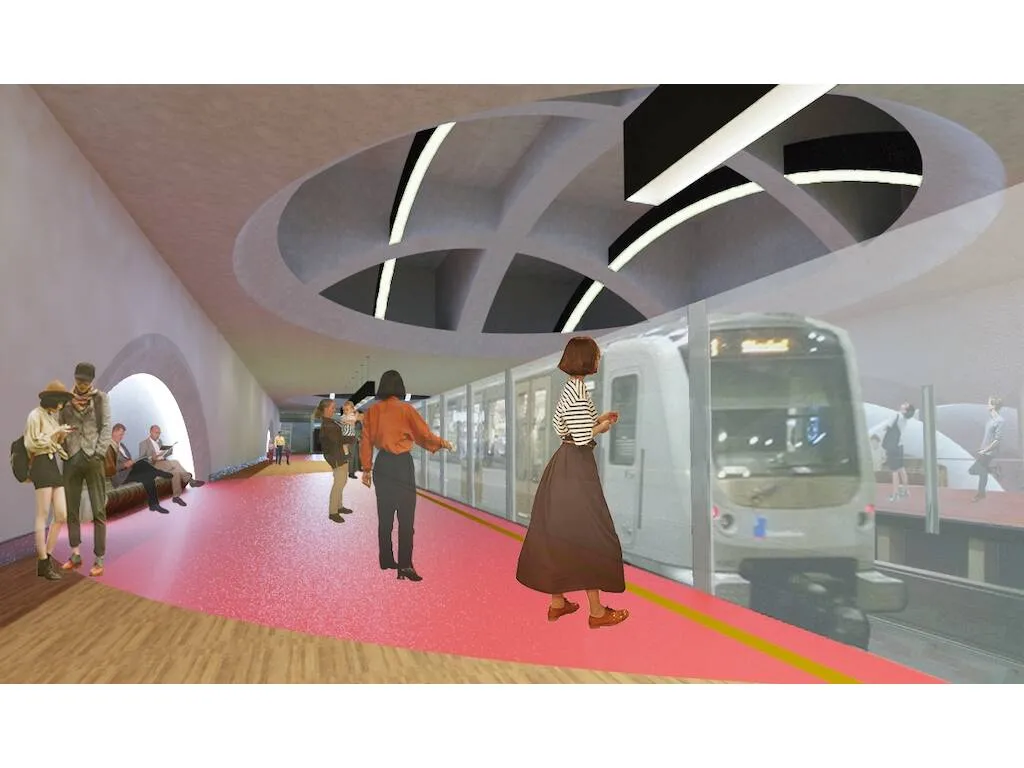
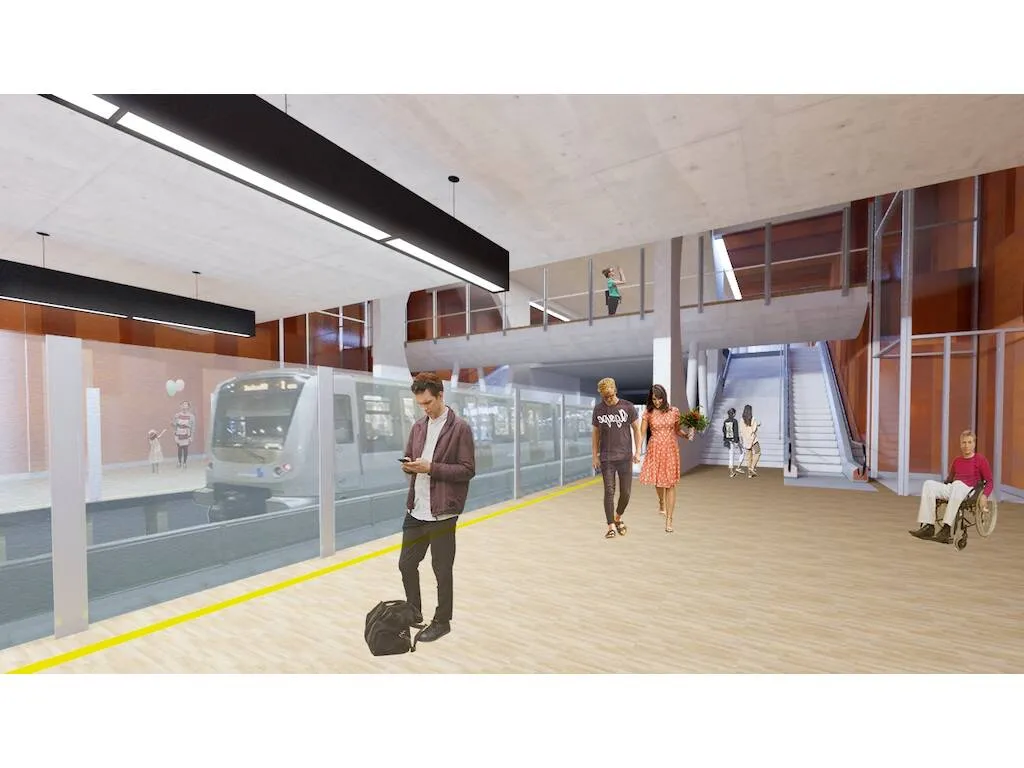
Toots Thielemans metro station, formerly known by the project name ‘Grondwet’, is located beneath Stalingradlaan, between Brussels-South and Anneessens stations. The station will have two platforms on level -2 and three mezzanines for the ticket offices and platform access. These will be accessible from Zuidlaan and the Zuidpaleis, and will also connect to Lemonnier tram station, which will remain in its current location, via a new pedestrian tunnel. Two mezzanines, 60 m and 30 m long, at either end, will span the tracks and connect to the station’s current entrance via a footbridge. Adaptation works will make the entire station accessible to people with reduced mobility. The construction of the new metro and tram stations and the two tunnels is one of the most ambitious and complex construction projects in Brussels today. Toots Thielemans metro station will open up the district around the Zuidpaleis, thanks to its location on Metro 3, Brussels’ new public transport artery. With capacity three times greater than the tram and services every three minutes, it will guarantee frequent, fast journeys.
Extensive experience
The fact that this project is part of a wider programme is another factor to consider. Jan Poppe says: “We are not directly dependent on other projects, but there is some overlap. Subcontractors are being used for signalling and systems across several stations, so there is a degree of synergy and a connection with our plans. The client is, of course, dependent on our project, as it is an important link in bringing the line into service.” The experience of the three partners in TM Toots is therefore invaluable in delivering the project on schedule and to the required standard. “We all know the context of projects on this scale, and we have extensive experience in tunnel construction,” they say in unison. “The Brussels context is particularly distinctive. It is a very specific and unusual place to work, including when it comes to approvals and permits.”
Minimising disruption
The works are taking place both above and below ground in a densely populated area with many shops. For this reason, TM Toots is working with the MIVB, the Brussels Region, the City of Brussels, the municipality of Saint-Gilles and other stakeholders on a comprehensive plan to minimise disruption, taking account of local residents and businesses. Measures include using methods that cause less noise and vibration, keeping the storage and work areas to an absolute minimum, and building a new roundabout to divert traffic on the Small Ring Road and keep traffic conditions as stable as possible as the project progresses through its various phases. The plan to minimise disruption also included providing temporary premises for some businesses in September at the newly inaugurated Stalingrad Village. TM Toots’ meticulous planning brought a further benefit. François-David Jonard says: “Together with the MIVB, we decided to build a roundabout on Boulevard du Midi around our site. It turns out that traffic now flows more smoothly than it did before, when there was no construction site. It is a very busy junction, but the temporary roundabout has made traffic flow much more smoothly. This is an example of a positive side effect of careful planning. Traffic conditions can be improved further after the works are complete.”
Climate and society
During the project, TM Toots has also committed, in close collaboration with MIVB, to offering internships and training to disadvantaged people and people with disabilities, and to employing them. The temporary joint venture also calls on jobseekers from Brussels for specific tasks such as external finishing, bricklaying, flooring and painting, as part of local integration projects. TM Toots is also actively working to reduce the carbon footprint of the works while monitoring it extensively. CO2 thresholds have been set for the largest activities, such as the delivery of concrete and reinforcing steel and the removal of soil, and are being monitored. Specifically, this means that the production and transport chains for these materials are determined and monitored from the outset in order to keep emissions as low as possible. Using solar panels, TM Toots generates most of the electricity needed on site for the office units, alongside energy-efficient site cabins. Given the high water consumption of the foundation techniques, the project recently switched to using water from the Senne instead of mains water. In addition, water extracted through groundwater dewatering is discharged mainly into the Senne rather than the sewer system. Almost no generators are used, thanks to specially provided electricity connections for the site facilities. Electric equipment is also used wherever possible.
Question about this story? Ask your question
Wie aan Toots Thielemans werkte
- contractorT.M. TootsMentioned in BESIX, Jan De Nul and Franki Construct start construction of Brussels metro station Toots Thielemans for STIB
Keep following this
Get an email when a new story is published. No account needed.
- ProjectToots Thielemans
- ThemeExtending the life of bridges and tunnels
- SubjectSewerage & underground infrastructure







