OCW & OCCN-CRIC investigate draining concrete for foundations and road surfacings
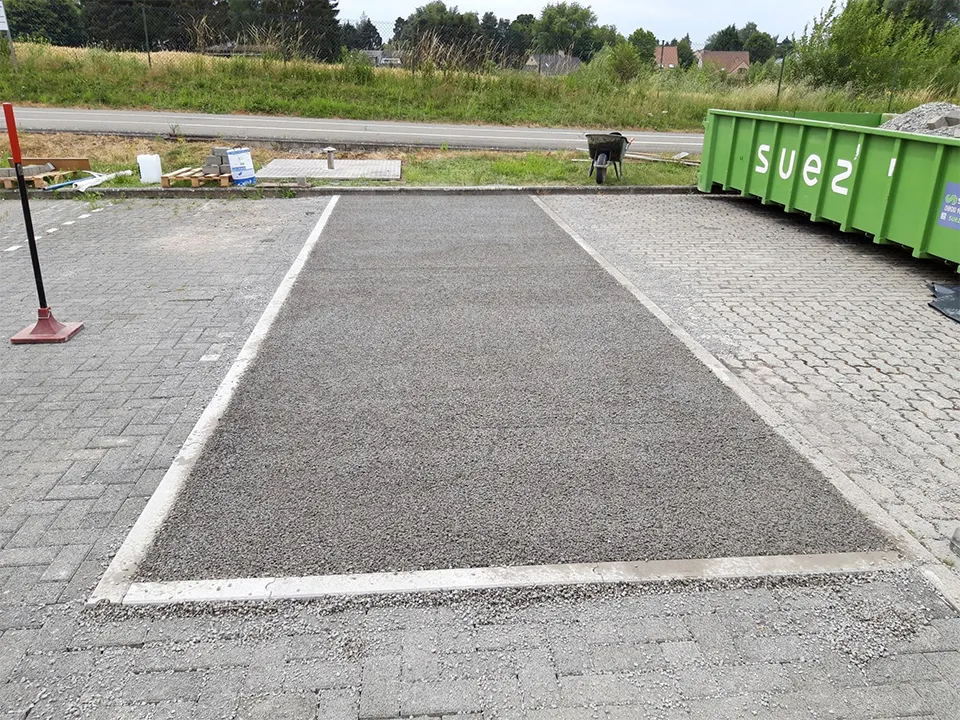
With current climate challenges putting integrated water management firmly in the spotlight, solutions include sustainable road surfacings that allow water to pass through, store it within the road structure and release it gradually or allow it to infiltrate into the ground.
Against this background, two Belgian research institutes, the Belgian Road Research Centre and the Research Centre for the Cement Industry, have joined forces on pre-normative research into draining lean concrete.
The Be-Drain project has a twofold normative objective: to draw up additional technical guidelines, performance characteristics and associated test methods for so-called draining or porous concrete, for use either as a foundation material within the road structure or as the road surfacing itself (= surface course). The reasons for this are:
Growing interest in and demand for permeable road surfacings, including cast-in-place porous concrete;
The need for a representative compaction method for draining lean concrete (as a road foundation) in the laboratory for COPRO/BENOR certification
Porous lean concrete has been used in Belgium for some time and is frequently used as a foundation, mainly beneath (permeable) paving. Technical specifications are included in the standard specifications for road construction in Flanders (SB250) and Wallonia (CCT Qualiroutes). The sector would also like this type of foundation to be certified. This certification is being discussed by the ‘COPRO Advisory Council for hydraulically bound mixtures’ and is based on a preliminary mix study, which must demonstrate that the required specifications are met. The challenge is to find a representative method for producing test specimens in the laboratory as part of that preliminary study. The currently prescribed compaction method does not reflect what can and should be achieved on site in terms of permeability.
Permeable road surfacings
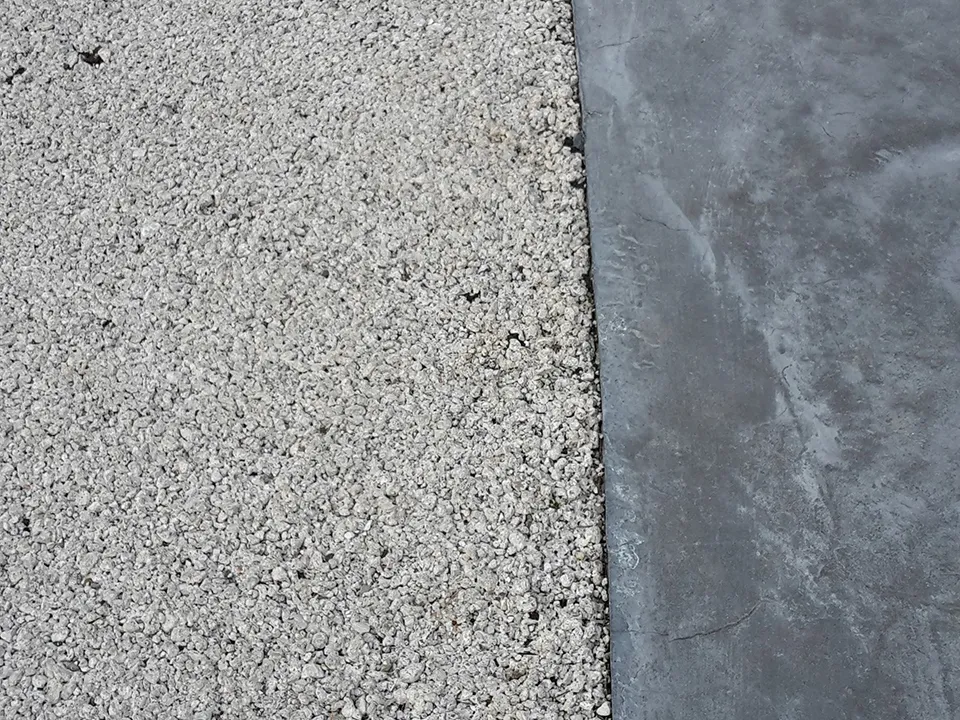
There is also renewed interest in permeable road surfacings, for which draining concrete is certainly a suitable option. In recent years, a trend towards using draining concrete surfacings for car parks and low-traffic areas has emerged in several other European countries, and some research has already been carried out, for example in France and Germany. Demand for cast-in-place draining concrete surfacings is also increasing in Belgium, and new products are coming onto the market to meet it, such as Hydromedia from Holcim. However, Belgium currently has no general technical guidelines covering concrete composition, performance requirements and/or the use of porous concrete as a road surfacing. Further pre-normative research is therefore needed to study both related topics, porous concrete for road surfacings and draining lean concrete, and to adapt and/or extend existing standards and technical guidelines.
Requirements for mechanical strength and permeability will vary depending on the application, as a foundation or a road surfacing. In principle, however, these are similar ‘dry’ concrete mixes with relatively low cement contents (150-300 kg/m³), a lower W/C ratio (0.25-0.40) and a limited or no sand fraction (< 4mm). The method of compaction on site, using various possible techniques such as a vibrating roller, vibrating plate, roller striker or slipform paver, will also affect the representative compaction required in the laboratory study. Finally, other functional requirements, such as ride quality, resistance to ravelling and freeze-thaw resistance, will also need to be studied for use as a road surfacing.
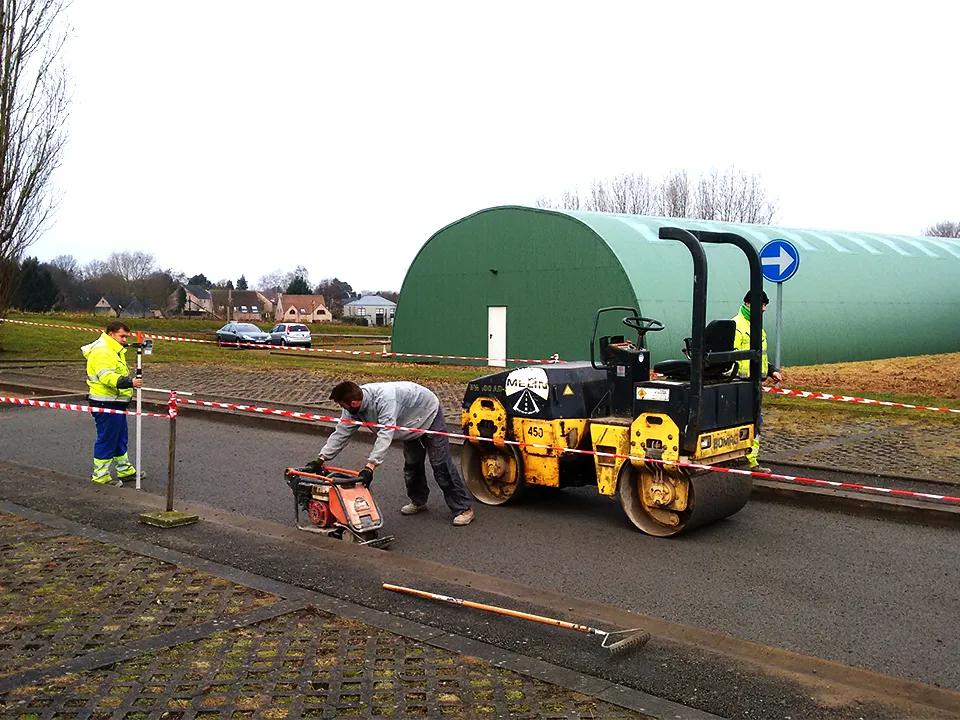
The research began in November 2020 and is scheduled to run for two years. Contractors and/or clients with draining concrete projects under way are welcome to contact OCW or OCCN-CRIC to discuss possible support. This will make it possible to compare the results in situ with those obtained in the laboratory, using different compaction methods.
OCW contact details:
Dr. Ir. Elia Boonen
02/766.03.41
[email protected]
CRIC-OCCN contact details:
Ir. Jurgen Perremans
02/626.89.28
[email protected]
Question about this story? Ask your question
Companies in this story
Keep following this
Get an email when a new story is published. No account needed.
- ThemeFuture-proofing roads and railways
- SubjectPublic space
- CompanyCopro