(Belgian) concrete: a low-carbon, high-performance solution for infrastructure and public spaces
Text and images Febelcem
The Belgian cement industry has set itself a clear goal: to be climate-neutral by 2050, and probably much sooner. This ambitious transformation programme contributes directly to Belgium’s decarbonisation targets and the EU’s interim targets: reducing greenhouse gas emissions by 55% compared with 1990 levels by 2030, and by 90% by 2040.
Cement production in Belgium, which supplies the entire construction sector as well as part of the Dutch and French markets, accounts for around 3% of national greenhouse gas emissions. The challenge is therefore considerable.
Decarbonisation is mobilising the entire construction value chain, and low-carbon cements and concretes are already available to contractors. It is often forgotten that the average CO2 footprint of cement produced and used in Belgium is among the lowest in the world. It has already fallen by more than 30% since 1990.
Alongside carbon capture and storage (CCS) projects, cement producers are also developing new cement formulations. The NEOCEM research programme, for example, carried out in collaboration with Buildwise, CRIC-OCCN and OCW, aims to demonstrate the performance of ternary cements with a lower clinker content. In particular, the aim is to validate the use of calcined clay, a promising alternative as blast-furnace slag becomes increasingly scarce. Each cement producer is therefore developing its own range, defined by its composition, particularly its clinker content, its short- and long-term technical performance, and its environmental footprint.
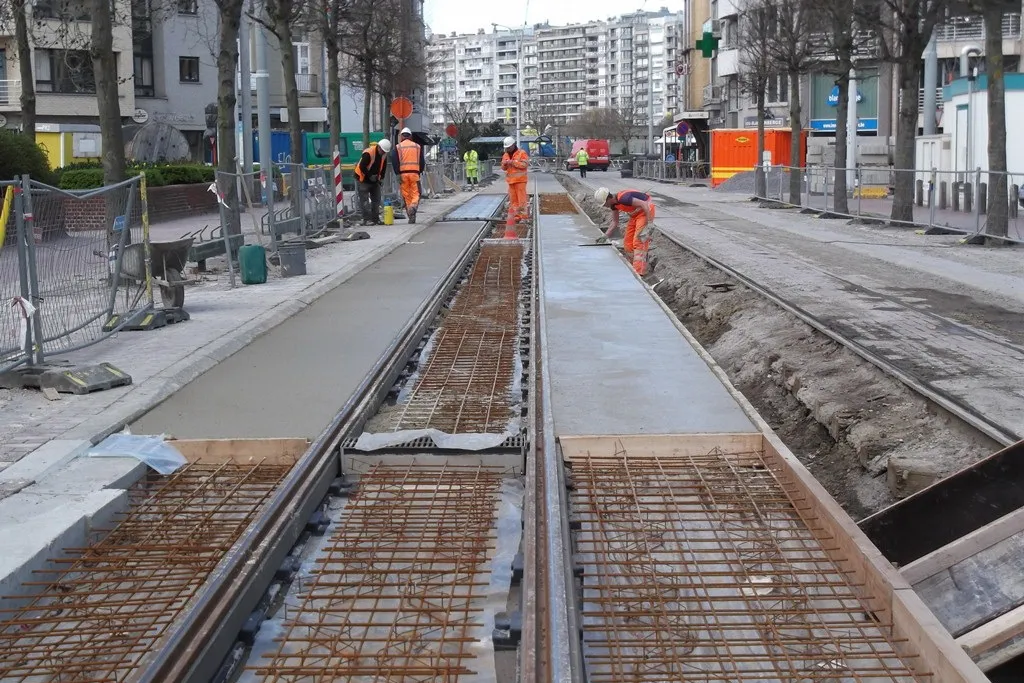
The sector’s responsibility is not limited to producing and selling cement. It extends across the entire construction value chain. With this in mind, Febelcem’s members are committed to developing circular practices for the use of concrete, a material particularly well suited to this, notably by reducing material consumption. However, we must not forget that circularity is about more than recycling: it must be incorporated from the design stage, an essential condition for ensuring that concrete is used optimally and sustainably.
As the saying goes, ‘What gets measured gets managed’. A material’s environmental footprint, including its CO2 footprint, is calculated using a life cycle assessment (LCA) and verified information, summarised in an environmental product declaration (EPD). Only on this basis can the environmental performance of construction solutions be compared objectively.
To date, few specifications include environmental criteria. However, European legislation, such as the taxonomy and the Energy Performance of Buildings Directive (EPBD), is encouraging initiatives in support of low-carbon materials. One example is the CO2 Performance Ladder, which paves the way for higher-quality public procurement by giving contractors offering low-carbon concrete solutions a competitive advantage alongside the price criterion. Another initiative, discussed within the Belgian Alliance for Sustainable Construction and led by the Flemish government, is the development of TOTEM Infra. This tool will make it possible to assess the environmental footprint of infrastructure works objectively, building on the TOTEM tool already used for buildings.
Question about this story? Ask your question
Keep following this
Get an email when a new story is published. No account needed.
- ThemeMaterials with a lower environmental impact
- SubjectPublic space